
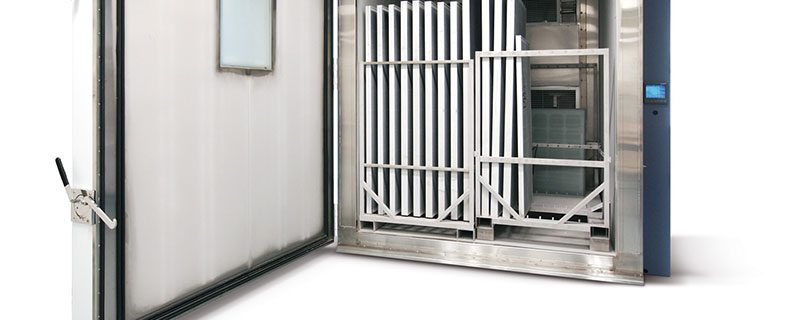

Are you installing solar panels near a coast line? Then your solar panels need to resist salt mist corrosion (IEC 61701). Or is your region dealing with large amounts of snow during winter? Installing solar panels with an increased load capacity (5400Pa) would be a good choice. The number of PV certifications has in the previous years been increasing a lot and solar system installers in many countries know that certified solar products are a required must have for their market.
The question is of course, which solar certifications are crucial for your solar installation business? Which certifications could mean a competitive advantage in this market? And what are the latest certification developments regarding new solar products, such as certification for building integrated solar modules (BIPV)?
This is an introductory guide about solar panel certifications and what you should basically know. A full and comprehensive overview about solar panel certifications, testing procedures and certification developments are covered by our popular Solar Panel Certification Guide which is the first and most comprehensive of its kind.
Why do you need CE and NRTL for your solar products?
Conformité Européenne (CE) is placed on products to state conformance with European Union regulations. It is the Authentication Certificate.
Nowadays applicable region:
CE is a mandatory conformity mark on many products that are consumed in the European Economic Area (EEA): all 28 countries of the EU + Iceland, Liechtenstein, Norway, Switzerland + Turkey. It means the product is produced conforming the EU safety, health and environmental requirements.
To sell your solar products in Europe, you definitely need this mark.
In the US, your solar panels need a Nationally Recognized Testing Laboratory mark (NRTL). There are many Nationally Recognized Testing Laboratories, of which UL is one.
Underwriters Laboratories Inc. (UL) – an independent, privately held product safety testing and certification company. The UL mark is not required by law, however it may be extremely difficult to sell solar panels without an UL Mark. Why?
In the US, without a NRTL mark you:
- Are not allowed to connect solar panels to the grid
- Will not receive Government rebates & tax incentives
- Will not receive coverage from your insurance after your house caught on fire.
Exception: an off-grid solar system, for which you don’t apply for government rebates & tax incentives. State & local codes determine which NRTLs are accepted.
NRTL Certifications
The major NRTL certification is UL 1703. UL 1703 covers flat-plate photovoltaic modules and panels that comply with the National Electric Code (NEC), OSHA, the National Fire Prevention Association, and will be readily accepted by local inspectors. The UL 1703 standard also means that the performance of the panels has been tested and has been found to perform to at least 90% or more of the manufacturers stated power rating.
TUV releases the International Electro technical Commission (IEC) certification
IEC 61215 / EN 61215 IEC 61215 Ed. 2 “Ageing of PV modules”
The IEC61215 covers the parameters which are responsible for the ageing of PV modules. This includes all major impact forces of nature:
- Sunlight incl. UV
- Climate (changing of climate, coldness, warmth, humidity)
- Mechanical load (hail, wind suction, wind pressure, snow parameters which are responsible for the ageing of PV modules)
For the standard IEC 61215 certification, 2400 Pa uniform load applies. However: when you install solar panels in areas with heavy snow, an increased load capacity of 5400Pa is advisable! This has been included in the IEC 61215 ed. 2. Nowadays many solar manufacturers produce according this requirement.
Solar system installers who do installation in areas with heavy snow should definitely use products with an increased load capacity: 5400 Pa
IEC 61646 – Thin-Film PV Modules
The IEC 61646 certification is for Thin-Film PV modules and is in many aspects identical to the international standard IEC 61215 for crystalline modules. An additional test takes the degradation behavior of amorphous silicon due to temperature and irradiance exposure into account.
IEC 61730 / EN 61730 – Safety qualifications
Photovoltaic (PV) module safety qualification, which was later issued as the European standard EN 61730 (almost similar).
The EN / IEC 61730 consists of 2 parts:
The first part covers all the requirements for construction and states the mandatory design characteristics of the modules. The second part consists of the requirements for testing. Part 2 of the EN IEC 61730 defines three different Application Classes for a module design, specifying the type of use, the related qualification tests and the resulting safety class modifications.
IEC 60364-4-41 – Protection against electric shock
Protection against electric shock for low-voltage electrical installations; It describes personnel safety measures for electrical systems. For photovoltaic systems it suggests total insulation, which requires a special insulation of the PV modules (according to Safety Class II) on the basis of the following requirements:
- Durability
- High dielectric strength
- Mechanical stability
- Sufficient insulation thickness and distances
IEC 62108 – Concentrator PV modules
A special certification for CCP is necessary, because the high concentration of the solar irradiance through lenses or mirrors causes higher stress on the equipment. The IEC 62108 standard specifies the criteria for the design qualification and type approval of concentrator photovoltaic modules and assemblies suitable for long-term operation in general open-air climates.
The world’s first IEC 62108 certificate for this technology was issued in June 2009 to California-based SolFocus.
IEC 61701 – Salt mist resistance testing on PV modules
The IEC 61701 certifications tests the resistance of photovoltaic (PV) modules against salt mist corrosion.
Solar installers that are operating in a highly corrosive atmosphere such as near the sea, the resistance of PV panels against the corrosive effects should be checked. It is definitely a good idea to us the salt mist corrosion certification in case you are installing PV modules near coasts or maritime applications.
Building Integrated Solar Panels
There are still no global unified standards for certifying Building Integrated Photovoltaic (BIPV) Solar Panels, however certification bodies such as Intertek test BIPV modules according to UL 1703 and IEC 61730 (safety), IEC 61215 and 61646 (performance) as well as building products AC 365 / AC 07.
Solar panel quality inspections
Are you purchasing solar panels, inverters or mounting racks in the Greater China region? Sinovoltaics performs independent quality inspections on-site at solar manufacturers.
Advantages:
- Replace defects prior to shipment
- Independent testing report
- 100% certainty about product quality
- International testing crew specialized in solar PV panels, inverters and mounting racks
Learn more about Sinovoltaics and its PV quality inspection and consultancy services

Pater
on 09 Mar 2011Pater
on 09 Mar 2011Juliet Chin
on 12 Apr 2011Juliet Chin
on 12 Apr 2011btelis
on 14 Apr 2011btelis
on 14 Apr 2011Ilias Papalaios
on 31 May 2011Ilias Papalaios
on 31 May 2011Φωτοβολταικα
on 30 Jun 2011Φωτοβολταικα
on 30 Jun 2011Ha Vanier
on 28 Aug 2011Ha Vanier
on 28 Aug 2011Janice
on 12 Oct 2011Janice
on 12 Oct 2011fotovoltaika
on 16 Feb 2012Ella
on 23 May 2012fotovoltaika
on 16 Feb 2012Ella
on 23 May 2012Fotovoltaika
on 15 Mar 2012Fotovoltaika
on 15 Mar 2012