The Importance of Battery Management Systems (BMS) in Energy Storage
Introduction
A Battery Management System (BMS) is an essential component of any Battery Energy Storage System (BESS). It ensures safe, efficient, and reliable operation by monitoring, controlling, and protecting battery cells from faults and failures. Without a proper BMS, batteries may experience overcharging, deep discharge, thermal runaway, or imbalanced performance, leading to reduced lifespan and safety risks.
This guide explains the role of a BMS, its key functions, types, and best practices for maximizing battery performance in energy storage applications.
1. What is a Battery Management System (BMS)?
A BMS is an electronic control system that supervises and regulates battery performance. It ensures that all battery cells operate within safe limits and prevents potential hazards.
Primary Functions of a BMS:
• Monitors key battery parameters (voltage, current, temperature, state of charge).
• Prevents unsafe conditions like overcharging, overheating, or deep discharge.
• Balances individual cell voltages to ensure uniform operation and prevent weak cells.
• Optimizes charge and discharge cycles to extend battery lifespan.
• Provides fault detection and protection to prevent catastrophic failures.
• Enables remote monitoring and diagnostics via software integration with Energy Management Systems (EMS).
Key Takeaway: The BMS acts as the brain of a BESS, managing its safety, efficiency, and longevity.
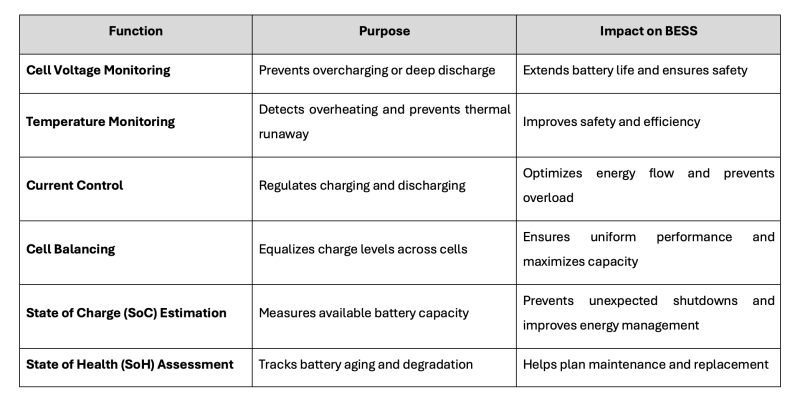
2. Key Functions of a BMS in a BESS

Key Takeaway: A well-designed BMS prevents cell degradation, improves efficiency, and enhances overall BESS reliability.
3. Types of Battery Management Systems
There are multiple types of BMS being used in a Battery Energy Storage System:
A. Centralized BMS
• One main controller manages all battery cells.
• Simple and cost-effective but less scalable.
• May still be used for small residential energy storage systems.
B. Modular BMS
• Each battery module has its own BMS, with a master controller overseeing operations between the different battery modules.
• More scalable and reliable than centralized systems.
• Suitable for large commercial and grid-scale BESS.
C. Distributed BMS
• Each battery cell has its own monitoring unit, communicating with a central processor.
• Highly scalable and fault-tolerant, but more complex and costly.
• Rarely used today, expect in some high-performance and mission-critical energy storage applications.
Key Takeaway: Modular BMS is the preferred choice for commercial and grid-scale BESS, balancing scalability, reliability, and cost.
4. BMS and Safety Management
The BMS plays a crucial role in battery safety by preventing dangerous conditions such as:
• Overcharging: Prevents excessive voltage buildup that can damage battery cells.
• Overdischarging: Stops cells from draining below safe levels, avoiding capacity loss.
• Short Circuits: Detects and isolates faulty battery modules to prevent system-wide failure.
• Thermal Runaway: Identifies overheating issues and triggers emergency shutdowns if needed.
Best Practice: Ensure the BMS is integrated with a thermal management system to maintain optimal battery temperatures.
5. BMS Communication and Integration with EMS
A BMS must seamlessly communicate with the Energy Management System (EMS) for optimized battery operation.
• SCADA Integration: Enables remote monitoring, predictive analytics, and automated fault detection.
• Communication Protocols: Uses Modbus, CAN Bus, or TCP/IP for real-time data exchange.
• Cloud-Based Monitoring: Allows real-time performance tracking and predictive maintenance alerts.
Best Practice: Choose a BMS with advanced analytics and remote diagnostics capabilities for proactive maintenance.
Conclusion
A Battery Management System (BMS) is the foundation of a safe, efficient, and long-lasting BESS. By ensuring accurate monitoring, fault protection, and intelligent energy management, a BMS maximizes battery performance and minimizes operational risks. Choosing the right BMS type, integration, and safety features is essential for reliable energy storage systems.
If you are developing or investing in a Battery Energy Storage System and want to ensure optimal safety, reliability, and long-term performance, contact Sinovoltaics today. Our energy storage experts provide independent technical advisory, quality assurance, and risk mitigation services to help you make informed and secure investment decisions.