Dynamic Mechanical Load Testing (IEC 61215 MQT 20) for Solar Modules

31 juli 2026

Solar modules experience not just static loads from wind and snow, but also repeated low-level mechanical stresses that occur thousands of times over a module's lifetime. These cyclic stresses are particularly dangerous because even a small amount of fatigue — if repeated enough times, can crack cells, break solder bonds, and degrade interconnects long before any single load event would cause obvious damage. The IEC 61215 MQT 20 cyclic dynamic mechanical load test is designed to detect these vulnerabilities. Here is a complete breakdown.

What is the MQT 20 Cyclic Dynamic Mechanical Load Test?
MQT 20, defined in IEC 61215-2:2021, evaluates a module's resistance to low-level, repetitive mechanical stress. Its purpose is:
To evaluate if components within the module are extremely susceptible to low levels of mechanical stress.

The most likely reason for extreme susceptibility to low levels of mechanical stress is a module assembly process that compromises the integrity of module components, for example, tabbing that puts too much pressure on the cell and creates microcracks.

Components that may be evaluated by the cyclic dynamic mechanical load test (DML) include:
• Solar cells
• Interconnect ribbons
• Electrical bonds
• Edge seals


Procedure

The test is carried out in accordance with IEC TS 62782.

IEC TS 62782 defines the specific cyclic load profile, frequency, amplitude, number of cycles, and measurement approach for the dynamic mechanical load test. The module is subjected to repeated positive and negative load cycles — simulating the alternating pressure and uplift experienced in the field under wind-induced vibration — while its electrical continuity is monitored.

Final Measurements
After completing the test, repeat the following:
MQT 01 — Visual inspection
MQT 15 — Wet leakage current test

Pass/Fail Criteria
A module passes MQT 20 if it meets both of the following requirements:
1. No evidence of major visual defects, as defined in IEC 61215-1:2021.
2. Wet leakage current must meet the same requirements as for the initial measurements.

MQT 20 vs MQT 16 — What is the Difference?
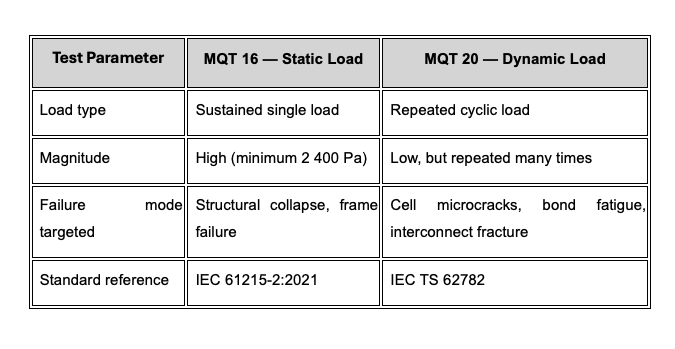
It is important to distinguish MQT 20 from MQT 16 (static mechanical load test):


MQT 16 checks whether a module can survive an extreme load event. MQT 20 checks whether a module can survive the cumulative fatigue of thousands of small load cycles, which is often a more relevant failure mode in the field.

Why MQT 20 Matters for PV Module Certification

Cell microcracks induced during manufacturing are one of the solar industry's most persistent hidden quality problems. A module can leave the factory with invisible microcracks that pass standard visual inspection, only to develop power degradation or complete cell failure years later as those cracks propagate under mechanical fatigue.

MQT 20 is specifically designed to expose this type of latent defect. If a module's tabbing process has applied excessive pressure to cells, even within normal assembly tolerances, repeated low-level cycling will cause pre-existing microcracks to grow and eventually affect electrical output. Interconnect ribbons that were soldered with marginal adhesion will similarly fail under cyclic stress before any static load test would reveal them.

For project developers and bankability assessors, MQT 20 provides an important additional layer of confidence beyond the static mechanical test, particularly for thin-cell or large-format modules where cell fragility and interconnect fatigue are greater concerns.

Need to Find an Accredited Lab for IEC 61215 Testing?
Sinovoltaics Lab Advisor helps you identify and compare accredited test laboratories for PV module qualification testing, including MQT 20 cyclic dynamic mechanical load testing and the full IEC 61215 sequence. Get connected with the right lab for your project quickly and transparently.
Find your IEC 61215 test lab → labadvisor.sinovoltaics.com

Read more about our Testing articles here.

Source: IEC 61215-2:2021 — Terrestrial photovoltaic (PV) modules – Design qualification and type approval – Part 2: Test procedures, Section 4.20

Place comment