IEC 61215 MQT 21: Potential Induced Degradation (PID) Test for Solar Modules

31 juli 2026

Potential Induced Degradation (PID) is one of the most commercially significant failure modes in solar installations. Modules operating in large strings can be exposed to high voltages relative to their grounded frames, driving leakage currents that gradually degrade cell performance, sometimes causing power losses of 30% or more. The IEC 61215 MQT 21 PID test evaluates a module's ability to withstand this voltage-driven degradation under accelerated stress conditions. Here is a complete breakdown.

What is the MQT 21 PID Test?

MQT 21, defined in IEC 61215-2:2021, applies elevated system voltage combined with high temperature and humidity to accelerate the PID mechanism. Its purpose is:
To measure the module design's ability to withstand degradation from applied system voltage, also known as Potential Induced Degradation (PID).

Note: The test is not designed to evaluate PID involving polarization mechanisms (PID-p), and therefore PID-p may not be detected

Sample Requirements

Sample selection for MQT 21 depends on how the module is specified for installation:
If the module is specified for strings with only one voltage polarity (one terminal tied to earth ground), the number of modules for testing shall be halved, and tested only in that specified polarity. Four samples total, two for each polarity of system voltage specified or allowed in the module documentation, shall be procured for each test.

Modules not explicitly requiring string connections with one terminal earthed shall be tested in both polarities. If only two modules are tested (one allowed polarity), the two modules not subjected to PID stress shall only progress through the test flow as far as MQT 21, and shall not be subjected to further testing. Specifically, the two unused modules shall progress through Gate No. 1 but not Gate No. 2.

If the PV module is provided with or specified for use with a specific means for earthing, the earthing means shall be included and considered part of the test sample. If the module is provided with or specified for use with means for mounting that could additionally influence the module grounding, those mounting means shall also be included as part of the test sample.

Apparatus
The test is carried out using the apparatus described in IEC TS 62804-1:2015, specifically an environmental chamber with voltage application capability as defined in that standard.

Test Conditions (Severities)
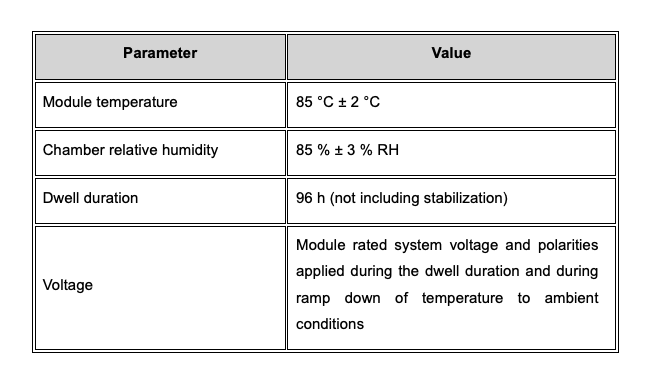
The test is carried out in accordance with the stress method testing in damp heat defined in IEC TS 62804-1:2015, with the following provisions:

Post-Test Sequence
After completing the PID stress, the following sequence must be observed carefully, including strict time limits between steps to ensure repeatability, particularly where partially-reversible PID may be present.

Post-Test Sequence
After completing the PID stress, the following sequence must be observed carefully — including strict time limits between steps to ensure repeatability, particularly where partially-reversible PID may be present.

Step 1 — MQT 01 (Visual Inspection) and MQT 15 (Wet Leakage Current): Must be performed within 8 hours of the end of the PID stress.

Step 2 — MQT 19.2 (Final Stabilization): Must begin no more than 48 hours after the end of MQT 21.

Step 3 — MQT 06.1 (Performance at STC, Gate 2): Must be performed no more than 48 hours after MQT 19.2, or within the time limit specified in the technology-specific stabilization procedure, whichever is shorter. Bifaciality coefficients shall be remeasured when performing MQT 06.1 for Gate 2.

Step 4 — MQT 03 (Insulation Test): Follows in sequence.
Storage between steps: Between step 2 ~ 4, modules shall be maintained indoors, in the dark, at temperatures of 25 °C or below to minimize recovery of partially-reversible PID.

Pass/Fail Criteria
A module passes MQT 21 if it meets both of the following requirements:
1. No evidence of major visual defects, as defined in IEC 61215-1:2021.
2. Wet leakage current must meet the same requirements as for the initial measurements.

Why MQT 21 Matters for PV Module Certification
PID is a particularly insidious degradation mode because it is system-voltage dependent, meaning modules installed in the same field can experience very different levels of stress depending on their position in a string. Modules at the negative end of a high-voltage string are most exposed. In hot, humid climates the leakage current pathway through the glass and encapsulant is enhanced, accelerating the mechanism.

The strict post-test time limits in MQT 21 reflect the partially reversible nature of PID in many cell technologies, a module left to recover at room temperature overnight could show significantly better results than one tested immediately. By requiring MQT 15 within 8 hours and controlling storage conditions between all subsequent steps, the standard ensures test results reflect the true severity of voltage-induced stress rather than spontaneous recovery.

For project developers, EPCs, and lenders financing high-voltage string inverter systems , particularly in tropical and subtropical climates, MQT 21 results are a key bankability indicator.

Need to Find an Accredited Lab for IEC 61215 Testing?
Sinovoltaics Lab Advisor helps you identify and compare accredited test laboratories for PV module qualification testing, including MQT 21 PID testing and the full IEC 61215 sequence. Get connected with the right lab for your project quickly and transparently.
Find your IEC 61215 test lab → labadvisor.sinovoltaics.com

Read more about our Testing articles here.

Source: IEC 61215-2:2021 — Terrestrial photovoltaic (PV) modules – Design qualification and type approval – Part 2: Test procedures, Section 4.21

Place comment