
Impact on Solar PV and Battery Storage Projects
Sinovoltaics Group | July 2026
EXECUTIVE SUMMARY: The EU has moved on two parallel tracks to require EU-manufactured inverters across both solar PV and battery energy storage systems (BESS). First, an immediate funding ban effective May 1, 2026, blocks European Investment Bank financing for solar, wind, and storage projects using inverters or PCS from high-risk countries (China, Russia, Iran, North Korea). Solar inverters were the primary target; Power Conversion Systems (PCS) in BESS were explicitly confirmed as included. Second, the proposed Industrial Accelerator Act (March 2026) would mandate EU-made solar inverters and cells for publicly-supported PV projects, and EU-origin BESS (including PCS) for storage projects. Together, these measures signal a structural shift in the EU clean energy supply chain away from Chinese-supplied power electronics.
1. Solar Inverters and BESS PCS: Why They Matter
A solar inverter converts direct current (DC) electricity generated by solar panels into alternating current (AC) suitable for the grid or on-site consumption. In a battery energy storage system (BESS), the equivalent component is called a Power Conversion System (PCS), which handles the same DC-to-AC conversion bidirectionally, managing both charging and discharging. In modern utility-scale systems, both solar inverters and BESS PCS are microprocessor-controlled, internet-connected devices with remote monitoring, grid-support functions, and firmware that can be updated over-the-air. Anyone reading articles on Sinovoltaics knows this..
This connectivity is central to the EU's regulatory concern. As the European Solar Manufacturing Council (ESMC) stated: "Inverters are the heart of every solar and energy storage installation and, as internet-connected devices, a potential gateway for cyberattacks." An inverter or PCS from a supplier in an adversarial country could allow remote access to, or disruption of, grid-connected infrastructure. This is a risk the EU now classifies as unacceptable in publicly-funded projects.
Today, Chinese manufacturers dominate the European market for both product categories. In solar inverters, Huawei, Sungrow, and GoodWe hold a large share of European installations. In BESS, Chinese suppliers including CATL, BYD, and Sungrow supply integrated all-in-one systems with embedded PCS. The EU's new regulatory architecture targets both markets simultaneously.
2. The Regulatory Landscape: Three Overlapping Frameworks
The EU's approach operates on three levels, each with different legal status, scope, and timelines. Together they create compounding pressure on projects using non-EU solar inverters or BESS PCS.
2.1 EU Funding Ban on High-Risk Inverter and PCS Suppliers (May 2026)
This is the most immediately impactful measure. Effective May 1, 2026, the European Commission has restricted EU funding, including financing through the European Investment Bank (EIB) and European Investment Fund (EIF), for solar, wind, and energy storage projects that use inverters or PCS from so-called "high-risk countries."
Countries designated as high-risk: “China, Russia, Iran, and North Korea”.
The Commission has not issued a formal public press release; however, the policy was communicated to financial institutions and took effect from May 1, 2026. It was first reported in relation to solar PV inverters (pv magazine, April 23, 2026), with ESS News confirming on May 4, 2026 that BESS PCS was explicitly included.
Solar Inverters: The Primary Target
Solar PV inverters were the starting point for this policy. Any solar project financed through the EIB, EIF, or other EU-backed mechanisms that specifies inverters from Huawei, Sungrow, GoodWe, Growatt, or any other Chinese (or Russian, Iranian, or North Korean) brand is now ineligible for that financing. The policy covers "inverters across all renewable energy applications" and applies globally, including Chinese-owned manufacturers that produce in Europe.
BESS PCS Explicitly Included
The Commission's documents explicitly state: "Energy storage systems / Power Conversion Systems (PCS) are explicitly included." This means BESS projects relying on integrated PCS supplied from high-risk country suppliers are in scope alongside solar inverters. The rule is technology-neutral between the two applications.
No Power Class Exemption
There are no exemptions based on power class or system size. Christoph Podewils, Secretary General of the ESMC, confirmed: "It's really a strict regulation, without many loopholes."
Chinese-Owned EU Manufacturers Also Excluded
The rule also applies to companies producing inverters or PCS in Europe but owned or controlled by entities from high-risk countries. A Chinese-owned manufacturing facility in Poland, for example, would still be excluded.
What Is Not Yet Covered
The Commission does not appear to be addressing the sourcing of passive components. Inverters and PCS units manufactured in Europe may source key components such as IGBTs and MOSFETs from Chinese suppliers, and this upstream dependency is not currently in scope.
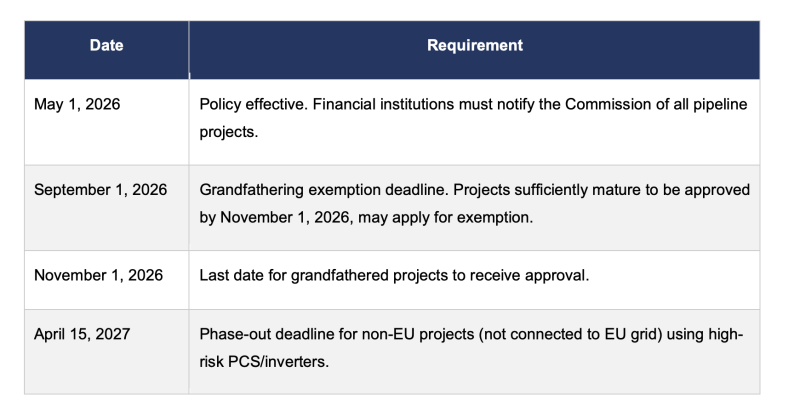
Key Dates and Transition Provisions
Financial Scale
The EIB funded approximately 20% of all EU solar deployment in 2025. In addition, the EIB has launched a dedicated €2 billion financing envelope for EU renewable energy projects, which is also subject to the ban. The scope of impacted financing is therefore substantial.
2.2 EU Industrial Accelerator Act (IAA): Proposed March 2026
On March 4–5, 2026, the European Commission published a draft regulation called the Industrial Accelerator Act (IAA). This is a broader industrial policy package that introduces binding Union origin and low-carbon requirements across multiple sectors, covering both solar PV inverters and BESS PCS.
The IAA is still a legislative proposal. It requires negotiation by the European Parliament and EU Council before adoption, and no indicative timeline for entry into force has been published. Industry observers note it may not enter force before 2027–2028, meaning the 1-year and 3-year implementation deadlines below are relative to a future date that is still unknown.
Solar PV Requirements Under the IAA
For solar projects awarded through public procurements, renewables auctions, and public support schemes, the IAA requires that both solar inverters and solar cells must be EU-manufactured within three years of the act entering into force. This is a stricter position than for BESS, as solar requires two EU-origin components simultaneously from the same deadline. Dries Acke, Deputy CEO of SolarPower Europe, called this a "watershed moment for industrial policy in Europe" while noting the three-year delay risks leaving European solar manufacturers without protection until as late as 2030.
BESS Requirements Under the IAA
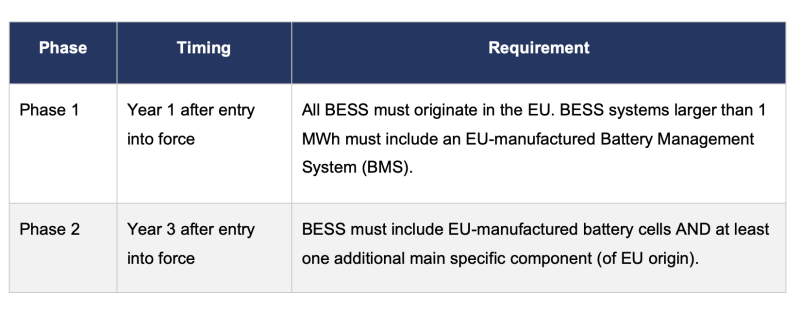
For BESS included in public procurements, renewables auctions, and public support schemes, the IAA introduces phased EU origin requirements:
PCS as the "Additional Main Specific Component"
The IAA does not yet publish a definitive list of what qualifies as an "additional main specific component." Given the parallel funding ban that explicitly names PCS, and the fact that PCS/inverter is the most strategically sensitive component after the BMS and battery cells, the PCS is the primary candidate for this category. The Commission will publish implementing acts to clarify the component list following adoption.
Scope: Public Funding and Procurement Only
The IAA requirements, covering both solar inverters and BESS PCS, apply exclusively to publicly-supported projects: contracts awarded through public procurements, renewable energy auctions (e.g., CfD, feed-in premium systems), and public support schemes. Fully private, merchant projects are currently outside this scope, though the funding ban (Section 2.1) does extend to EIB/EIF financing for private projects as well.
Foreign Direct Investment Rules
The IAA also introduces FDI restrictions in battery and solar PV sectors where a single third country holds more than 40% of global manufacturing capacity. Investments above €100 million from such investors (targeting Chinese battery/solar investors) would require a joint venture structure with an EU partner, a maximum 49% ownership stake, IP licensing for EU benefit, at least 50% EU employees, and a minimum 1% reinvestment of annual revenue into EU R&D.
2.3 Net-Zero Industry Act (NZIA): Regulation EU 2024/1735
The Net-Zero Industry Act (Regulation EU 2024/1735) entered into force on June 29, 2024 and has applied since that date, with the exception of Articles 26 and 28, which apply from December 30, 2025. The NZIA is the foundation of the EU's clean technology manufacturing framework and is the parent regulation to which both the IAA and the funding ban relate.
Article 26: Sustainability and Resilience Criteria in Auctions
From December 30, 2025, EU member states must apply non-price sustainability and resilience criteria to either at least 30% of their annually auctioned renewable energy capacity, or to at least 6 GW per year. The first NZIA-compliant auctions with these criteria were expected to open in 2026.
For solar PV and BESS alike, this means that auction processes must assess and score offers partly on supply chain diversification and environmental performance, not solely on price. Projects relying on a single non-EU supplier country for solar inverters or BESS PCS would score lower under resilience criteria, putting Chinese-supplied equipment at a structural disadvantage in publicly tendered projects.
Resilience Trigger Thresholds
The resilience assessment becomes mandatory when: (a) a single non-EU country supplies more than 50% of EU annual demand for a net-zero technology, or (b) supply from a single third country has increased by at least 10 percentage points annually for two consecutive years and reaches at least 40% of EU supply. Both thresholds are already met for Chinese-supplied solar inverters and BESS PCS.
Strategic Technology Benchmarks
The NZIA sets a non-binding benchmark for 40% local EU manufacturing of net-zero technologies by 2030, and a 15% EU global market share by 2040. BESS is listed as a strategic net-zero technology. Strategic project status under the NZIA unlocks faster permitting, priority grid access, and financial and advisory support from member state and EU-level bodies.
3. Practical Implications
3.1 Impact on Solar PV Projects
Every solar project in Europe that relies on EIB or EU-backed financing and specifies inverters from Huawei, Sungrow, GoodWe, Growatt, or any other Chinese brand is now affected. This is not a future risk; it has been in effect since May 1, 2026. Projects that are sufficiently mature to be approved by November 1, 2026 may apply for a grandfathering exemption. All others must switch inverter supplier to remain eligible for EU financing.
For project developers in the European solar market, this means supply chain reassessment is now a financing prerequisite. European inverter brands, including SMA Solar Technology (Germany), Fronius (Austria), Ingeteam (Spain), ABB/Fimer (Switzerland/Italy), and Schneider Electric (France), are positioned to absorb the redirected demand. European grid-scale solar inverter capacity has been maintained despite Chinese competition and can scale.
3.2 All-in-One BESS Systems Face Maximum Disruption
In BESS, the most commercially disrupted product category is the all-in-one (AIO) system, where the Asian manufacturer supplies an integrated unit containing battery cells, BMS, and PCS in a single container. These systems account for a significant share of current European BESS deployments. Under the May 2026 funding ban, they are ineligible for EIB/EIF-backed project financing from Day 1.
3.3 Project Financing Implications
Any project in development that anticipates EIB, EIF, or EU public funding (including REPowerEU mechanisms and national public support schemes) must now assess both its solar inverter and BESS PCS supply chains. Projects at an early enough stage to switch suppliers are not eligible for grandfathering; they must switch. Only projects sufficiently mature to receive final approval by November 1, 2026 may claim exemption.
This has immediate bankability consequences. Lenders and equity investors participating in EU-backed project structures will require supply chain confirmation before committing.
3.4 Supply Chain Transition
European manufacturers positioned to benefit span both product categories. For solar inverters: SMA Solar Technology (Germany), Fronius (Austria), Ingeteam (Spain), Schneider Electric (France). For BESS PCS: ABB (Switzerland), Siemens Energy (Germany), Ingeteam (Spain), Power Electronics (Spain). Demand for their products is expected to accelerate significantly, with Europe having installed 25.3 GWh of BESS in 2025 and a projected 35.1 GWh in 2026.
3.5 Chinese Suppliers' Response
China's Ministry of Commerce (MOFCOM) issued a formal protest in May 2026, calling the EU's designation of China as a "high-risk country" without "any factual evidence" a violation of mutual trust and an act of stigmatization. MOFCOM warned that the measures could destabilize industrial and supply chains and stated that China "will take necessary measures to safeguard the legitimate and lawful rights and interests of Chinese enterprises." No specific countermeasures have been announced as of July 2026.
3.6 Passive Components: A Remaining Dependency
The EU's current framework does not address passive components. European-manufactured PCS units typically source IGBTs, MOSFETs, and other high-voltage switching components from Asian (including Chinese) suppliers. This upstream dependency is not yet in regulatory scope but may become a future policy concern as the EU deepens its semiconductor and power electronics strategy.
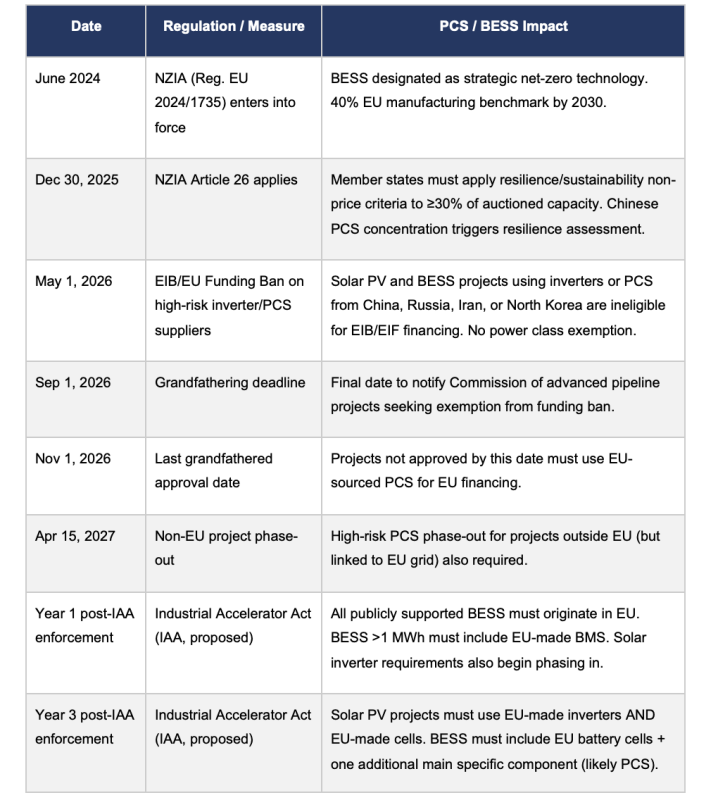
4. Regulatory Timeline Summary
5. Key Open Questions
• Will the Industrial Accelerator Act explicitly name PCS as a required EU-origin component in its implementing acts? The current proposal leaves this open to delegated regulation.
• Will the funding ban be formally published, or remain an informal Commission communication? Publication would provide a clearer legal basis for project developers and lenders.
• How will "Union origin" be defined for complex systems like PCS, which may be assembled in Europe but use Asian-sourced power electronics semiconductors?
• Will the EU extend the scope of restrictions to passive components (IGBTs, MOSFETs) as part of a broader power electronics sovereignty agenda?
• Will China's MOFCOM follow through on "necessary measures", and if so, in what form?
6. Sources
1. ", "ESS News (May 4, 2026): "EU funding ban on high-risk inverters, including Chinese suppliers, extends to BESS PCS." https://www.ess-news.com/2026/05/04/eu-funding-ban-on-high-risk-inverters-including-chinese-suppliers-extends-to-bess-pcs/
2. ", "pv magazine (March 5, 2026): "European Commission proposes Made in EU requirements for solar inverters, cells." https://www.pv-magazine.com/2026/03/05/european-commission-proposes-made-in-eu-requirements-for-solar-inverters-cells/
3. ", "Gleiss Lutz (March 5, 2026): "Industrial Accelerator Act: New requirements aimed at boosting EU industry." https://www.gleisslutz.com/en/know-how/industrial-accelerator-act-new-requirements-aimed-boosting-eu-industry
4. ", "EUR-Lex: Regulation (EU) 2024/1735 of the European Parliament and of the Council – Net-Zero Industry Act. https://eur-lex.europa.eu/EN/legal-content/summary/eu-net-zero-industry-act.html
5. ", "Herbert Smith Freehills (2025): "The Net-Zero Industry Act – New Implementing Rules to Accelerate Clean Technology Manufacturing in the EU." https://www.hsfkramer.com/notes/energy/2025-posts/the-net-zero-industry-act-new-implementing-rules-to-accelerate-clean-technology-manufacturing-in-the-eu
6. ", "Global Policy Watch (August 2025): "Adoption of Implementing Act on Non-Price Criteria in Renewable Energy Auctions." https://www.globalpolicywatch.com/2025/08/adoption-of-implementing-act-on-non-price-criteria-in-renewable-energy-auctions/
7. ", "ESG Today (March 2026): "EU Commission Unveils Industrial Accelerator Act with New Made-in-EU Requirements for Cleantech Procurement." https://www.esgtoday.com/european-commission-unveils-low-carbon-made-in-eu-rules-for-manufacturing-cleantech-sectors/
8. ", "Carbon Brief (2026): "Q&A: What the EU's new industry and ‘Made in Europe' rules mean for climate action." https://www.carbonbrief.org/qa-what-the-eus-new-industry-and-made-in-europe-rules-mean-for-climate-action/