
Turkey has overtaken the EU as Europe's biggest solar module producer
Turkey has overtaken the EU as Europe's biggest solar module producer
19 augustus 2026
Lausanne, Switzerland – August 19, 2026 – Cell capacity would need to grow 12-fold to catch up with module targets, and one German company makes nearly all the region's solar-grade polysilicon.
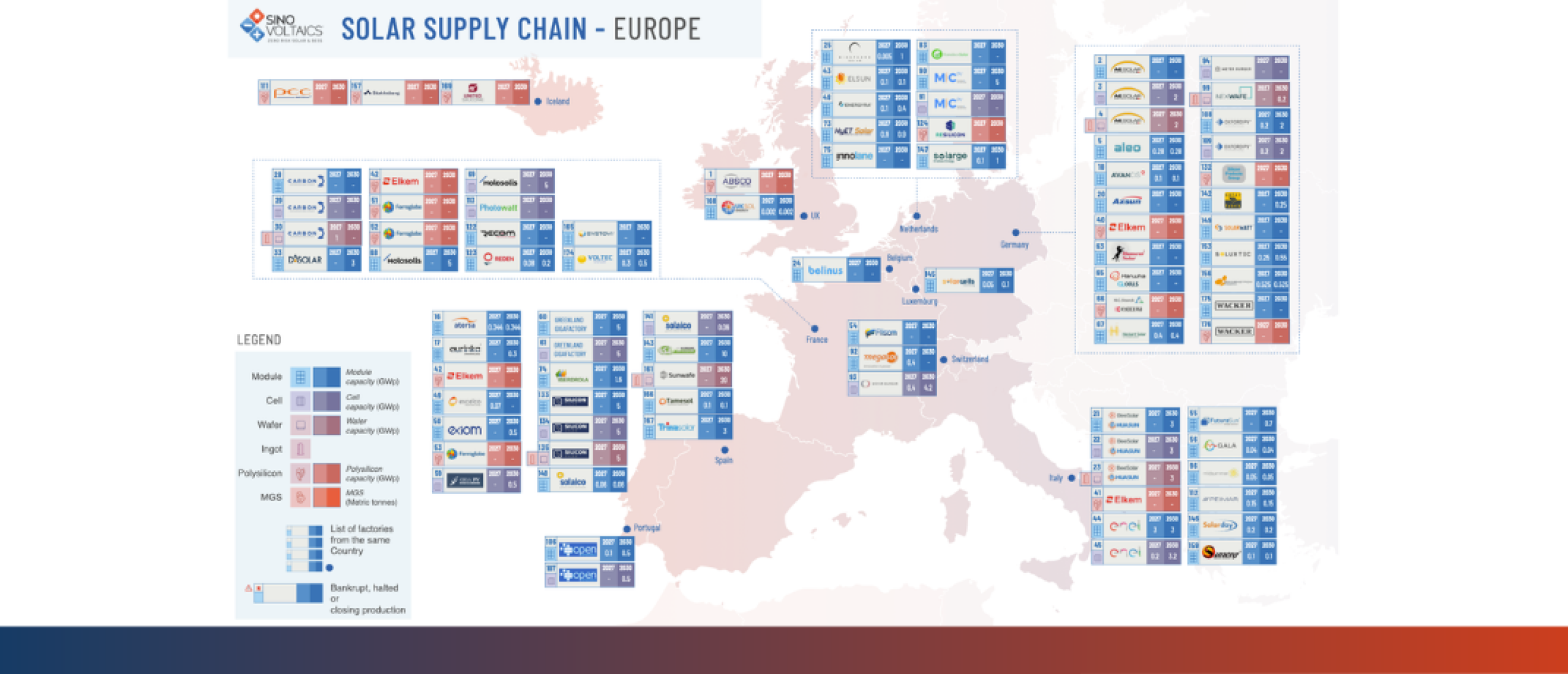
Turkey now accounts for more current solar module manufacturing capacity than Italy, Germany, Spain, France and the Netherlands combined, according to a newly updated pan-European Solar Supply Chain Map developed by Sinovoltaics, covering 178 production sites and projects across roughly 25 countries. The finding runs counter to the EU's own story about a "Made in Europe" solar comeback.
The tracker, developed and maintained by Sinovoltaics, puts Turkey's current module capacity at 13.2 GWp, rising to a targeted 23.2 GWp by 2027/30, driven by projects such as Astronergy's new Balıkesir facility and JTPV/Schmid-Pekintaş's planned 5 GW cell plant in Düzce. Across the wider region, current module capacity stands at 24.2 GWp; Turkey alone accounts for more than half of it. That compares with just 5.3 GWp of cell capacity and 1.2 GWp of ingot/wafer capacity. Polysilicon capacity nominally stands at 27.6 GWp, but that figure comes almost entirely from one producer, Wacker in Germany. Every other regional entry makes lower-grade metallurgical silicon feedstock, not solar-grade material.
"Europe has spent years discussing the reshoring of solar manufacturing, yet the data shows that module assembly capacity is concentrating in Turkey rather than the EU. Meanwhile, the more complex upstream stages, including cell, wafer, and polysilicon production, still barely exist at scale on the continent,” commented Dricus De Rooij, CEO of Sinovoltaics.
Strip Turkey out and the EU's own picture looks worse. Filtered to EU member states only, the map shows just 9.7 GWp of current module capacity, 1.2 GWp of cells, and 0.2 GWp of ingots and wafers, all far short of the roughly 76 GWp per segment implied by the Net-Zero Industry Act's 2030 target of sourcing 40% of deployment domestically. Much of what Europe counts as regional module capacity sits in a country outside that target's domestic-content rules.
The 2027/30 pipeline is real but far from confirmed. Planned capacity would grow to 88.2 GWp of modules, 65.2 GWp of cells, 46.7 GWp of ingots/wafers and 68.4 GWp of polysilicon: cell capacity would need to grow roughly 12-fold and wafer capacity nearly 40-fold to catch up with a 3.6x expansion in modules. But 61% of planned module capacity is still at the "announced" stage, and roughly one in seven tracked entries (28 of 183) is cancelled or suspended, including Meyer Burger's German cell insolvency and Solarwatt's Dresden closure.
About Sinovoltaics
Since 2010, Sinovoltaics, a Dutch-German Battery Energy Storage (BESS) and solar photovoltaic (PV) technical compliance and quality assurance service firm, has been a pioneer in the BESS and solar photovoltaic industries. With innovative software solutions such as SELMA® software and BESSecure, Sinovoltaics’ mission is to eliminate all photovoltaic and BESS product defects, enabling investors and the world to succeed with minimal investment risks.
Sinovoltaics’ services include quality assurance inspections, factory audits, Environmental, Social, and Governance (ESG) reporting, and traceability audits for utility-scale solar and BESS developers and investors. The company maintains a global presence with offices in Switzerland, the United States, Hong Kong, Mainland China and Vietnam, as well as factory inspection and audit teams strategically located in China, Vietnam, Türkiye, Thailand, India and other key manufacturing bases.
Media Contact
Rasa Jakaitis
Media Manager
mailto:rasa@sinovoltaics.com
+37060152349
Lithuania
Read more of our ->> press releases.
Place comment