
Introducing the Sinovoltaics PV Lab Test Advisor
Getting lab testing right for a utility-scale solar project is harder than it looks. Ask five procurement engineers which tests to run and you will get five different answers. Ask a lab and they will quote you for everything. Ask a manufacturer and they will tell you their modules already passed the standard certification testing. None of these answers help you decide what to test, on how many modules, and at what priority level, before you have already signed the purchase contract.
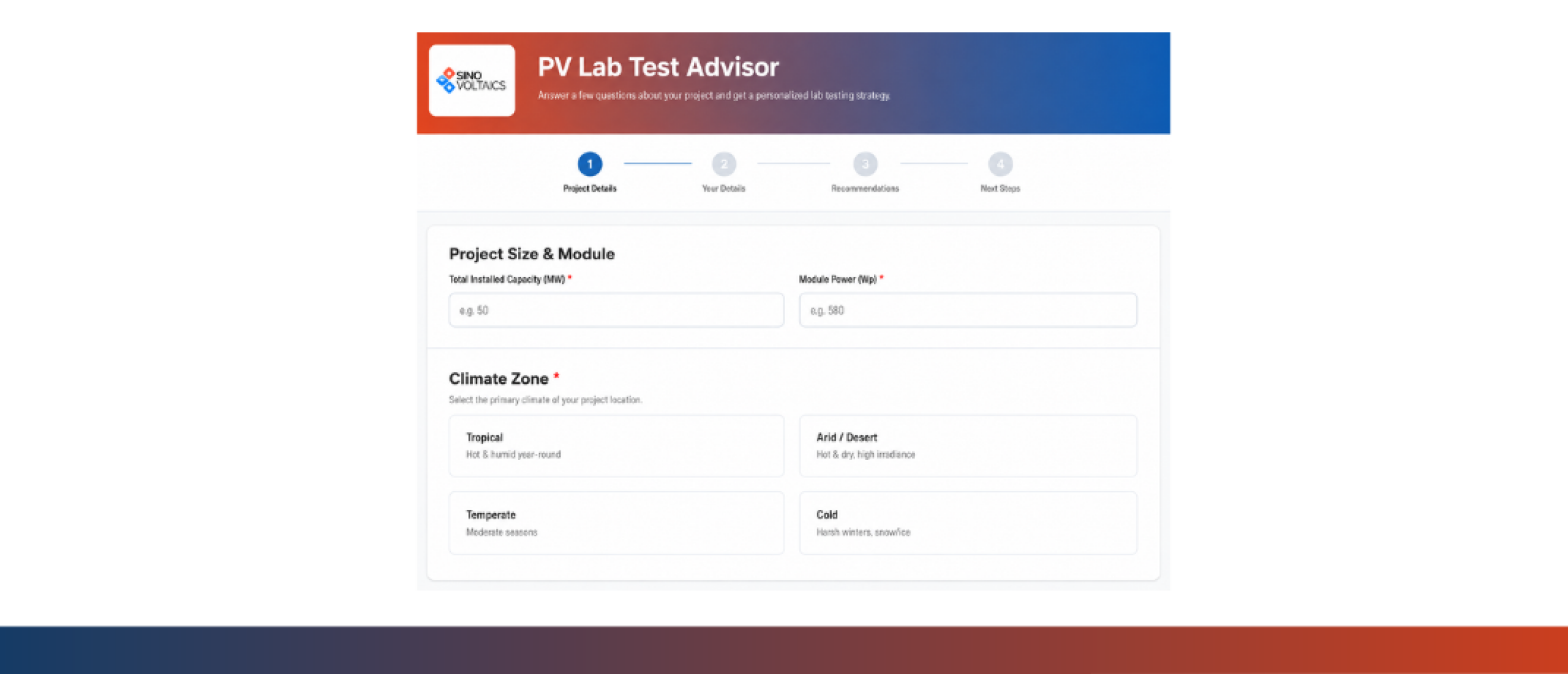
We built the Sinovoltaics PV Lab Test Advisor to solve this problem. It is a free, browser-based tool aimed at developers, independent power producers (IPPs), and EPCs working on utility-scale solar PV projects. It takes inputs about your project and returns a prioritised lab testing strategy, a sampling plan based on ISO 2859-1, and pass/fail criteria for every recommended test. The result is a downloadable PDF report you can share with your team.
This article explains what the tool does, how the scoring logic works, and why the questions it asks are the ones that matter.
Why Lab Testing Strategies Are Not One-Size-Fits-All
The standard solar industry answer to module quality assurance is IEC 61215 and IEC 61730 (Quality and Safety) the basic qualification tests every commercially available module must pass. These are important minimum thresholds, but they were never designed to predict field performance under your specific project conditions.
You don’t need a PhD in solar engineering to guess that a 200 MW TOPCon project in coastal Vietnam faces completely different degradation risks than a 50 MW PERC project in Finland. The relevant tests are different. The priority levels are different. The sampling depth is different. Yet most testing scopes are still built from generic templates that do not account for any of these.
The cost of getting this wrong is huge. Under-testing exposes your project to risks you did not quantify, a risk which only grows considering 20 to 30 years of unknown underperformance in the field. Over-testing wastes budget and delays financial close. A well-calibrated testing scope that is specific to your project conditions is therefore essential.
This is what the PV Lab Test Advisor is designed to produce, whether you are a developer scoping a new project, an IPP preparing for financial close, or an EPC finalising procurement.
What the Tool Asks and Why
The tool collects inputs covering five dimensions of your project. Each one feeds directly into the scoring engine.
1. Project Size (MW) and Module Power (Wp)
These two numbers together determine the total module count and the per-batch lot size. The lot size drives the ISO 2859-1 sampling calculation. A 100 MW project at 580 Wp contains approximately 172,000 modules. Split across five delivery batches, each batch has a lot of roughly 34,000 modules, which determines how many units should be sampled per test.
Project size also affects which tests are financially justified. Certain tests like Extended Damp Heat, PAN File, Gel Content only make economic sense above certain project scales. The scoring rules reflect this.
2. Climate Zone
Climate is the single strongest driver of long-term degradation. The tool currently supports four zones: Tropical, Arid/Desert, Temperate, and Cold.
Tropical climates elevate Extended Damp Heat, PID, and UV-Induced Degradation as priorities. Arid conditions amplify thermal cycling and UV exposure. Cold climates push Dynamic Mechanical Load and Low Irradiance Performance testing to the foreground. These weightings are grounded in published field data and IEC technical standards.
3. Environmental Conditions
Site-specific conditions are layered on top of the climate zone. Users can select multiple conditions simultaneously: Coastal/Marine, High Wind, Sand/Dust, Agricultural (ammonia), High Altitude, Snow, and Hail.
Each condition maps to specific tests. Coastal exposure triggers Salt Mist Corrosion (IEC 61701) as a required test. Agricultural environments trigger Ammonia Corrosion (IEC 62716). Hail-prone regions elevate both Hail Test and Dynamic Mechanical Load scoring. When multiple conditions combine — for example, large-format modules in a high-wind coastal environment — the tool applies three-factor interaction rules that capture compounded risk beyond what any single condition would generate.
4. Cell Design
The tool currently supports eight cell designs: TOPCon, PERC/PERC+, HJT, IBC, ABC, MWT, HBC, and Other/Unknown. Each design carries a different risk fingerprint.
For example, research and industrial data has shown that the newer generation of solar cells, (now dominating the market), TopCon , is more suceptible to UVID as its predecessor, PERC type solar cells.
For PERC, LID and LeTID are the primary concerns due to the P-type architecture.
For HJT, amorphous silicon passivation layer sensitivity to moisture drives Extended Damp Heat priority. Each design's scoring is explained in the expanded test cards within the tool output.
5. Module Configuration
Glass-glass versus glass-backsheet, and bifacial versus monofacial, affects moisture ingress pathways, encapsulant behaviour, and electrical insulation requirements. Bifacial modules automatically trigger Bifaciality Determination (IEC TS 60904-1-2) as a required test. Bifacial glass-glass configurations additionally require Wet Leakage Current (IEC 61215-2), as the dual-glass construction creates a different electrical insulation geometry compared to glass-backsheet designs. Glass-backsheet configurations add Peel/Adhesion testing to the scope, given the higher delamination risk at the encapsulant-to-backsheet interface.
How the Scoring Engine Works
The tool scores each of 19 tests on a numerical scale. Scores are additive — every matching rule contributes its points — and are then mapped to three display tiers:
• Required: The test is clearly justified by the project profile. Skip it at your own risk.
• Strongly Recommended: The test is relevant but not universally critical. Justified for most project scales.
• Optional / Project-Specific: Worth considering but dependent on budget and specific risk appetite.
There are currently more than 30 scoring rules covering individual inputs (climate, technology, configuration, project size, module power) plus 15 multi-factor interaction rules that capture risk combinations no single-input rule can catch.
The scoring is intentionally transparent. Every recommended test in the output includes a written explanation of why it was flagged, grounded in the specific combination of your project inputs — not a generic description. If you selected TOPCon modules for a tropical coastal project, the tool will tell you why Extended Damp Heat scored high and which BOM and process variables are relevant.
Sampling Plans Based on ISO 2859-1
Every recommended test includes a module sample size calculated from ISO 2859-1, the international standard for attribute sampling plans. We use two inspection levels:
• Destructive tests (e.g. Extended Damp Heat, Salt Mist, Thermal Cycling): Special Level S-1 — the minimum sample size justified for tests that permanently consume the module. For a 20 MW batch at 580 Wp, this produces a sample of 5 modules.
• Non-destructive tests (e.g. PID, LID, LeTID, VI+EL+Pmax): Special Level S-2 — slightly higher, producing 8 modules for the same lot size. This reflects that non-destructive tests can be performed on more units without consuming them, while still avoiding the commercially unrealistic sample sizes that General Level sampling produces.
One test — PAN File / Energy Rating (IEC 61853) — is exempt from batch sampling entirely. A PAN File characterises the performance One measurement per unique design is the norm; the PAN File characterises module design performance, not production lot quality, so batch sampling does not apply.
We deliberately avoided General Inspection Levels (G-I to G-III), which produce sample sizes of 125–200 modules for large lots. Nobody runs 125 modules through a climate chamber. Sampling plans that nobody follows are not sampling plans but liability disclaimers.
A Worked Example: 100 MW TOPCon Project, Tropical Climate, Coastal
To illustrate how it works, consider the following project profile: 100 MW, 580 Wp TOPCon modules, bifacial glass-glass, tropical climate, coastal and high-wind environmental conditions.
The tool splits this into 5 delivery batches of 20 MW each. Per-batch lot size: 34,483 modules. The top-priority tests generated for this profile:
1. Extended Damp Heat (Required) — elevated by tropical climate, TOPCon cell design, coastal exposure, and the three-factor interaction rule combining all three. Destructive: 5 modules per batch.
2. PID (Required) — elevated by tropical humidity, coastal salt exposure, and TOPCon-specific PID-p risk. IEC TS 62804-1 (2025 edition) with UV illumination recommended. Non-destructive: 8 modules per batch.
3. UV-Induced Degradation (Required) — tropical UV combined with front-side passivation sensitivity makes this critical. Destructive: 5 modules per batch.
4. Salt Mist Corrosion / IEC 61701 (Required) — binary trigger from coastal environment. Destructive: 5 modules per batch.
5. Bifaciality Determination (Required) — binary trigger from bifacial glass-glass configuration. Non-destructive: 8 modules per batch.
6. Wet Leakage Current (Required) — binary trigger from bifacial glass-glass configuration. Non-destructive: 8 modules per batch.
7. Dynamic Mechanical Load (Required) — elevated by high-wind environment plus the coastal/high-wind interaction rule. Destructive: 5 modules per batch.
8. Visual Inspection + EL + Pmax@STC (Required) — baseline for every project. Non-destructive: 8 modules per batch.
The full report for this profile also includes Strongly Recommended and Optional tests, each with their own explanations, sampling numbers, and pass/fail criteria.
Pass/Fail Criteria
A testing scope without defined pass/fail criteria is incomplete. Every test in the output includes a suggested acceptance threshold. Where the governing standard defines a specific criterion — for example, IEC 61701 (no corrosion penetrating to cell area; insulation resistance >40 MΩ) — we cite it directly.
Where the standard provides test methodology but not a numeric threshold — common for IEC Technical Specifications — we provide a default criterion based on industry practice. For example: less than 5% maximum power loss for PID per IEC TS 62804-1.
These criteria are starting points for negotiation with your lab and your module supplier, not hard limits. Project context matters — a lower tolerance may be justified for a 25-year merchant revenue project than for a subsidised residential installation.
What the Tool Does Not Do
Transparency about scope is as important as the scope itself. The PV Lab Test Advisor does not:
• Replace IEC 61215 / IEC 61730 qualification testing. The tool generates a supplementary testing strategy beyond baseline qualification — not a substitute for it.
• Account for BOM composition. This is the most significant current limitation. Without knowing the specific backsheet, or junction box design, the tool cannot be fully precise about degradation risk. BOM-level inputs would substantially improve accuracy and are under consideration for a future version.
• Guarantee that recommended tests will detect all defects. Sampling involves statistical confidence intervals, not certainty. The output is a risk-calibrated recommendation, not an insurance policy.
Available Now
The Sinovoltaics PV Lab Test Advisor is live at labadvisor.sinovoltaics.com. It is free to use. The questionnaire takes under five minutes to complete and produces a downloadable PDF report you can share internally or with your testing laboratory.
If you are a developer, IPP, or EPC procuring modules for a utility-scale project and want a second opinion on your existing testing scope, or if you are building a testing strategy from scratch, the tool is a useful starting point.
For project-specific guidance beyond what the tool provides — including BOM review, supplier audit, or on-site quality assurance, contact the Sinovoltaics team directly.
Follow us to receive the latest news!
Follow us to receive the latest news!
<:optin-form-placeholder>

From IEC 61215 to Bankability: Designing a PV Testing Scope That Actually Protects Your Project




Place comment