Cooling Technologies for BESS: Air or Liquid cooling?
Introduction
Battery Energy Storage Systems (BESS) generate heat during charging and discharging. Without proper cooling, excessive heat can lead to reduced efficiency, accelerated battery degradation, and safety risks such as thermal runaway. Selecting the right cooling technology is essential for ensuring long-term performance, reliability, and safety.
This guide explores the main cooling technologies for BESS—air and liquid, comparing their advantages, disadvantages, and best applications.
1. Why Cooling is Critical for BESS Performance
• Prevents Overheating: Reduces the risk of thermal runaway, which can cause fire hazards.
• Extends Battery Life: Maintains optimal temperature, slowing degradation.
• Improves Efficiency: Keeps internal resistance low, reducing energy loss.
• Ensures Safety Compliance: Helps meet UL 9540A and NFPA 855 fire safety standards.
Key Takeaway: Effective thermal management maximizes efficiency, lifespan, and safety in energy storage systems.
2. Types of Cooling Technologies for BESS
A. Air Cooling
How it Works:
• Uses fans and ventilation systems to circulate air around battery modules.
• Heat is dissipated through natural convection or forced airflow.
Advantages:
✔ Low cost and simple design
✔ Minimal maintenance requirements
✔ Energy-efficient for small to mid-sized BESS
Disadvantages:
✖ Less effective in high-temperature environments
✖ Limited heat dissipation capacity for high-density battery systems
✖ Requires significant ventilation space
Best Applications:
• Small to medium-scale BESS (residential, commercial).
• Moderate climate conditions with lower heat exposure.
B. Liquid Cooling
How it Works:
• Uses coolant-filled tubes or plates to absorb and transfer heat away from battery cells.
• Requires pumps and heat exchangers to circulate liquid.
Advantages:
✔ Superior heat dissipation for large-scale BESS
✔ Compact system design (requires less ventilation space)
✔ More effective in extreme temperatures
✔ Enhances battery lifespan by maintaining uniform temperature
Disadvantages:
✖ Higher upfront cost due to additional components
✖ Requires regular maintenance to prevent coolant leaks
✖ More complex installation and integration
Best Applications:
• Large-scale utility BESS where heat dissipation is critical.
• Hot climate regions where air cooling is insufficient.
• High-energy-density systems requiring precise temperature control.
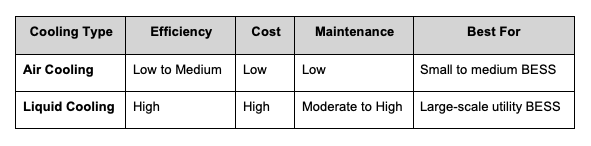
3. Comparison of Cooling Technologies
Key Takeaway: Liquid cooling is best for high-power applications, while air cooling is cost-effective for smaller systems.
4. Selecting the Right Cooling System for Your BESS
Consider the following factors when choosing a cooling system:
• Environmental Conditions: Air cooling is ideal for mild climates, while liquid cooling is necessary for hot regions.
• Energy Density: High-capacity batteries generate more heat, requiring liquid cooling.
• Salty environment: if your BESS site is close to the ocean for example, we strongly recommend liquid cooling to avoid potential corrosion.
• Budget & Maintenance Requirements: Air cooling is low-cost but less effective in extreme conditions.
Best Practice: Conduct a thermal analysis before selecting a cooling system to ensure optimal heat management.
Conclusion
Choosing the right cooling technology is crucial for BESS performance, longevity, and safety.
• Air cooling is simple and cost-effective for small to medium BESS installations.
• Liquid cooling is best suited for large-scale energy storage systems that require advanced thermal management and consistent temperature control.
By selecting the appropriate cooling solution and conducting a thorough thermal analysis during the design phase, operators can improve system efficiency, extend battery lifespan, and enhance overall safety.
If you need expert guidance on BESS design, thermal management, quality assurance, or supplier selection, contact Sinovoltaics to discuss your project requirements and discover how our independent technical advisory services can help optimize your energy storage investment.