BESS Fire Alarm

The Best, Good, and Bad of Fire Safety FAT Testing for BESS

Introduction
Fire safety is the test you hope your BESS never needs to pass in real life. So the only place you really get to check if it works is at the factory.

The problem: fire safety FAT means very different things to different manufacturers. We have inspected over 350 factories. Roughly 20% of the non-conformities we flag during BESS Factory Acceptance Testing are tied to fire safety. Wrong wiring, missing or defective components.

This is a post in our Best, Good, Bad series on FAT testing. Three ways the same test gets done. Three very different levels of protection for your battery.

Bad: software-only command test
This is the version that takes 15 minutes and gets a green tick.

The factory engineer stands in front of your BESS screen, sends an “alarm” command to the BMS, watches the alarm bit flip on the screen, and calls it a day. No real sensor input. No real alarm. No real venting. Just a digital handshake between two software layers that were already designed to talk to each other.

What this test confirms: the BMS can receive a command. That is it.

What it does not confirm: that the smoke detector wired to channel 4 is actually wired to channel 4. That the alarm is blasting through the factory when there is an issue. That the HVAC shuts off when it should and stays on when it should not.

We have seen all of these fail at sites where the factory FAT report said “fire safety: PASS.” The report was technically true. The test was the wrong test.

Good: trigger one real sensor
A clear step up. Someone goes inside the container with a heat source or a smoke source, triggers one detector, and watches what happens.

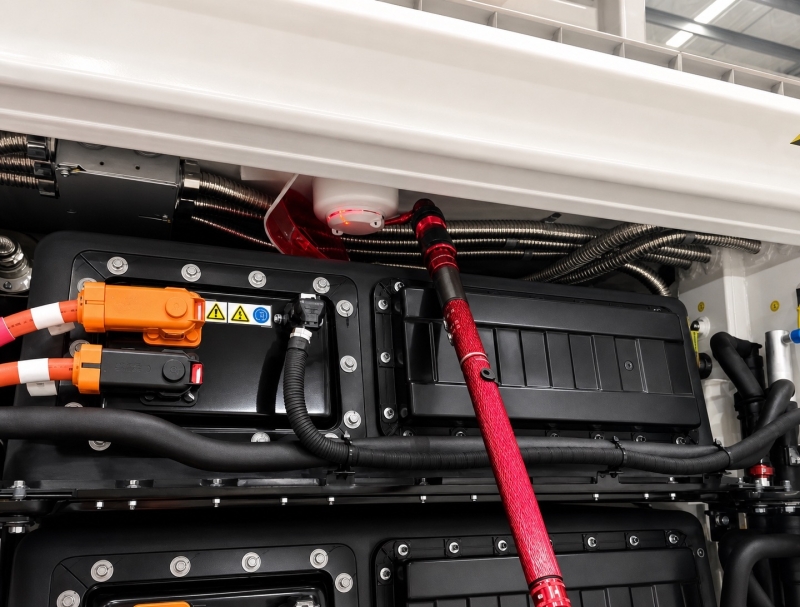
Heat stick or smoke sticks are the usual tools. It looks like a selfie stick as you can see in below picture.


The detector picks up the smoke or heat, the BMS reads it, the alarm fires, the event is logged. You can see the chain working.

This is much better than the software-only version. You confirmed that at least one real sensor is connected, calibrated, and feeding the right input.

But you still missed a lot. Most fire safety systems have multiple detection layers: smoke, heat, and chemical agents. Triggering just one of them tells you nothing about the others.

This is the most common version we see in the field. And I am always surprised by how many times this test has failed due to a 10$ component not working.

Best: full heat, smoke, and chemicals detection testing
The version that actually tells you the BESS is ready for fire detection event.

You test all three triggers: heat sensors, smoke detectors, gas detectors. You trigger them one at a time, then together. You watch the full safety sequence run.

Note : smoke and heat are usually triggered by dedicated stick. For chemical testing, it is a bit more rock n roll usually as the chemical being used for testing is usually something you could find in your DIY shop. And spraying too much chemical might block your BESS for long minutes if not hours, resulting in funny situations.

What “full” means in practice:

Detection. Each sensor type is triggered separately.

Logic. The control unit receives the right alarm code, not a generic fault. And is currently logged.

Action. HVAC fans shut off (this matters, fans push fire). Suppression system arms. Visual and sound alarms are triggered. Note : we won’t actually spread the content of the suppression system as part of the test. This part remains theoretical.

Recovery. You can clear the alarm and bring the system back to a safe state as per the manufacturer’s instructions.

Three things to write into your FAT protocol
If you only change three things in your next BESS contract, make it these.

  1. Specify the trigger method, not just the test name. “Fire safety system test” can mean any of the three versions above. Clear testing protocol with triggers must be physical (heat stick, smoke stick, chemical release), not software commands should be added to your contract.
  2. Test the full chain, not just detection. The contract should list every action the alarm should produce: HVAC, suppression, venting, …. All of them get verified, on every BESS.
  3. Do not sample. Some manufacturers will offer to test 2 BESS out of 50. Fire safety is the one place where a “representative sample” is meaningless. The container that fails will be the one you did not test. Every BESS gets the full sequence.

    Why this matters more in 2026
    UL 9540A-2026 and NFPA 855-2026 raised the bar on what fire safety documentation must show. The Hazard Mitigation Analysis (HMA) required by NFPA 855 Section 4.4 now has to evaluate the reliability of seven critical safety systems during a thermal runaway event. Suppression. Gas detection. Smoke detection. Fire detection. Exhaust ventilation. Combustible gas reduction. Explosion control.

    A software-only FAT does not give you any of that. A single-sensor FAT gives you maybe one of the seven. Only the full chain test gives you the data you need to defend the HMA later.

    The takeaway
    A fire safety system you have not fully triggered is a fire safety system you have not tested. The factory is the last place you can do it without the BESS being on a live grid, in a potentially populated area, with a 20-year warranty clock running.

    Spend the extra time. Bring the heat stick, the smoke stick, and the chemicals. Run the full sequence on every BESS. The cost of the test is a rounding error compared to the cost of finding out later that it did not work.

    Planning a BESS project? Talk to our team about a witnessed FAT that covers the full fire safety chain, not just the software handshake.
Place comment