How to Conduct a Successful Factory Audit for BESS Suppliers
Introduction
Selecting a reliable Battery Energy Storage System (BESS) supplier requires thorough factory audits to ensure product quality, manufacturing standards, and compliance with safety regulations. A well-executed audit helps identify potential risks, process inefficiencies, and supplier reliability, ultimately ensuring a high-quality and durable BESS.
This guide outlines the key steps, criteria, and best practices for conducting a successful factory audit for BESS suppliers.
1. Why Factory Audits Are Important for BESS Procurement
• Ensures product quality by verifying materials, assembly processes, and safety standards.
• Reduces risks of defects by identifying weak points in manufacturing and quality control.
• Confirms supplier reliability by assessing operational capacity and compliance with industry standards.
• Avoids hidden costs related to poor manufacturing, delays, and product failures.
Key Takeaway: A factory audit minimizes risks and ensures the supplier can deliver a high-quality, reliable BESS.
2. Key Areas to Assess During a Factory Audit
A. Quality Management and Certifications
• Does the supplier follow ISO 9001 (Quality Management) and ISO 14001 (Environmental Management) standards?
• Are the BESS, PCS, and battery cells certified under UL 9540, IEC 62619, or UL1973?
• How does the supplier handle defective units, factory acceptance testing (FAT), and site commissioning support?
Best Practice: Require suppliers to provide full certification documentation and independent testing reports.
B. Manufacturing Process and Equipment
• Are battery cells, packs, and PCS integrated in-house or outsourced?
• Does the facility use automated vs. manual processes, and how is quality consistency ensured?
• Is there a clean room environment for lithium-ion battery cells assembly?
• What are the testing procedures at each production stage?
Best Practice: Choose suppliers with in-house manufacturing and rigorous quality controls to reduce risks of defects.
C. Factory Acceptance Testing (FAT) Capabilities
• Does the supplier conduct full-system FAT before shipment?
• Are test parameters aligned with contractual specifications (voltage, capacity, efficiency)?
• Are there dedicated FAT testing rooms with load simulation equipment?
Best Practice: Witness FAT testing in-person or through third-party inspection before approving shipment.
D. Supply Chain and Raw Material Sourcing
• Where are the battery cells, PCS, and BMS sourced from?
• Are there multiple suppliers to avoid dependency on a single vendor?
• Does the supplier have a logistics plan for meeting delivery deadlines?
Best Practice: Work with suppliers who have diversified supply chains to avoid delays due to material shortages.
E. Workforce and Compliance
• Are employees properly trained for BESS assembly, testing, and handling?
• Are there workplace safety protocols and compliance with labor laws?
• What are the emergency response procedures for battery-related incidents?
Best Practice: Choose suppliers with a strong safety culture and certified workforce training programs.
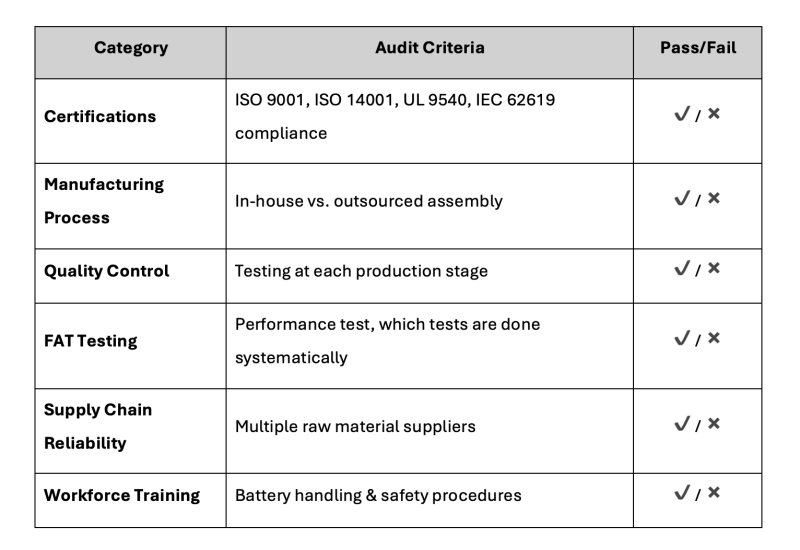
3. Factory Audit Checklist for BESS Suppliers
Best Practice: Use a structured checklist to ensure all critical areas are assessed and documented.
4. Post-Audit Evaluation and Supplier Selection
• Assign a risk score based on the audit findings.
• Negotiate improvements if issues are identified.
• Approve or reject the supplier based on compliance with required standards.
Key Takeaway: Select suppliers with strong quality management, supply chain stability, and rigorous testing processes.
Conclusion
A factory audit is a crucial step in BESS procurement, helping ensure high-quality manufacturing, regulatory compliance, and supply chain reliability. By conducting comprehensive supplier audits, energy storage buyers can reduce project risks, improve system performance, and support long-term operational success.
Whether you are evaluating a new BESS supplier or strengthening your existing procurement process, a thorough factory audit provides valuable insights into manufacturing quality, testing capabilities, and supplier reliability. Contact Sinovoltaics to learn how our independent factory audit and quality assurance services can help you make informed supplier decisions and mitigate supply chain risks throughout your energy storage projects.