The Impact of Climate on Battery Energy Storage Systems
Introduction
Environmental conditions play a critical role in the performance, lifespan, and safety of Battery Energy Storage Systems (BESS). Factors such as temperature, humidity, and extreme weather can significantly impact battery efficiency, degradation, and reliability.
This guide explores how climate conditions affect BESS performance and the best practices to mitigate environmental risks for long-term system stability.
1. How Temperature Affects BESS Performance
A. High Temperatures (Above 40°C / 104°F)
• Accelerates battery degradation, reducing lifespan.
• Increases the risk of thermal runaway, potentially leading to fire hazards.
• Reduces round-trip efficiency due to higher internal resistance.
B. Low Temperatures (Below 0°C / 32°F)
• Slows down battery chemical reactions, reducing charge/discharge efficiency.
• Limits available capacity, causing power shortages in cold environments.
• Increases internal resistance, leading to voltage drops and reduced power output.
Best Practices for Temperature Management:
• Climate-controlled enclosures or HVAC systems for large-scale BESS is a no-brainer
• Implement battery preheating systems for cold-weather operation.
• Select LFP (Lithium Iron Phosphate) batteries, which have better thermal stability than NMC.
Key Takeaway: Maintaining optimal battery temperature (15-30°C / 59-86°F) extends battery life and prevents failures.
2. Humidity and Moisture Control
Excess humidity and moisture exposure can cause:
• Corrosion of battery terminals and electrical connections.
• Short circuits and insulation failures, leading to safety hazards.
• Reduced BESS lifespan due to exposure to condensation.
Best Practices for Humidity Management:
• Use liquid cooling for coastline environment to reduce corrosion.
• Use Ingress Protection (IP) rated enclosures (e.g., IP55 or higher for outdoor
BESS)
• Perform regular visual inspections for condensation buildup.
Key Takeaway: A humidity-controlled environment prevents corrosion, short circuits, and premature battery failure.
3. Impact of Extreme Weather Events
A. Heatwaves
• Can cause overheating, reducing battery efficiency and lifespan.
• Solution: Install liquid cooling systems for large-scale storage.
B. Freezing Conditions
• Slows battery reaction times, limiting power output.
• Solution: Use thermal insulation and battery preheaters.
C. Flooding and Heavy Rain
• Water infiltration can short-circuit battery systems.
• Solution: Elevate BESS enclosures above flood levels and use sealed IP67-rated enclosures.
D. Wildfires and Air Pollution
• High temperatures and smoke can damage battery components.
• Solution: Use fire-resistant housing and install air filtration systems.
Key Takeaway: Designing BESS for extreme weather resilience ensures uninterrupted operation in harsh climates.
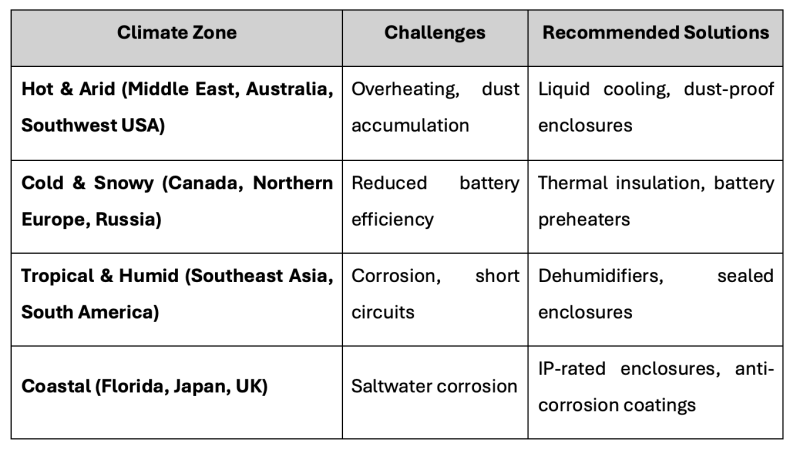
4. Geographic Considerations for BESS Deployment

Best Practice: Consider local climate factors when selecting BESS components and enclosures.
Conclusion
Climate conditions have a major impact on BESS efficiency, safety, and lifespan. By implementing temperature control, humidity protection, and extreme weather resilience strategies, energy storage operators can ensure long-term system stability and reliability.
To ensure your BESS projects are optimized for diverse environmental conditions, contact Sinovoltaics for expert technical advisory, quality assurance, and independent engineering support tailored to your energy storage needs.