Independent eyes at take-over.
Site acceptance testing is the last quality gate before your BESS enters commercial operation and the moment your warranty reference is set for the next decade. Sinovoltaics witnesses your SAT independently, verifies the system arrived and was installed intact, and captures a BESSecure baseline at energisation: thermal and voltage signatures, per rack. Disputes are resolved before take-over, not in year three.
What SAT witnessing covers
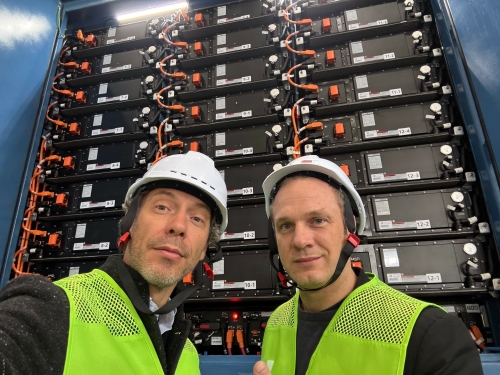
BESS SAT witnessing is the independent verification of site acceptance tests: reviewing the test protocol, witnessing commissioning tests on site, verifying pack integrity after transport and installation, and documenting system performance as the contractual baseline for take-over and warranty.
Included in every engagement:
- SAT protocol review - test program checked against your contract, grid requirements and ESCA-aligned SAT appendices before testing starts
- Independent witnessing of commissioning tests: capacity, round-trip efficiency, response, protection and safety functions
- BESSecure baseline capture - thermal and voltage signatures recorded per rack at energisation, the warranty reference for every future year
- Pack integrity verification after transport and installation - the damage window between FAT and SAT is where problems hide
- Dispute resolution support before take-over: deviations documented, severity-classified and negotiated while you still hold leverage
Deliverables: witness report per test, deviation register, rack-level baseline dataset, acceptance recommendation.
FAT vs SAT: why you need both
Factory acceptance testing (FAT) proves the system performs before it ships. Site acceptance testing (SAT) proves it still performs after transport, installation and grid connection, the phase in which racks are shipped across oceans, craned into position, cabled by site crews and connected to a real grid.
A system that passed FAT can still fail SAT. Cells shift in transport. Connections loosen. Configurations change. Without independent SAT, those problems become yours at take-over - silently.
When Sinovoltaics performed your FAT, SAT becomes a direct comparison: the same engineers’ methodology, the same rack-level fingerprints, before and after. That FAT-to-SAT continuity is the strongest acceptance evidence available in the industry. In short: whichever way you frame the SAT vs FAT question, the answer is both - one proves the build, the other proves the delivery.
Read more: FAT vs SAT in BESS projects: what a witness actually checks →
When you need this
- A BESS project is approaching mechanical completion or energisation
- Your EPC or integrator runs the SAT and you have no independent verification
- Your contract includes performance guarantees that will be measured “per SAT results”
- You are taking over a system whose FAT you did not witness
- Lenders or insurers require independent commissioning oversight
The baseline that pays for itself
Every SAT baseline captured at energisation feeds directly into:
- The BESSecure Portfolio Program - annual rack-level verification against the day-one fingerprint
- Warranty validation - capacity and RTE measured against contract curves, from a defensible starting point
- Augmentation planning - fade projections from your own data
Owners who skip baseline capture at SAT pay for it at every warranty discussion for the next ten years.
Why Sinovoltaics
- BESS FAT/SAT track record across Europe and Asia - recent references: Czech Republic 80 MWh, Sweden 138 MWh (incl. transformer & PCS FAT), France 44 MWh, Japan 16 MWh
- 100% pack testing methodology (BESSential) with 200+ MWh track record
- Independent of every manufacturer, integrator and O&M provider
- ISO 9001:2015 · ISO/IEC 17020:2012 discipline
- ESCA-aligned SAT appendices: acceptance criteria and data rights written into your contract before shipment
Energisation is a one-time event.
Baseline it. → Request a SAT scope