
Sinovoltaics Releases 2026 North America Solar Supply Chain Map: Module Capacity Surges While Wafers and Cells Remain the Industry's Weak Link
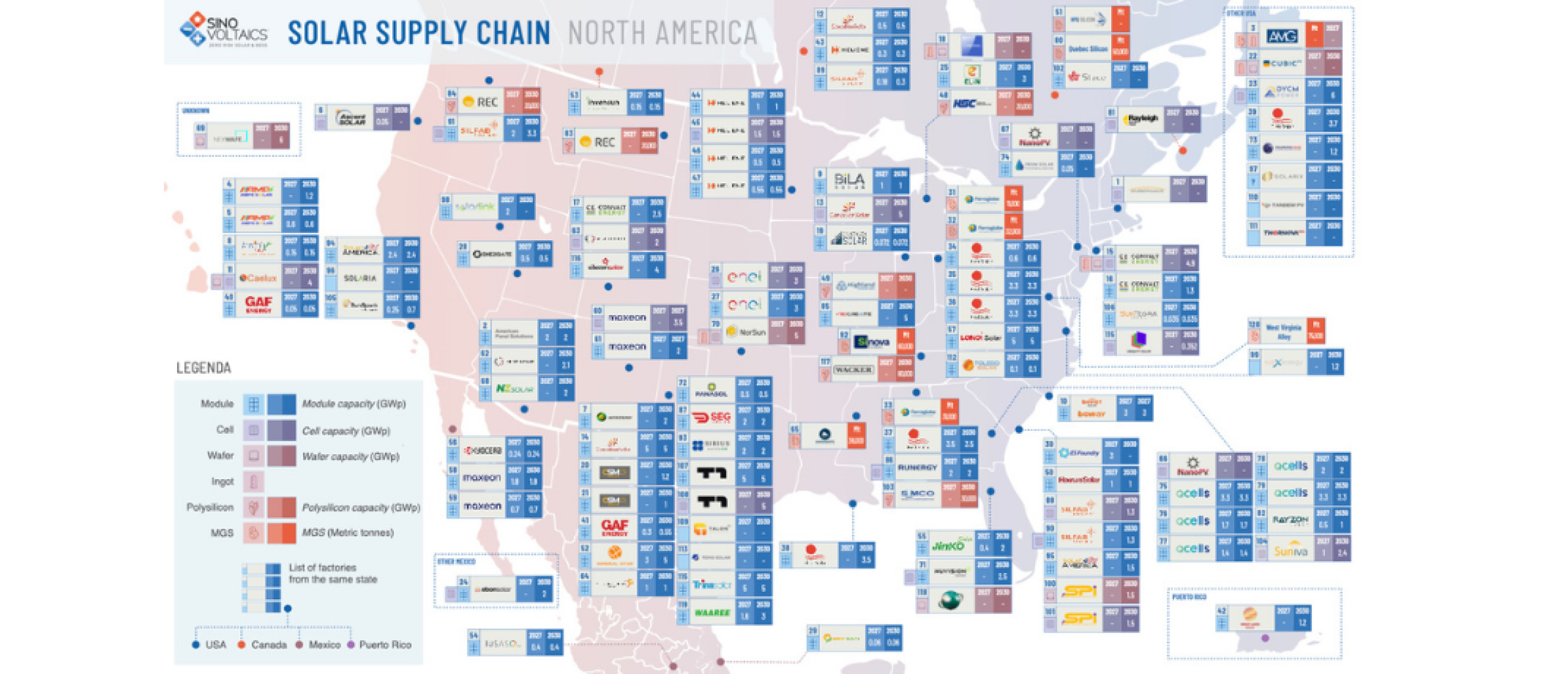
Lausanne, Switzerland – July 30, 2026 – Sinovoltaics, the Dutch-German solar PV and battery energy storage (BESS) technical compliance and quality assurance firm, today released Edition 1 of its North America Solar Supply Chain Map for 2026, a facility-level view of module, cell, wafer, and polysilicon manufacturing across the region. The map catalogs more than 120 manufacturing sites tied to roughly 100 companies across the United States, Canada, and Mexico: a supply chain still shaped like a funnel, broad at the module stage and narrow everywhere above it.
North America's module assembly capacity has reached approximately 83 GW, versus roughly 12 GW of cell capacity and just 3 GW of wafer capacity, so most cells and nearly all wafers feeding domestic module lines are still imported. Sinovoltaics' pipeline data shows module capacity climbing toward 161 GW by 2030, with cell capacity growing nearly eightfold to 93 GW and wafer capacity expanding more than tenfold to 41 GW, evidence that new investment is aimed squarely at the supply chain's weakest points. Independent tracking from the Solar Energy Industries Association shows module capacity past 60 GW, the first new US ingot and wafer facility since 2016, and the return of domestic cell production, though analysts agree upstream capacity remains the binding constraint on domestic content.
Investment is concentrating in two corridors: the Southeast (Georgia, South Carolina, and Tennessee) and the Southwest (Texas and Arizona), reflecting federal and state incentives plus emerging local supplier ecosystems. The facility list spans established manufacturers such as First Solar, Qcells, Trina Solar, Canadian Solar, LONGi's Illuminate USA, and JinkoSolar, alongside newer entrants including T1 Energy, Suniva, Toledo Solar, Heliene, CubicPV, and NorSun, several of which target the under-built ingot, wafer, and polysilicon stages directly.
"Capacity announcements don't guarantee supply security; verified, operating factories do," said Dricus de Rooij, co-founder and CEO of Sinovoltaics. "This map is meant to help procurement and investment teams tell the two apart before they sign a contract, not after."
The release lands as manufacturers navigate a shifting backdrop: 2025 legislation shortened the runway for several federal tax credits, new Foreign Entity of Concern (FEOC) rules reshape who can claim the Section 45X production credit from 2026 onward, and trade cases and permitting timelines have slowed some announced upstream projects even as others, including new polysilicon to module partnerships, have moved forward.
About Sinovoltaics
Since 2010, Sinovoltaics, a Dutch-German Battery Energy Storage (BESS) and solar photovoltaic (PV) technical compliance and quality assurance service firm, has been a pioneer in the BESS and solar photovoltaic industries. With innovative software solutions such as SELMA® software and BESSecure, Sinovoltaics’ mission is to eliminate all photovoltaic and BESS product defects, enabling investors and the world to succeed with minimal investment risks.
Sinovoltaics’ services include quality assurance inspections, factory audits, Environmental, Social, and Governance (ESG) reporting, and traceability audits for utility-scale solar and BESS developers and investors. The company maintains a global presence with offices in Switzerland, the United States, Hong Kong, Mainland China and Vietnam, as well as factory inspection and audit teams strategically located in China, Vietnam, Türkiye, Thailand, India and other key manufacturing bases.
Media Contact
Rasa Jakaitis
Media Manager
rasa@sinovoltaics.com
+37060152349
Lithuania
Read more of our ->> press releases.
