
About This Webinar
Utility-scale battery energy storage is central to the clean energy transition. Yet mounting evidence suggests that the systems investors and operators are relying on may be losing capacity far faster than originally modelled — with direct consequences for revenue, asset value, and long-term project returns.
Research from Modo Energy found that BESS assets in Great Britain are losing an average of 4% of their capacity per year over 365 cycles. In ERCOT (Texas), the figure is steeper still — approximately 7% over the same period. These are not theoretical projections; they are signals drawn from real operational data.
In Webinar 33, Sinovoltaics brings together two specialists to address this issue from complementary angles: market economics and physical quality. Ovais Kashif of Modo Energy examines why batteries in Texas appear to degrade faster than those in Great Britain, tracing the cause to evolving revenue strategies and operational behaviour. Tristan Moeller of Sinovoltaics then focuses on the factory level, explaining how temperature management failures and inadequate pre-shipment testing accelerate degradation before assets even reach the field.
Speakers:
- Ovais Kashif — U.S. West Market Lead, Modo Energy
- Tristan Moeller — Business Development Director, Central Europe, Sinovoltaics
Moderator: Rasa Jakaitis — Media Manager, Sinovoltaics
Webinar Transcript
Welcome and Introduction
[00:00:00] Rasa Jakaitis (Moderator): Hello everyone, and welcome to the Sinovoltaics webinar. My name is Rasa Jakaitis, Media Manager at Sinovoltaics, and I will be moderating today’s session on BESS degradation.
[00:00:53] From our conversations with industry leaders, it became clear that this topic is both timely and critically important — reflected in a record number of registrations, with delegates joining from more than 84 countries.
[00:01:00] Utility-scale batteries are central to the clean energy transition, yet recent research shows that systems may be degrading much faster than expected. Modo Energy found that BESS assets in Great Britain are losing an average of 4% of capacity per year over 365 cycles. A separate Modo Energy study on ERCOT in Texas revealed steeper losses of around 7% over the same period.
[00:01:33] Why is this happening? What are the implications for operators and investors? And how can faster-than-expected degradation be prevented? Those are the questions we will address today.
[00:02:00] A brief note on format: this webinar runs for approximately one hour. Two expert presentations will be followed by a Q&A session. Please submit questions via the Q&A chat at any time. The session is being recorded and will be published on the Sinovoltaics YouTube channel.
Presentation 1: BESS Revenue Performance and Degradation Trends in ERCOT and Great Britain
[00:06:00] Ovais Kashif (Modo Energy): At Modo Energy, I cover our research on the Texas, California, and SPP markets, with a focus on grid-scale battery energy storage. Today I will walk through two analyses: one on the Texas ERCOT market examining energy capacities over the past five years, and a comparison with our Great Britain study. The headline finding is that batteries in Texas are degrading faster. In the first half I will explain why, from an operational and revenue strategy perspective. The second half covers the broader revenue context in Texas and why energy capacity is becoming increasingly vital.
[00:07:00] Modo Energy provides market insights for grid-scale battery energy storage across global markets — from Europe and the US to Australia — serving financiers, owners, and operators. For project developers seeking financing, we provide price forecasts and investment outlooks. For owners and operators with assets already in the market, we advise on day-to-day operations and revenue strategies. Our insights are derived entirely from publicly available market data.
Methodology: Measuring Energy Capacity Decline
[00:08:00] Our analysis compares actual battery performance against a forecasted degradation curve. Most systems share the same cell chemistries and supply chains across geographies, so the projected curve is the same for both markets: faster degradation early in a battery’s life, slowing as the years progress. We use cycles as the unit of utilisation — one full cycle being when a battery exports energy equal to its total capacity. Most systems are expected to be repowered around the 60% capacity mark, after 10,000 to 12,000 cycles.
[00:10:00] To measure capacity decline, we track the maximum amount of energy a battery exports between import events on any given day. This is used as a proxy for available energy capacity. We then monitor how that maximum export figure declines over the battery’s lifetime relative to cycles completed.
[00:11:00] As an example: a 200 MWh battery that exported 191 MWh near the start of its life was later observed exporting only 178 MWh in winter 2024 — a 6% decline between those two points. This figure is likely an overestimate of true physical degradation, as it can also reflect recoverable losses such as cell imbalances, or operator decisions to limit exports. The 4% and 7% figures for GB and ERCOT respectively are best estimates based on available data, not definitive measurements of cell chemistry degradation.
Why ERCOT Batteries Appear to Degrade Faster
[00:14:00] The key difference between Texas and Great Britain is not the batteries themselves — it is how they are being operated, driven by the revenue environment in each market.
[00:14:30] In Texas, cycling frequency has remained relatively stable at around 0.8 cycles per day over the past five years. However, depth of discharge has been increasing — meaning that each time a battery discharges, it is doing so across a larger proportion of its energy capacity. In Great Britain, depth of discharge has seen modest growth, but cycling frequency has increased significantly.
[00:15:00] Operating at extreme ends of the state of charge — either fully depleted or fully charged — is a known accelerant of battery degradation. This is the behaviour now emerging in Texas as batteries transition from ancillary services to energy arbitrage
[00:16:00] Historically, Texas batteries earned the majority of their revenue from frequency regulation services — a fast-acting ancillary service requiring small, frequent charge and discharge events that keep the state of charge relatively flat. As these services have become saturated and clearing prices have fallen, batteries have shifted to real-time energy arbitrage. ERCOT is known for sharp price spikes, so batteries now charge during morning and afternoon hours and discharge later in the day, operating closer to both the upper and lower limits of their capacity. This behaviour is consistent with faster degradation.
[00:18:00] This progression — from frequency response into energy arbitrage — is a common pattern across mature battery markets. One reason GB has not seen equivalent degradation signals is the existence of a capacity market, which incentivises asset owners to overbuild capacity. A battery reported as 100 MWh is typically built to around 120 MWh in GB. This buffer masks true degradation in the measured data. ERCOT has no capacity market, so Texas batteries are built closer to their nameplate figure, with less headroom.
Revenue Outlook and the Growing Importance of Energy Capacity
[00:20:00] Battery revenues in Texas have declined significantly. The Modo Energy ERCOT Index shows that the summer of 2023 was a high-water mark — tight system conditions drove ancillary service prices sharply higher. Since then, as the fleet has grown and services have saturated, revenues have trended steadily lower. Current year revenues are tracking at roughly half the level seen in the same period last year.
[00:21:00] Energy arbitrage is now the primary revenue driver for most Texas batteries. In absolute terms, energy trading income has increased, but because the fleet has grown so rapidly, revenue per kilowatt of capacity has not kept pace. The spread between peak and off-peak prices has not widened quickly enough to compensate for ancillary service saturation.
[00:22:00] Texas is a nodal market, meaning each battery is exposed to the local price at its point of connection. Revenue performance therefore varies significantly by location. Batteries near high-demand nodes — such as the Houston area — can better capture evening price spikes as solar comes off the system. Batteries in the far west of the state, where there is excess wind generation and structurally depressed prices, are at a disadvantage for energy arbitrage.
[00:23:00] Two-hour batteries consistently earn more than one-hour batteries in Texas. One-hour assets tend to reserve more capacity for ancillary services — earning capacity payments without cycling. Two-hour assets are better positioned to capture energy arbitrage opportunities. Almost the entire cohort of new capacity entering ERCOT in the most recent quarter consisted of two-hour batteries. Four-hour batteries are expected to follow within months.
[00:24:00] The implication for investors is direct: preserving energy capacity over the battery’s life is no longer just a technical matter — it is central to financial performance. A battery operating below its nameplate capacity misses arbitrage opportunities in a market where margins are already compressed.
Presentation 2: BESS Quality, Temperature, and Pre-Shipment Testing
[00:25:00] Tristan Moeller (Sinovoltaics): Ovais has given us a clear view of how operational behaviour drives degradation in the market. I will now focus on the physical side — specifically, what happens at the factory level and why it matters for the long-term performance of your asset.
The Limits of Standard Factory Acceptance Testing
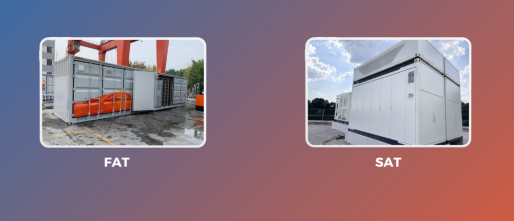
[00:26:00] A conventional Factory Acceptance Test (FAT) for a BESS typically consists of a standardised checklist of 12 to 26 points provided by the manufacturer. The centrepiece is a performance or capacity test: one discharge and one charge cycle with a half-hour rest period in between. This test validates that the asset delivers the capacity contractualised with the supplier.
[00:27:00] In practice, only 10% of containers in a given project are typically sampled for this test. On a ten-container project, that means one container is capacity-tested. The rest leave the factory on the basis of that single sample.
[00:28:00] The standard FAT is a useful baseline, but it has significant blind spots. It checks whether the asset meets contractual thresholds, not whether internal conditions are optimised for long-term performance. Think of it as confirming that a building exists — without being able to look inside the rooms.
Temperature as the Primary Degradation Multiplier
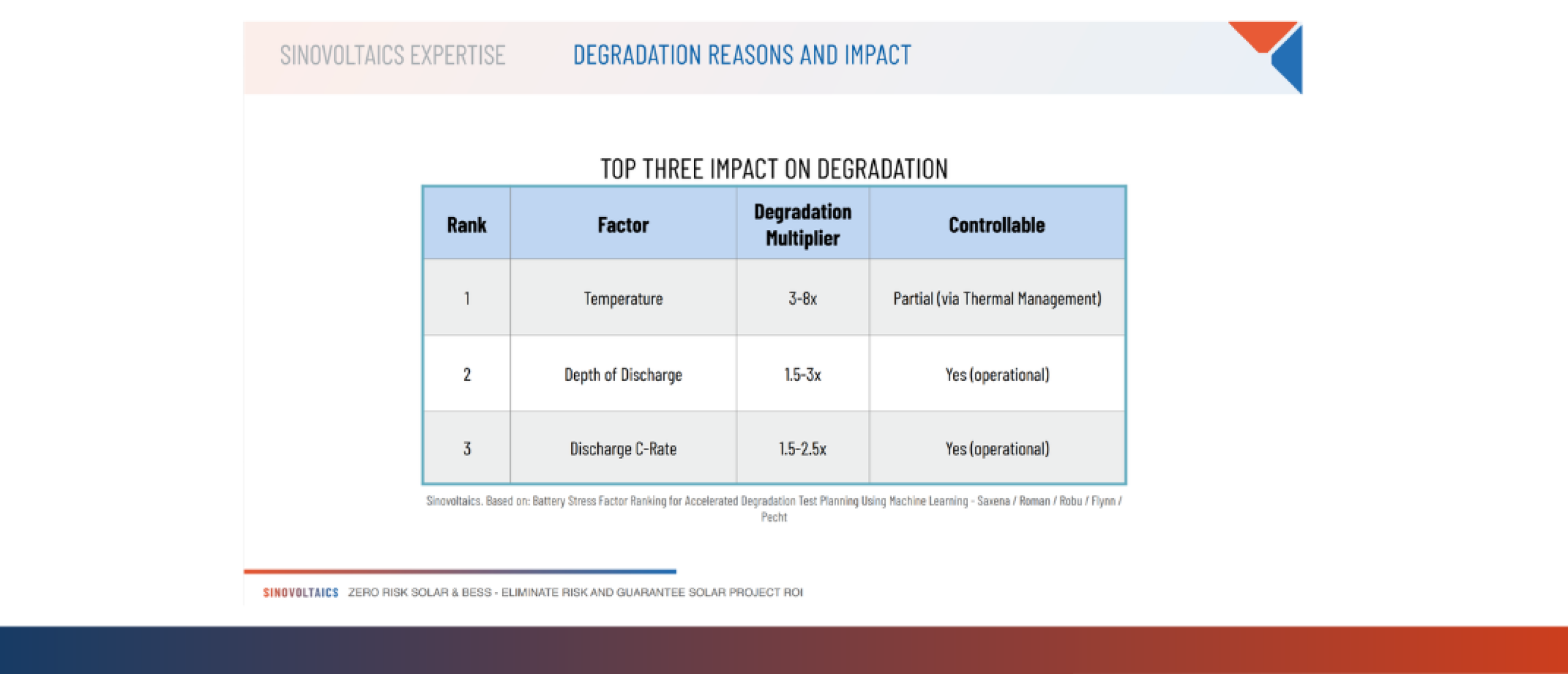
[00:30:00] Of the major drivers of BESS degradation — depth of discharge, C-rate, and temperature — temperature has the largest single impact, and it is the one most frequently overlooked in pre-shipment testing.
[00:31:00] The Arrhenius relationship describes how reaction rates in battery cells accelerate with temperature. As a practical rule of thumb: for every 10-degree Celsius rise in operating temperature, degradation approximately doubles. Across a range of 25°C to 55°C, the degradation multiplier can be anywhere from three to eight times the baseline. Manufacturer datasheets and performance warranties are almost universally based on a 25°C reference condition — essentially laboratory conditions that rarely reflect real-world operation.
[00:32:00] This has direct consequences for how performance guarantees are written and enforced. If the contractual threshold for temperature is set at 60°C — as we have seen in real projects — the bar is so high it is virtually impossible to fail the test, even when actual operating conditions are causing meaningful degradation. The contract appears robust on paper but provides no real protection.
What Standard FATs Miss on Thermal Management
[00:33:00] Across the supplier base, the thermal management elements typically included in a standard FAT are limited to two checks: a liquid cooling system inspection and a cooling and heating system check. Cell-level temperature testing — which we consider one of the most critical early-warning indicators for future degradation — is almost entirely absent from standard FAT documentation.
[00:34:00] The key issue is not only the absolute temperature values recorded during a test, but the differential between cells. Where significant temperature variation exists across a battery rack, cells will degrade at different rates over the asset’s operational life. The result is uneven capacity loss, reduced system efficiency, and potential income shortfalls — none of which would be flagged by a standard FAT threshold check.
BESSential: Data-Driven Inspection at Cell Level
[00:35:00] Sinovoltaics developed BESSential to address these gaps. Rather than adding new tests, BESSential works with the data already being generated during the FAT performance test — the data stored by the Battery Management System (BMS) during the capacity cycle. This data is your data as the asset owner; you have an absolute right to receive it.
[00:36:00] BESSential goes beyond container-level analysis to examine individual battery packs, identifying deviations in temperature, voltage, round-trip efficiency, and capacity balance at a granular level. Analysis is returned within 24 hours of receiving the BMS data. This creates no additional logistical burden for the supplier, as the performance test should already be part of the FAT process.
[00:37:00] The practical finding from our work: in two out of three containers inspected — across multiple projects and suppliers — we identify issues. These range from temperature and voltage irregularities to round-trip efficiency deviations. Many would not be caught by a standard FAT checklist.
Contracts and Performance Guarantees: A Critical Vulnerability
[00:38:00] A common view in the industry is that performance warranties and service-level agreements with suppliers will protect asset owners if degradation exceeds projections. In principle, this is correct. In practice, the contract has to be written with precision.
[00:39:00] Degradation guarantees are almost universally referenced to 25°C. Claiming against a warranty when real-world temperatures have exceeded that baseline is extremely difficult to prove under most contract structures. Pass/fail criteria for FAT tests are frequently left undefined or set at levels that are nearly impossible to breach. Contract language is often complex in ways that make disputes difficult to resolve in the asset owner’s favour.
[00:40:00] Our recommendation is to have an independent party review performance guarantees and FAT documentation before contracts are signed. Ensure that pass/fail criteria are explicitly defined and derived from the technical tender or supplier datasheets. Suppliers who resist this level of scrutiny should be treated as a red flag.
Q&A Session
[00:41:00] Q: Was the maximum exported energy measured after cell balancing? Could cell imbalance distort the degradation figures?
Ovais: The export data we use does not allow us to distinguish whether cell imbalance was present on any given day. It is possible that on specific days, lower export volumes reflect cell imbalances rather than true capacity loss. However, because our methodology tracks the maximum export over the entire lifetime of the asset, individual days where imbalance may have suppressed exports would simply not register as the maximum data point. The long-run signal is therefore more robust to this distortion, though it remains a source of potential overestimation in the degradation figures
[00:42:00] Q: Are arbitrage margins shrinking due to competition? Should future BESS deployment focus on co-located hybrid projects rather than standalone?
Ovais: Margins have remained compressed partly due to battery competition, but more fundamentally because demand on the Texas grid has not yet grown to match the pace of supply. The large-load conversation — data centres, electrification of oil and gas operations, projects such as OpenAI’s Abilene facility — will add gigawatts of demand to the ERCOT system, and we expect price spreads to widen toward the end of the decade as a result.
As for standalone versus co-located hybrid deployment: the answer is location-specific. In areas of structural price depression — such as the far west of Texas due to excess wind — co-location with solar can help smooth dispatch. Near high-demand nodes such as Houston, standalone batteries can capture evening price spikes effectively. The standalone business case is not disappearing; it is evolving.
[00:44:00] Q: Do all suppliers have test benches capable of charging and discharging during FAT?
Tristan: Most tier-one suppliers have the technical capability to run charge and discharge tests during FAT. The practical challenge is logistics — the window between end-of-line production and shipment is tight. What we are seeing increasingly is that some FAT elements are being absorbed into the production process itself as an inline inspection, to create more time and capacity for testing. To answer directly: yes, the majority of established suppliers can do it.
[00:46:00] Q: Is the standard FAT sufficient, or should additional testing be required
Tristan: The standard FAT is better than nothing — and not all suppliers provide even that level of documentation. However, a standard FAT is optimised for the supplier’s process, not your asset’s specific requirements. Our recommendation is to tailor FAT requirements to the technical specifications and performance commitments in your contract. When you push suppliers on expanding their FAT scope, how they respond is informative: suppliers who are open to it are demonstrating quality confidence. Those who push back significantly are signalling a risk.
[00:48:00] Q: In the two studies, were charge/discharge cycles the only degradation factor analysed? What proportion of degradation is attributable to cycling alone?
Ovais: The analysis looks at two operational variables: depth of discharge and cycling rate (C-rate). It does not include temperature as an input, because we do not have access to individual batteries’ thermal management data. We do conduct some locational analysis, and in a market like Texas where ambient temperatures can be extreme, regional variation in observed degradation rates is visible. Cycling is not the only driver of degradation — it is one of several. Both studies will be linked in the follow-up email
[00:50:00] Q: The average depth of discharge of 30% seems low. Can you explain?
Ovais: The 30% figure is an average across the entire ERCOT fleet and across the full year. It blends batteries doing deep energy arbitrage cycles (discharging 80 to 90% of capacity) with batteries operating primarily in low-throughput ancillary services such as regulation, where depth of discharge in any given period is very small. The average looks low because a significant portion of the fleet is still earning revenues from low-energy-throughput services. Comparing this average to Great Britain’s equivalent figure provides a sense of the relative operational intensity between markets.
[00:51:00] Q: What certificates, FAT information, and warranty conditions should contractors require from manufacturers?
Tristan: On certificates: requirements vary by destination market, so localised certification strings are essential. Certificates should be verified during end-of-line FAT, not accepted solely on documentation.
On FAT and warranty documentation: the most important step is to define explicit pass/fail criteria for every test point, derived from your technical tender and the supplier’s datasheets. What we frequently see is that pass/fail criteria are absent or left open, an open answer to what should be a binary question. On performance warranties: read the contract language carefully. Terminology is often complex in ways that create ambiguity around claims, particularly on temperature-related degradation. If in doubt, have an independent party review the warranty before signing.
[00:54:00] Q: How does BESSential obtain cell temperature data — from the supplier’s test or independently? And is it available publicly?
Tristan: The data comes from the Battery Management System during the FAT performance test. This data is generated regardless of whether BESSential is used — it is stored by the BMS as part of the standard test cycle. As the asset owner, you have the right to request this data. We obtain it from the supplier on behalf of our clients, typically in XLS or CSV format, and analyse it within 24 hours.
BESSential is not open-source. It is a proprietary service offered by Sinovoltaics. Those interested can contact us directly.
[00:56:00] Q: Do two-hour BESS assets generate enough additional revenue to offset the higher CapEx and OpEx compared to one-hour systems?
Ovais: In the current ERCOT market, yes — the additional revenue from a two-hour asset is generally offsetting the cost of augmentation or the premium of going to two hours from the outset. Almost all new capacity entering ERCOT in the most recent quarter consisted of two-hour batteries, reflecting investor confidence in the thesis that longer duration earns higher IRR multiples in the current market environment.
[00:57:00] The trend is extending further. Four-hour batteries are expected to come online in Texas within months. As solar generation comes off the system in the evening, price spikes are moving later into the day — a pattern that structurally favours longer duration. The general thesis is that the additional hours of duration are worth the investment in the current and near-term ERCOT market.
Closing Remarks
[00:58:00] Rasa: Thank you to both Ovais and Tristan for an exceptionally well-received session — the volume of questions today reflects just how pressing this topic is for the industry.
The central takeaway is that BESS degradation is not purely a technical problem. It is a financial, operational, and strategic one. It can be driven by market revenue strategy — as the ERCOT data demonstrates — by depth of discharge and cycling behaviour, and by quality and thermal management failures that originate at the factory. Addressing it requires attention at every stage: contract design, pre-shipment testing, and ongoing operational management.
Questions we were unable to address during the session will be answered in writing and sent to all registered attendees.
[00:59:00] Ovais: Thank you, Rasa. Thank you everyone.
[00:59:10] Tristan: Thank you all. Bye-bye.
Follow us to receive the latest news!
Follow us to receive the latest news!
<:optin-form-placeholder>

BESS Degradation: Causes, Impacts, and Prevention Strategies



Place comment