
Battery energy storage systems (BESS) are playing an increasingly critical role in the global energy transition. As deployment accelerates worldwide, investors, developers, and asset owners are focusing not only on project execution but also on long-term operational performance and financial returns.
Yet one important challenge continues to emerge across the industry: the gap between forecasted and actual BESS performance.
Performance models, warranty assumptions, round-trip efficiency calculations, and degradation forecasts are often used to underpin investment decisions. However, real-world operating conditions rarely align perfectly with these assumptions. Factors such as battery degradation, thermal management, quality control, cycling patterns, commissioning issues, and operational strategies can significantly impact long-term asset performance and project profitability.
In this webinar #35, experts from Merus Power and Sinovoltaics explore why BESS performance forecasts often differ from operational reality and what project stakeholders can do to minimize risk. The discussion covers battery degradation mechanisms, performance guarantees, round-trip efficiency (RTE), quality assurance during manufacturing, Factory Acceptance Testing (FAT), Site Acceptance Testing (SAT), and best practices for maximizing asset value throughout a project's lifetime.
Whether you are a developer, investor, EPC contractor, asset manager, or BESS owner, this webinar provides valuable insights into the technical and commercial factors that influence long-term battery storage performance.
Speakers:
- Markus Ovaskainen, Sales and Marketing Director, Merus Power
- Ville Julin, Business Development Director – North & South Europe, Sinovoltaics
Moderator:
- Rasa Jakaitis, Media Manager, Sinovoltaics
Webinar Transcription:
00:00:00
Rasa Jakaitis:
Hello everyone, and welcome back to the Sinovoltaics webinar series in 2026.
My name is Rasa Jakaitis, Media Manager at Sinovoltaics, and I will be moderating today’s webinar on BESS performance forecasting and operational reality.
Yesterday, Benchmark Mineral Intelligence announced that 2026 is expected to be another strong year for battery energy storage, with forecasted additions exceeding 450 GWh.
Energy storage project development is clearly not slowing down this year.
At the same time, it is crucial for asset owners, project developers, and investors to understand that BESS performance forecasts often look very different from real-world outcomes — and that gap can lead to unpleasant surprises.
So, what are the key factors driving the discrepancy between forecasted and actual BESS performance? And how do these factors directly impact financial returns?
That is exactly what we will explore in today’s webinar.
Before I introduce our speakers, a few quick notes:
- This webinar will last approximately one hour.
- The presentations will be followed by a Q&A session.
- On the right-hand side of your screen, you will see a Q&A chat box. Please use it to submit your questions during the presentations.
- This webinar is being recorded and will be uploaded to Sinovoltaics’ YouTube channel.
If you would like to stay ahead of the latest developments in renewable energy, do not forget to subscribe to our channel.
Now let me introduce today’s speakers.
00:02:24
Today we are joined by Markus Ovaskainen.
Markus is Sales and Marketing Director at Merus Power and has been working in the energy storage sector since 2017 across R&D, project delivery, and commercial roles.
He personally commissioned the first megawatt-scale battery energy storage project in Finland.
For the past four years, Markus has led the sales and marketing team at Merus Power, where he has played a key role in building the company’s BESS growth story from its early stages.
He holds a Master’s degree in Power Electronics.
Merus Power itself is a Finnish technology company specializing in advanced battery energy storage systems and power quality solutions that support grid stability, compliance, and renewable integration.
Warm welcome, Markus.
Markus Ovaskainen: Thank you.
00:03:03
We are also joined today by my colleague, Ville Julin.
Hi Ville.
Ville Julin:
Hello.
Rasa Jakaitis:
Ville is Business Development Director for North & South Europe at Sinovoltaics.
He is an energy storage expert with a Master’s degree in Electrical Engineering.
Ville has delivered high-quality utility-scale battery energy storage projects across:
- The Nordics
- The Baltics
- Spain
- Australia
- Latin America, including Peru and Chile
He has extensive experience in:
- Early-stage project development
- RFQs
- Revenue analysis
working closely with both developers and investors.
Originally from Finland, Ville is now based in sunny Barcelona.
Before I hand over the virtual microphone, let me quickly introduce Sinovoltaics for those joining our webinars for the first time.
Sinovoltaics is a Dutch-German company providing technical compliance and quality assurance services for both BESS and PV sectors.
We offer:
- Inspections
- Factory audits
- ESG reporting
- Traceability audits
for utility-scale developers and investors.
With more than 15 years of experience, we have audited over 350 PV and BESS factories globally, covering major components such as:
- Modules
- Inverters
- Transformers
- Cables
- And more
With boots on the ground across Asia and around the world, we are a trusted partner for high-quality renewable energy projects.
Without further ado, let us jump directly into the topic.
Markus, the floor is yours.
00:05:29
Markus Ovaskainen:
Thank you, Rasa, and thank you to Sinovoltaics for the opportunity to speak in this webinar.
I hope today’s session will be valuable for everyone listening.
I have around 25 minutes, so let us get straight into it.
Before diving into the topic itself, let me briefly introduce Merus Power for those who may not be familiar with us.
We are a Finnish technology company operating in both:
- Power quality solutions
- Energy storage systems
We have been active in the market since 2008.
When Finland’s energy storage market started expanding, we delivered three out of the country’s first four megawatt-class BESS projects.
We manufacture our own power electronics in Finland, which forms the basis of the complete energy storage systems we deliver.
We provide projects on a full EPC or EPCI basis, including operational services throughout the entire lifetime of the equipment.
00:06:44
Now, regarding today’s topic.
Many of you may have expected a highly technical review of operational versus forecasted performance.
However, I think it is more interesting to start by discussing why such discrepancies exist in the first place, particularly from a market dynamics perspective.
When I look at the energy storage market — especially in Europe, where Merus Power operates — I see a market that is overwhelmingly investor-driven.
I would estimate that roughly 95% of all energy storage projects built in Europe are ultimately owned by institutional investors.
Some public energy companies are also investing, but overall the market structure and its dynamics are largely shaped by institutional investment.
This has important consequences.
Performance guarantees and technical guarantees are often simplified into financial metrics that correspond directly to revenue streams.
Typical guaranteed performance metrics include:
- Charge and discharge power at the point of connection
- Roundtrip efficiency (RTE)
- Energy capacity at the point of connection
- Capacity degradation over time as a function of battery cycling
For example, contracts commonly specify how the battery should degrade under:
- One cycle per day
- Two cycles per day
- Or similar assumptions
These metrics are then used in investment calculations and financial forecasting.
As a result, optimization efforts during project negotiations focus heavily on maximizing these values.
00:09:02
Because the market is investor-driven, risk exposure is often managed more through:
- Warranties
- Guarantees
- Termination clauses
- Contractual penalties
than through deep technical due diligence.
This has created some unusual consequences in the market.
Today, it is common to see:
- 10-year warranties
- 15-year warranties
- Even 20-year warranties
for battery degradation and full BESS performance.
However, these warranties may be attached to battery products that:
- Were manufactured only months ago
- Come from companies that have existed for less than 15 years
Naturally, there are clear limitations to how accurately performance can be forecast over such long periods.
But because the market demands these warranties, suppliers provide them.
In many cases, battery manufacturers provide guarantees to:
- System integrators
- EPC contractors
who then pass those guarantees on to investors.
This creates an additional layer of interpretation between the battery itself and the actual performance at the grid connection point.
In my view, the market has reached a situation where contractual guarantees sometimes matter more than the physical reality behind them.
This creates two possibilities:
1. Suppliers take uncontrolled risks by promising overly optimistic long-term guarantees.
2. Guarantees become extremely conservative and disconnected from actual technical performance.
00:12:05
One of the key challenges today is that many performance guarantees are backed by heavy contractual mechanisms:
- Bank guarantees
- Penalty clauses
- Termination rights
rather than by deep technical validation.
For example:
- How exactly is the promised roundtrip efficiency achieved?
- How efficient is the PCS across different operating points?
- What electrochemical assumptions are used in degradation modeling?
These are often difficult questions to answer.
Battery degradation models in particular are usually among the manufacturer’s most closely guarded intellectual property.
As a result, suppliers may end up competing more on their willingness to take contractual risks than on actual technical performance.
This is something all buyers should think carefully about.
Many EPC contractors and system integrators entering the market today have existed for only a short period of time.
Yet they are providing long-term guarantees to investors while still relying on third-party battery supplier warranties themselves.
In many cases, neither the buyer nor the integrator fully understands the true technical basis of the guarantees being offered.
My conclusion is that the market would function much better if asset owners themselves developed deeper technical understanding of:
- How BESS systems perform
- How performance evolves over time
- How degradation actually occurs
This would allow investors to rely not only on contractual guarantees, but also on their own technical due diligence.
00:16:13
Now let us discuss some specific pitfalls that can create discrepancies between forecasted and actual performance.
First, it is extremely important to understand how guaranteed metrics are actually defined.
Metrics such as:
- Roundtrip efficiency
- Energy capacity
- Charge/discharge power
are all defined under specific IEC standards.
Many people assume these values are intuitive, but they are actually measured under very strict standard conditions.
The key realization is that values like RTE and energy capacity are highly dependent on operating conditions.
They are not universal numbers.
For example, RTE can vary significantly depending on:
- Installed power-to-energy ratio
- System design
- Grid connection voltage
- Ambient temperature
- Cooling system operation
Therefore, comparing one system with 85% RTE to another with 87% RTE tells you almost nothing unless you understand the full system configuration.
My recommendation is that buyers learn exactly:
- How these values are defined
- How they are measured
- How they behave under different operating conditions
00:18:33
Roundtrip efficiency is a good example.
RTE is typically used in investment calculations as the metric representing energy losses and therefore lost revenue.
However, standard RTE measurements assume:
- Full charging power
- Full discharging power
- Worst-case operating conditions
In reality, battery systems rarely operate this way continuously.
If charging or discharging power changes, RTE changes as well.
To accurately model energy losses, much more detailed simulation is required.
In high-voltage-connected BESS systems, most losses occur due to:
- Battery internal resistance
- Heat generation
- Thermal management systems
rather than simply transformers or cables.
This means that one simple RTE value does not truly describe how well a system is designed.
To help improve understanding in the market, Merus Power plans to publish an RTE calculator on our website along with a detailed explanatory blog post.
Our goal is to educate the market on how these metrics are actually defined and measured.
Unfortunately, many companies today still use their own custom RTE definitions rather than IEC-standard definitions.
00:21:20
Another important topic is system availability.
Because the BESS market is highly capex-driven, suppliers are often incentivized to build compact, cost-optimized systems.
However, availability directly impacts long-term revenue generation.
If a system:
- Is not designed for long operational life
- Lacks credible O&M support
- Experiences repetitive failures
then actual revenue performance will differ significantly from investment forecasts.
Even if suppliers meet contractual response times and warranty obligations, downtime still reduces revenue.
That is why factors such as:
- PCS design reliability
- Battery reliability
- O&M capabilities
- Spare part availability
are critically important.
These are decisions made before the contract is signed.
Once the project is operational, there is very little opportunity to influence them.
00:26:38
Finally, let us discuss battery degradation and cycling.
Battery degradation is incredibly complex.
Yet the market often simplifies it into very basic assumptions such as:
- One cycle per day
- Two cycles per day
- X number of cycles over lifetime
In reality, battery degradation depends on many factors:
- Rest time between cycles
- Average state of charge
- Depth of discharge
- Ambient temperature
- Cooling settings
- Power profile during operation
Commercial battery operation is rarely a simple full charge/full discharge cycle.
Most systems operate dynamically across multiple markets and continuously varying operating conditions.
Therefore, every cycle is effectively different.
To model degradation accurately, one would need to:
1. Simulate the actual market dispatch profile.
2. Model the battery electrochemically.
3. Evaluate degradation under realistic operating conditions.
The market today still prefers simplified contractual guarantees.
However, I strongly believe we will eventually move toward more physically realistic degradation modeling.
Based on our own project experience, I can say that battery degradation tables have often proven far more conservative than actual real-world degradation.
I will leave the reasons behind that for the Q&A session.
Thank you very much for listening.
And once again, thank you to Sinovoltaics for the opportunity.
Please stay tuned for our upcoming RTE calculator launch.
I will now hand over to Ville.
00:31:50
Rasa Jakaitis:
Thank you, Markus, for this enlightening presentation and for explaining why BESS performance forecasts often differ from operational reality.
I will now hand over the microphone to my colleague Ville, who will discuss battery degradation in more detail and how accelerated degradation can be avoided.
Ville, the floor is yours.
00:32:43
Ville Julin:
Thank you, Rasa, and thank you Markus for the excellent presentation.
I will focus specifically on battery degradation, particularly accelerated degradation caused by poor quality control.
To begin, let us look at some recent industry developments.
These issues are becoming increasingly common in the field.
According to recent market observations:
- One in five BESS projects has experienced issues related to efficiency losses, downtime, component failures, or accelerated degradation.
- A 1–2% drop in efficiency can translate into millions of euros in lost lifetime revenue per gigawatt installed.
Another major issue has been commissioning delays.
Because the battery storage market is still relatively young and evolving rapidly, delays can significantly impact project ROI.
Projects that are delayed risk missing favorable market windows and revenue opportunities.
We have also seen many cases where systems fail site acceptance testing because they do not reach their contractual nameplate capacity.
This exposes major quality gaps that ideally should have been identified earlier through:
- Factory Acceptance Testing (FAT)
- Production monitoring
- Quality assurance processes
00:34:17
So what are the financial impacts of accelerated battery degradation?
First, degraded batteries provide less usable energy to trade in the market while auxiliary consumption remains constant.
This directly reduces project revenues.
Second, some market participation schemes require minimum guaranteed power or energy capacity.
If degradation occurs too quickly, the battery may no longer qualify for participation.
In other cases, projects may face contractual penalties for underperformance.
Third, owners may need to augment the battery system much earlier than expected.
This requires additional capital expenditure not only for replacement equipment, but also for:
- Installation
- Commissioning
- Testing
During augmentation periods, the system also remains unavailable for market participation.
In co-located wind and solar projects, degradation can additionally reduce the battery’s ability to:
- Store excess renewable generation
- Shift energy into high-price periods
- Minimize curtailment
This further reduces overall project revenues.
00:36:30
So how can accelerated degradation be avoided?
As Markus explained very well, contractual structures are important.
However, quality assurance during manufacturing is equally critical.
There are several key stages:
1. Supplier audits and technical due diligence
2. Production monitoring
3. Factory Acceptance Testing (FAT)
4. Site Acceptance Testing (SAT)
5. Operational monitoring and optimization
Everything starts with the battery cells themselves.
One of the most important degradation drivers is temperature.
Higher temperatures accelerate battery degradation significantly.
Internal resistance is one of the key indicators.
Two cells may initially have identical capacity, but if one has higher internal resistance, it will generate more heat and degrade faster over time.
Because battery containers are often assembled by system integration factories using cells from various suppliers, it is extremely important to understand:
- Incoming quality control procedures
- Data collection methods
- Cell acceptance criteria
Once cells are integrated into modules and racks, making corrections becomes much more difficult.
Therefore, contracts should ideally include clear acceptance limits for:
- Internal resistance
- Voltage deviations
- Temperature differences
- Other key quality indicators
00:40:57
During production monitoring, we verify that factories follow proper standard operating procedures.
This includes checking:
- Machine calibration
- Maintenance routines
- Raw material storage conditions
- Temperature and humidity controls
- Personnel procedures
We also verify that the correct bill of materials is used.
For example:
- Only approved cell suppliers are used
- No cheaper substitute components are introduced
- All equipment is certified for the target market region
Cooling systems are a good example.
Some manufacturers use different cooling system configurations for:
- Europe
- The US
- Other markets
Long-term field performance can differ substantially depending on these design choices.
00:43:09
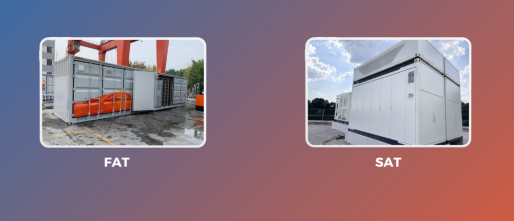
Once the container reaches the end of the production line, Factory Acceptance Testing is performed.
This typically includes:
- Visual inspections
- Mechanical testing
- Electrical testing
- Performance testing
- Safety testing
- Spray testing
The most important part for performance validation is usually the full charge/discharge cycle.
This verifies:
- Energy capacity
- Roundtrip efficiency
- Power capability
However, manufacturers typically leave performance buffers in the contractual capacity.
This means some modules inside the container may already be underperforming while the overall container still passes FAT.
To address this issue, we developed software called BESSential.
The software allows us to analyze:
- Individual modules
- Individual racks
- Thermal performance
- Deviation from specifications
If problematic modules are identified at the factory, they can be replaced before shipment.
This avoids major problems later during site acceptance testing.
00:45:32
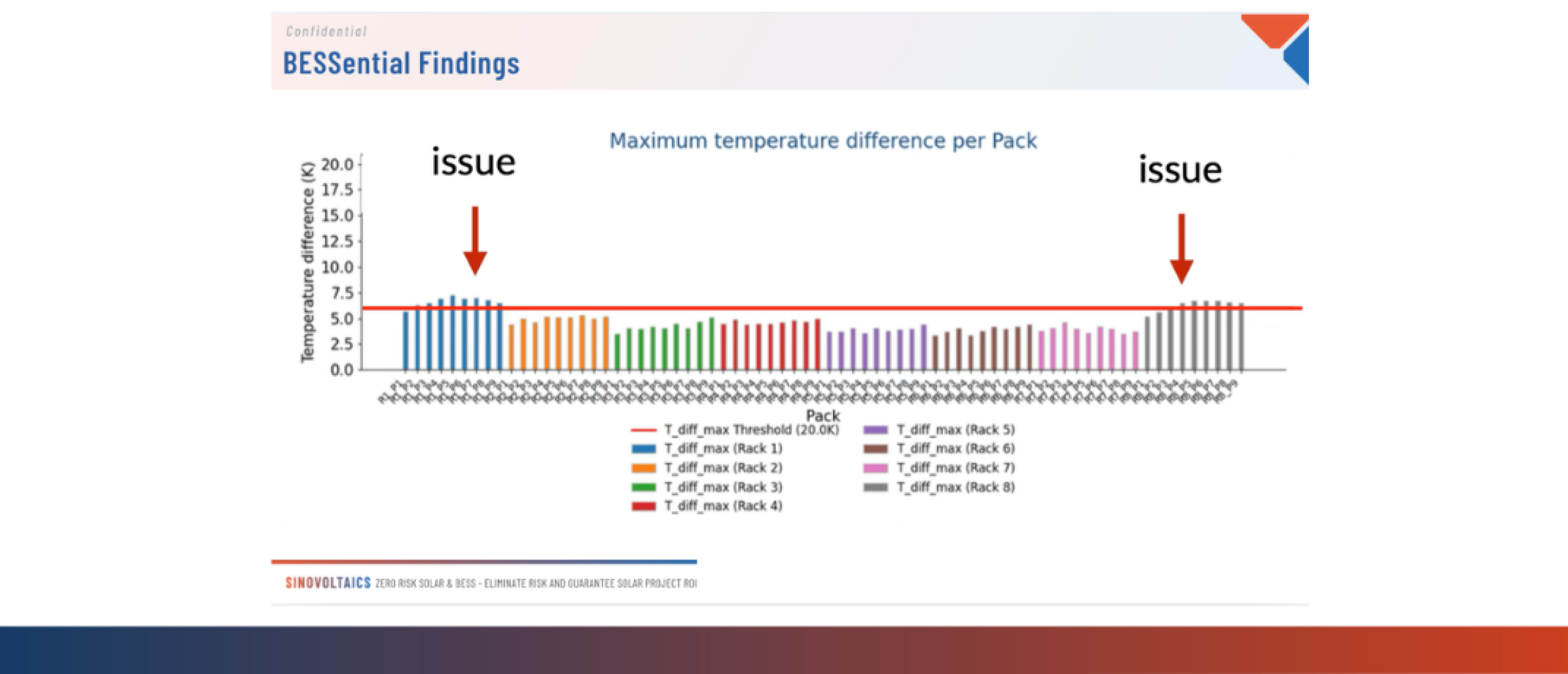
Last year, we analyzed more than 500 MWh of battery systems using the BESSential software.
Even among Tier 1 suppliers, approximately 66% of projects showed some form of issue.
Most of these problems were related to:
- Thermal management
- Temperature differences between modules
- Uneven cooling distribution
For example, modules located:
- In the center of racks
- Near the top of containers
often experience higher temperatures and therefore faster degradation.
We generally observe two possible root causes:
1. Cell quality variations, such as differences in internal resistance
2. Cooling system design limitations
Because every manufacturer uses different:
- Container layouts
- Cooling systems
- Airflow configurations
- Thermal management equipment
thermal performance can vary significantly between suppliers.
That concludes my presentation.
I look forward to the Q&A session.
00:47:47 — Q&A Session
Rasa Jakaitis:
Thank you, Ville.
Markus, I invite you to join us for the Q&A session.
The Q&A chat box has been extremely active throughout the presentations, and we received a record number of questions.
We only have about 10 minutes remaining, so any unanswered questions will be addressed afterward via email.
00:48:31
Question:
Are suppliers providing longer warranties in colder climates such as Northern Europe because colder temperatures reduce battery degradation?
Markus Ovaskainen:
I do not believe warranty lengths themselves differ significantly by climate.
However, thermal management becomes much more important in cold environments.
Many battery products are designed for global deployment rather than specifically optimized for Nordic winter conditions.
Extreme cold temperatures may therefore require:
- Additional modifications
- Specialized shelter structures
- Enhanced thermal management systems
But overall, I do not see warranty durations varying substantially because of climate alone.
00:50:22
Question:
How do you evaluate O&M or integrator guarantees backed by international insurance companies?
Markus Ovaskainen:
As an EPC and system integrator ourselves, we naturally aim to provide guarantees that are technically credible and aligned with the underlying battery supplier warranties.
However, I see major variations in the market regarding:
- How guarantees are framed
- How suppliers interpret performance metrics
- How contractual obligations are structured
Even after seven years in the energy storage market, I still find these guarantees complex.
For buyers entering the market without deep technical expertise, navigating these structures can be extremely difficult.
00:51:32
Question:*
How can long-term operational performance be forecast accurately if OEMs are the only parties with detailed electrochemical models?
Markus Ovaskainen:
It is true that OEMs possess the most detailed cell-level information.
However, independent engineering companies are increasingly emerging that specialize in:
- Battery testing
- Independent degradation analysis
- Second-opinion technical modeling
I believe this market will grow significantly as investors seek deeper understanding beyond contractual guarantees.
00:52:45
Question:
What is the best practice for ensuring high BESS quality, and what are the biggest risks of skipping quality control?
Ville Julin:
The first step is supplier selection.
Generally, suppliers that both:
- Manufacture their own cells
- Integrate their own systems
are often safer choices.
If quality control is skipped, many issues can emerge later, including:
- Accelerated degradation
- Thermal management failures
- Fire safety failures
- Corrosion problems
- Water ingress
- Power electronics damage
One of the most common issues we see is malfunctioning fire safety systems.
That alone can create extremely large financial risks.
My recommendation is to:
- Audit suppliers early
- Verify manufacturing quality thoroughly
- Inspect as many containers as possible
Battery manufacturing still contains a significant amount of manual craftsmanship compared with PV manufacturing.
00:55:32
Question:
Is the BESSential FAT procedure accepted by all major suppliers?
Ville Julin:
We have not yet implemented it with every major supplier, but we are working with many of them.
Over time, suppliers increasingly understand that:
- We are not trying to access their intellectual property
- We are focusing on quality validation
- We are helping improve long-term project reliability
Acceptance is improving continuously.
00:56:15
Question:*
How many cycles per day are realistically feasible for utility-scale BESS projects?
Markus Ovaskainen:
Most utility-scale projects today are designed around approximately two cycles per day.
Technically, more cycles are possible.
However, increasing cycle frequency significantly increases degradation risk.
In practice, the additional revenue often does not justify the accelerated battery wear.
Therefore, I rarely see investment cases based on three or four cycles per day.
00:57:27
Question:
Is it realistic for a properly managed BESS system to retain approximately 70% capacity after 4,500–5,000 full cycles?
Markus Ovaskainen:
Yes.
Of course, the exact outcome depends heavily on:
- Operating conditions
- Cycling profile
- Temperature management
- Usage strategy
But generally speaking, yes, that is a realistic expectation.
00:58:16
Question:
Is fixed fire protection equipment also tested during FAT?
Ville Julin:
Yes.
One of the most important parts of FAT is verifying that:
- Sensors function correctly
- Smoke and heat detection systems operate properly
- Signals are correctly communicated to the BMS
We simulate smoke and heat conditions during testing.
Sometimes issues are discovered such as:
- Faulty sensors
- Disconnected cables
- Improper communication signals
These are exactly the types of issues that need to be identified before shipment.
00:59:43
Question:
What is currently the biggest challenge for Merus Power in the market?
Markus Ovaskainen:
The biggest challenge is balancing realistic technical guarantees with market expectations.
The market increasingly demands:
- Longer warranties
- Stronger guarantees
- More aggressive contractual commitments
Many companies are willing to accept those risks in order to win projects quickly.
At Merus Power, we aim to remain a reliable and technically credible EPC and system integrator.
We want our systems to genuinely perform over the long term, and we already have references demonstrating this.
However, maintaining technical realism while competing in an increasingly aggressive market environment remains challenging.
01:00:15 — Closing Remarks
Rasa Jakaitis:
Thank you, Markus.
And thank you both — Markus and Ville — for the excellent presentations.
We had more than 200 people join us live today, which is a fantastic start for this year’s webinar series.
We will now conclude today’s webinar.
Please keep an eye on upcoming webinars from Sinovoltaics.
All unanswered questions will be followed up in writing afterward.
Thank you everyone, and we look forward to seeing you again soon in future Sinovoltaics webinars.
Markus Ovaskainen:
Thank you. Bye-bye.
Ville Julin:
Thank you everybody. Thank you, Rasa. Bye-bye.
Follow us to receive the latest news!
Follow us to receive the latest news!
<:optin-form-placeholder>

When Models Meet Reality – BESS Performance Forecasting vs. Operational Surprises
Place comment