BESS Safety Standards and Certifications: What You Need to Know
Introduction
Safety is a critical priority in Battery Energy Storage Systems (BESS), as improper design, installation, or operation can lead to fire hazards, electrical faults, and thermal runaway. Compliance with international safety standards and certifications ensures that a BESS meets strict safety, reliability, and performance requirements.
This guide outlines the key BESS safety standards, the importance of compliance, and best practices for ensuring a safe and certified energy storage system.
1. Why Safety Standards Matter in BESS
• Prevents hazards such as thermal runaway, short circuits, and overheating.
• Ensures compliance with local regulations, avoiding legal and financial penalties.
• Enhances reliability, reducing downtime and maintenance costs.
• Improves insurance and financing approval, as certified systems are lower risk.
Key Takeaway: Compliance with safety standards ensures a BESS operates safely, efficiently, and legally.
2. Key BESS Safety Standards and Certifications
Different countries have specific regulations for battery energy storage, covering manufacturing, testing, installation, and fire safety.
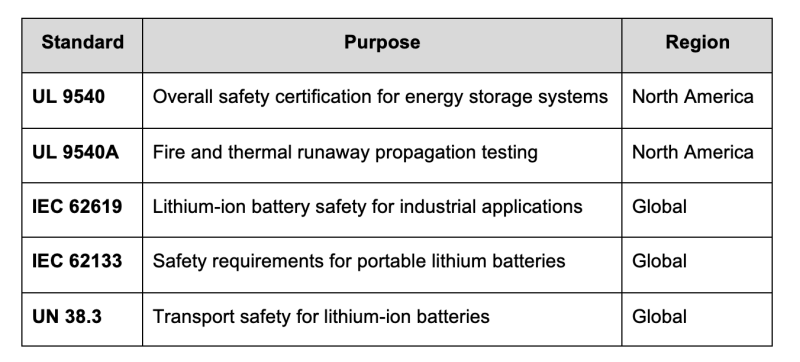
A. Battery Safety Standards

Key Takeaway: UL 9540 and IEC 62619 are the most important battery safety standards for commercial and grid-scale BESS.
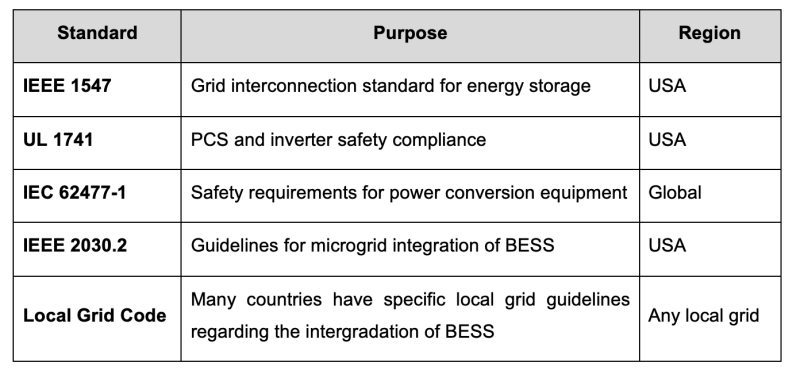
B. Electrical and Grid Compliance Standards
Key Takeaway: Compliance with IEEE 1547 and UL 1741 is essential for grid-connected BESS to ensure safe and reliable integration.
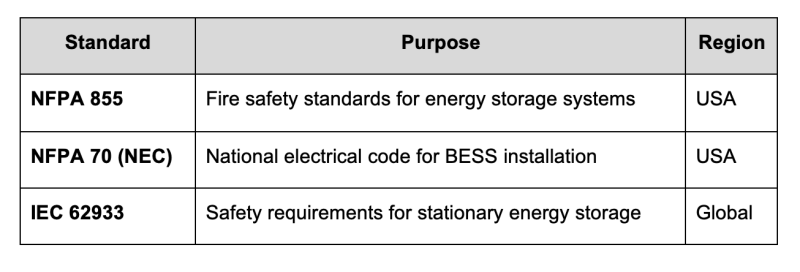
C. Fire and Installation Safety Standards
Key Takeaway: NFPA 855 is critical for ensuring fire safety and proper installation of BESS in the United States.
3. Factory Testing and Certification Requirements
Before deployment, a BESS must undergo rigorous factory testing to verify compliance with safety standards.
Key Factory Acceptance Tests (FAT) for Safety Compliance:
• Short Circuit and Insulation Test – Ensures protection against electrical faults.
• BESS Performance Testing– Confirms normal operation of BESS before shipment. Using our BESSential service ensure full compliancy with contractualised data
• Ingress Protection (IP) Test – Shower Testing– Assesses resistance to water leakage.
Best Practice: Require third-party certification from organizations like SINOVOLTAICS or TÜV to validate safety compliance.
4. Best Practices for BESS Safety and Compliance
1) Select Certified Components – Ensure that batteries, PCS, and BMS comply with UL 9540, IEC 62619, and IEEE 1547.
2) Follow Manufacturer Installation Guidelines
3) Implement Thermal Management Systems – Use liquid or hybrid cooling for large-scale BESS to prevent overheating.
4) Verify the integrity of Fire Suppression Systems – Use gas-based or aerosol fire suppression to contain thermal events.
5) Conduct Regular Safety Checks – Perform annual inspections and preventive maintenance to detect potential risks.
Key Takeaway: Proper installation, monitoring, and maintenance significantly reduce safety risks and operational failures.
Conclusion
Adhering to BESS safety standards and certifications is essential for ensuring a secure, reliable, and legally compliant energy storage system. By selecting certified components, following proper installation guidelines, and implementing safety best practices, operators can mitigate risks and enhance system longevity.
If you need expert guidance on BESS safety, certification, or risk mitigation, our team is here to help. Contact Sinovoltaics today to discuss how we can support your project.