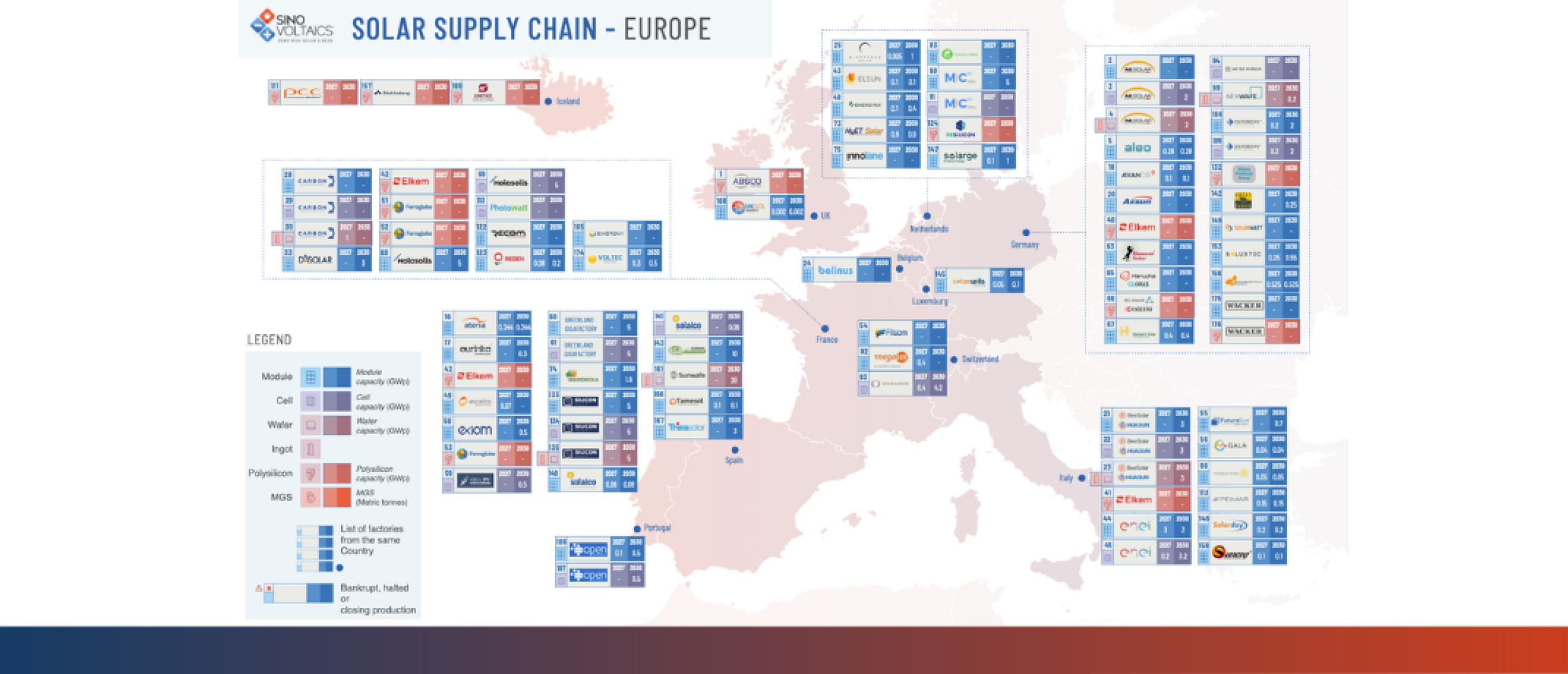

Where are Europe's solar factories located? Which manufacturers produce PV modules, solar cells, wafers, and polysilicon? And how much manufacturing capacity is actually operational? These are critical questions for developers, EPCs, investors, and procurement teams seeking greater visibility into the European PV supply chain. The Sinovoltaics Europe Solar Supply Chain Map provides a comprehensive overview of the region's solar manufacturing landscape, helping stakeholders understand where products are made, who manufactures them, and how production capacity is evolving.
Governments, manufacturers, and investors are working to strengthen domestic production, improve supply chain resilience, and support Europe's clean energy transition. At the same time, not every announced manufacturing project will become an operational facility, making it increasingly important to distinguish between current production capacity and future plans.
To help industry stakeholders navigate these developments, Sinovoltaics has released the Europe Solar Supply Chain Map – Edition 1, 2026. The latest edition provides an updated overview of PV manufacturing across Europe, the Mediterranean, and Türkiye, tracking facilities throughout the solar value chain, from metallurgical-grade silicon (MGS) and polysilicon to wafers, solar cells, and PV modules.
Why the Europe Solar Supply Chain Map Matters
Understanding where solar products are manufactured has become an essential part of supplier due diligence and procurement planning.
For project developers, EPC contractors, investors, asset owners, and manufacturers, supply chain transparency helps answer critical questions such as:
- Which factories are already operational?
- Which projects are under construction?
- Which manufacturing facilities have only been announced?
- How quickly is Europe's manufacturing capacity expanding?
Answering these questions enables organizations to make more informed sourcing decisions while reducing supply chain risk.
Europe Solar Manufacturing Capacity in 2026
The latest edition of the Europe Solar Supply Chain Map shows continued growth across the region's manufacturing base.
Current PV module manufacturing capacity has increased to 24.2 GW, while announced projects could increase total capacity to approximately 88.2 GW by 2027–2030.
Growth is also expected across upstream manufacturing:
- Solar cell production: 5.3 GW today, expanding toward 65.2 GW
- Wafer manufacturing: 1.2 GW today, with announced capacity reaching 46.7 GW
- Polysilicon production: Planned expansion continues across several projects
- Metallurgical-grade silicon (MGS): Approximately 1.24 million metric tonnes of production capacity
Although module manufacturing remains Europe's strongest segment today, much of the industry's future investment is concentrated in upstream manufacturing, helping reduce dependence on imported raw materials and intermediate products.
New Solar Manufacturing Projects in Europe
Edition 1, 2026 introduces five new manufacturers and projects to the Europe Solar Supply Chain Map:
- Solar Organic Centro España
- Solar Fabrik GmbH
- RESiLICON
- Astronergy
- JTPV / Schmid-Pekintaş
These additions reflect ongoing investment throughout Europe's solar manufacturing ecosystem and demonstrate increasing interest in expanding domestic production capabilities.
As new projects continue to emerge, keeping manufacturing data up to date becomes increasingly valuable for organizations monitoring supplier capabilities and market developments.
Operational vs. Announced Solar Manufacturing Capacity
While announced manufacturing capacity continues to grow, capacity announcements alone do not tell the complete story.
Many factories remain in various stages of development, including:
- Planned
- Financing
- Construction
- Commissioning
- Operational
Project timelines can change due to financing conditions, permitting, equipment delivery, market demand, or policy developments.
For procurement teams and investors, understanding project status is often just as important as understanding planned production capacity.
Comparison with the Previous Edition
Compared with the previous edition, the European solar manufacturing landscape has evolved considerably.
Previously, much of the market discussion centered on factory closures, bankruptcies, and industry consolidation as manufacturers navigated challenging market conditions.
The latest edition presents a different picture.
The focus has shifted toward expanding manufacturing capacity, new factory announcements, and increasing investment across the PV value chain. While execution risks remain, the overall direction suggests Europe is gradually rebuilding its domestic manufacturing ecosystem through investments in both downstream module production and upstream manufacturing.
This transition reflects Europe's broader strategy to strengthen supply chain resilience while supporting long-term energy security and industrial competitiveness.
How the Europe Solar Supply Chain Map Supports Supplier Selection
Whether you are developing a utility-scale solar project, evaluating manufacturing partners, or monitoring the European PV market, having access to reliable manufacturing information can support better decision-making.
The Sinovoltaics Solar Supply Chain Maps are designed to provide an independent overview of manufacturing locations, technologies, production capacity, and project status, helping industry stakeholders better understand the evolving global solar supply chain.
As Europe's manufacturing ecosystem continues to develop, maintaining visibility across the entire value chain, from raw materials to finished PV modules, will remain increasingly important.
Download the Europe Solar Supply Chain Map
The Sinovoltaics Europe Solar Supply Chain Map – Edition 1, 2026 provides a comprehensive overview of solar manufacturing across Europe, the Mediterranean, and Türkiye.
Whether you are evaluating suppliers, conducting market research, planning new investments, or assessing supply chain resilience, the latest edition offers valuable insights into one of the world's fastest-evolving PV manufacturing regions. 👉 Download the latest Europe Solar Supply Chain Maps here.