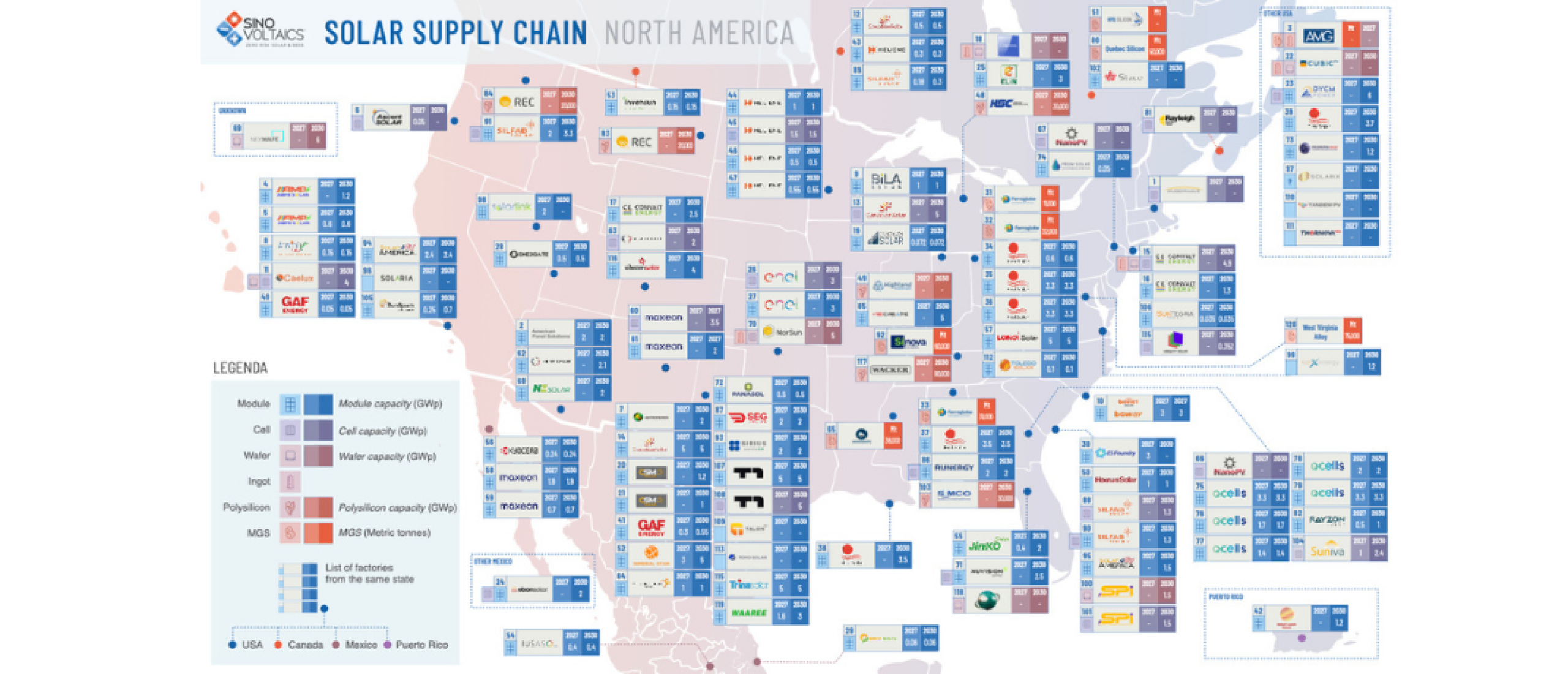

North America is rapidly expanding its solar manufacturing capacity, but one major challenge remains: the region still depends heavily on imported solar cells and wafers despite strong module production.
As solar deployment accelerates and supply chain policies tighten, understanding where the real manufacturing gaps exist has become increasingly important for developers, manufacturers, and policymakers.
Our latest North America PV Manufacturing Analysis examines current capacity and the project pipeline across the solar PV supply chain, providing insights into how the industry is evolving and where future opportunities lie.
Current Manufacturing Landscape
Solar manufacturing capacity in North America has grown significantly in recent years, particularly in module assembly. However, upstream segments of the supply chain remain underdeveloped.
Current estimated capacity in the region includes:
- Module manufacturing: ~83 GW currently operating
- Cell manufacturing: ~12 GW
- Wafer manufacturing: ~3 GW
This imbalance means that many module manufacturers still rely on imported cells and wafers, primarily from Asia.
Rapid Expansion Ahead
A large pipeline of announced projects suggests that North America’s manufacturing ecosystem will expand significantly over the next several years.
Projected capacity by 2030:
- Module manufacturing: ~161GW
- Cell manufacturing: ~93 GW
- Wafer manufacturing: ~41 GW
While module manufacturing will continue to grow, the most dramatic expansion is expected in cell and wafer production, which are critical for building a more resilient regional supply chain.
Key Manufacturing Hubs
Most manufacturing investment is currently concentrated in the United States, particularly in:
- Southeast U.S. – Georgia, South Carolina, Tennessee, and Alabama
- Southwest U.S.– Texas and Arizona
These regions benefit from strong policy support, logistics infrastructure, and proximity to large solar deployment markets.
Policy Driving Investment
Much of the current manufacturing expansion is driven by the Inflation Reduction Act (IRA), which provides production incentives across the solar supply chain.
These incentives have significantly improved the economics of domestic manufacturing, encouraging companies to invest in integrated facilities that combine wafer, cell, and module production.
The Remaining Challenge
Despite strong investment momentum, wafer and cell manufacturing remain the largest supply chain gaps in North America.
Closing these gaps will be essential for creating a fully integrated solar manufacturing ecosystem and reducing reliance on imported components.
Outlook
North America is transitioning from a module assembly hub dependent on imports toward a more complete solar manufacturing ecosystem. If announced projects are realized, the region could achieve a far more balanced supply chain by the end of the decade.
For industry stakeholders, understanding these developments will be critical as the solar market continues to grow.
Work With Sinovoltaics on Solar Supply Chain Insights
If your company is navigating the rapidly evolving solar manufacturing landscape, Sinovoltaics provides supply chain analysis and industry insights to support strategic decision-making. Contact the Sinovoltaics team to learn how our data and insights can support your project strategy.