
Battery storage has never been cheaper, and demand has never been broader. Chinese battery energy storage system (BESS) prices have fallen about 70% since 2022, while data centers have joined utilities and developers as major buyers. But a record-low bid is not always a good deal. For anyone procuring or financing storage, the question is no longer just what a system costs today, but what is driving that price, where it goes next and what it might be hiding.
On November 10, 2026, Sinovoltaics hosted its webinar "Energy Storage Pricing and Market Outlook: Current Trends, Key Drivers and the Road to 2030" in collaboration with Benchmark Mineral Intelligence. Pete Tillotson, Senior Analyst at Benchmark, shared the market and pricing outlook. I, Arthur Claire, Director of Technology at Sinovoltaics, did my best to show the seven shortcuts suppliers use to hit aggressive prices, and how to protect your contract against each one.
Here are the key insights.
Key takeaways
- Global BESS installations are forecast to reach around 466 GWh in 2026, up 34% year on year.
- Data centers could account for around 8% of BESS demand by 2030 and 10% by 2035.
- The lithium price rally has a limited effect on system prices: lithium is only about 10% of a Chinese AC block’s cost.
- Europe- and US-made systems are expected to still cost 2 to 2.6 times more than Chinese systems in 2031.
- Low prices can hide quality risks. See the 7 shortcuts behind cheap BESS bids below, with a contract clause for each.
BESS demand in 2026: 466 GWh and spreading beyond China
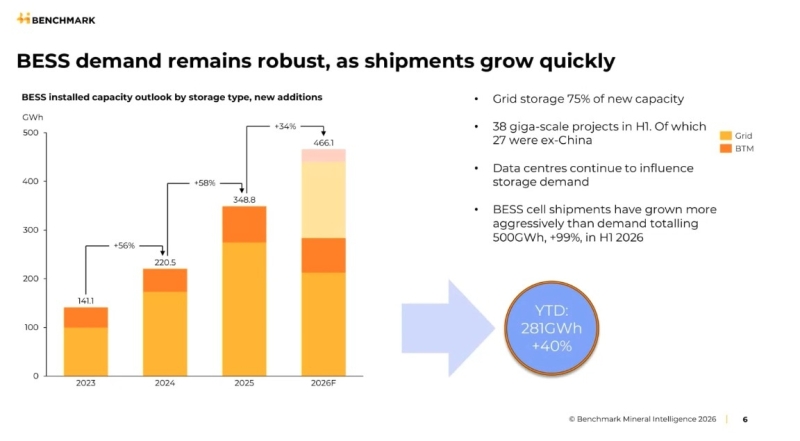
BESS demand keeps growing fast. Benchmark forecasts around 466 GWh of new BESS capacity in 2026, up 34% on 2025, after growth of 56% in 2024 and 58% in 2025. Year to date, installations reached 281 GWh (+40%), and grid storage makes up about 75% of new capacity.
Source: Benchmark Mineral Intelligence
Storage is also taking a bigger share of the overall battery market. BESS accounts for about 24% of global battery demand in 2026, up from 11% in 2022, as total demand grows from around 0.7 TWh to 2 TWh. EVs still dominate at 67%.
A few other trends stood out:
- Supply is outpacing demand. BESS cell shipments reached 500 GWh in H1 2026, up 99%, growing faster than installations.
- Growth is spreading beyond China and the US. The two markets account for 87% of grid deployments to date but only 66% of the 2026-27 pipeline. Year to date, Europe grew 182% and the rest of the world 164%, compared with 10-11% in China and the US. Of the 38 giga-scale projects announced in H1, 27 were outside China.
- Projects are getting bigger and longer. Average project size in Australia rose from 366 MWh in 2023 to 882 MWh in 2026, and in Chile from 64 MWh to 602 MWh. Systems of more than four hours are expected to make up about a third of grid capacity by 2028.
- Solar pairing is on the rise. In Europe, BESS paired with solar has grown quickly since 2024 and now makes up a growing share of new operational capacity.
- LFP remains the dominant chemistry. LFP holds around 95% of grid BESS installations today, with sodium-ion expected to gain share gradually after 2030.
Why data centers are becoming a major BESS buyer
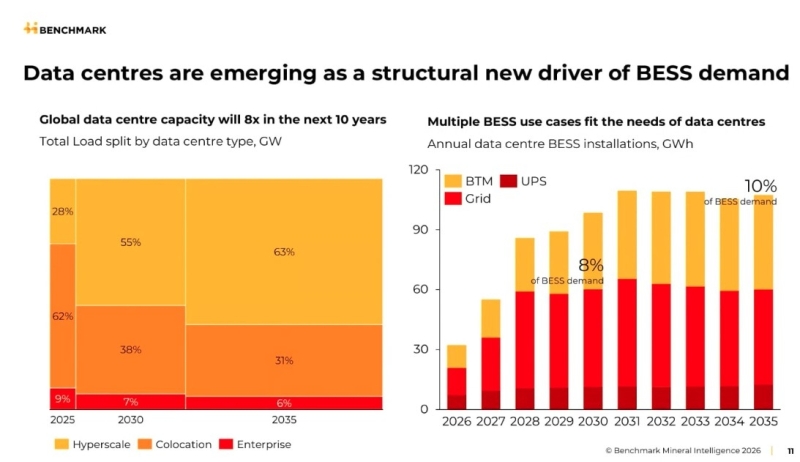
Data centers are becoming a lasting source of BESS demand, not a passing trend. Benchmark expects global data center capacity to grow 8x over the next decade, with hyperscale facilities rising from 28% of load in 2025 to 63% by 2035. Data centers could account for around 8% of BESS demand by 2030 and 10% by 2035.
Source: Benchmark Mineral Intelligence
Onsite gas has become a common way to power new AI campuses without waiting for a grid connection, but it is running into limits:
- Long lead times. Heavy-duty gas turbines now take 3+ years to deliver, with order books close to full until 2030.
- Rising costs. New gas plant costs are up 66% since 2023, from under $1,500/kW to over $2,150/kW.
- Load swings. AI training loads move by megawatts in milliseconds, faster than turbines can follow without damage.
This means every behind-the-meter campus already needs batteries to stabilize its load. As gas faces queues and reliability issues, those batteries are increasingly becoming the bridge to a grid connection.
Pete also noted that hyperscalers remain largely grid-first, with onsite gas as a speed-to-power exception. BESS is rarely sized to run a full data center for long. Instead, it typically covers a slice of load for a few hours, and sizing depends on the use case: peak shaving, backup, renewable firming or long-duration storage.
BESS prices in 2026: down about 70% since 2022
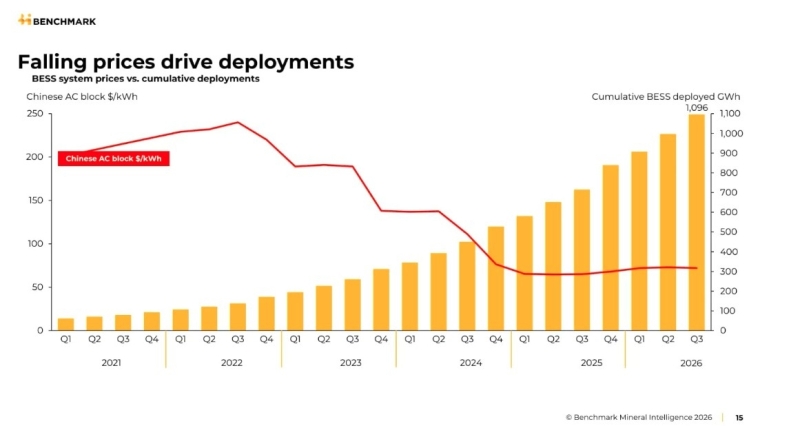
Falling prices have been the main engine of deployment. Chinese AC block prices peaked at around $240/kWh in 2022 and dropped to roughly $65-70/kWh by 2025, about 70% lower. Over the same period, cumulative BESS deployments climbed past 1,000 GWh, reaching 1,096 GWh in Q3 2026.
Source: Benchmark Mineral Intelligence
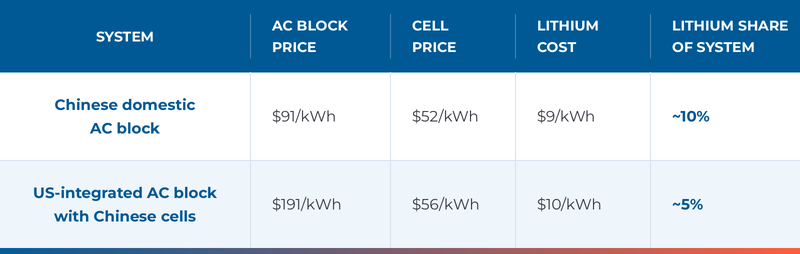
Since late 2025, lithium carbonate prices have rallied, raising the question of whether system prices will follow. Benchmark's answer: only to a limited extent, because lithium makes up a small share of total cost. Based on a 100 MW, 4-hour lithium iron phosphate (LFP) AC block:
 Lithium Share of BESS System Cost: China vs. US
The comparison also shows how costs pass through to the full system. In China, cells make up 57% of the AC block price. In a US-integrated system using the same Chinese cells, they make up just 29%, with integration, local costs and other components accounting for the rest. In practice, even if lithium prices doubled, a Chinese AC block would rise by only around $9/kWh.
BESS price outlook to 2031: the local-content premium stays
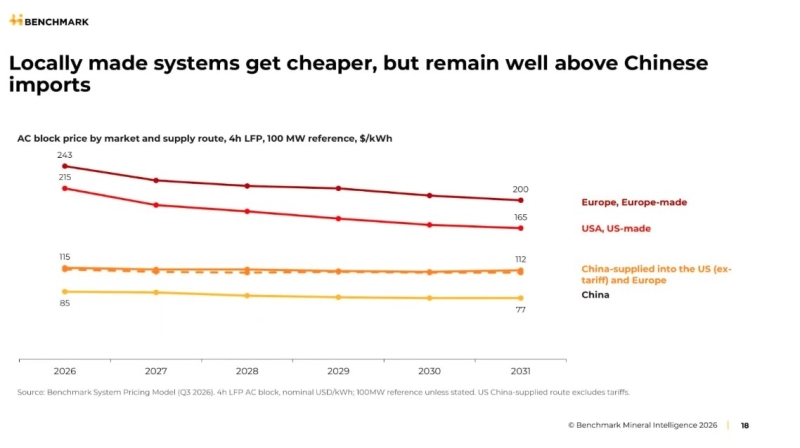
Benchmark expects prices to stay low through 2030, but where a system is made will matter more than ever. Locally made systems in Europe and the US are forecast to get cheaper yet remain well above Chinese imports.
Source: Benchmark Mineral Intelligence
 BESS AC Block Prices by Supply Route: 2026 vs. 2031
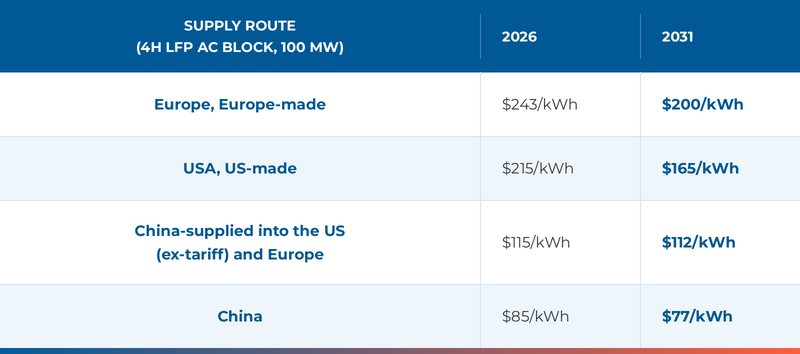
Locally made systems get cheaper, but not fast enough to close the gap. By 2031, a Europe-made 4-hour LFP AC block is expected to cost around $200/kWh (down 18% from 2026) and a US-made one $165/kWh (down 23%). Over the same period, Chinese domestic systems slip from $85 to $77/kWh, and Chinese systems shipped into Europe or the US (before tariffs) stay around $112/kWh. For buyers, this means budgeting for a premium of two times or more where local content rules apply, and making supply chain checks part of every tender.
Policy is a key factor behind that gap. In Europe, the proposed Industrial Accelerator Act would phase in local content rules: BESS and battery management systems (BMS) would need to be EU-produced one year after the law passes, and EU battery cells plus one more key component after three years. Separately, an inverter and power conversion system (PCS) ban applies to projects receiving European Investment Bank (EIB) or European Investment Fund (EIF) funding, excluding high-risk suppliers from new projects from November 2026, with a grandfathering window that protects most 2026 and 2027 projects.
On technology, LFP is set to stay on top for 0–4-hour systems. Average grid durations have already risen from 1.6 hours in 2020 to 3.0 hours in 2025. Alternative technologies will need to compete on both cost and performance. Sodium-ion stands out as the main challenger, offering better low-temperature performance, safety and materials security, but it still needs to improve energy density, top-end cycle life, scale and cost competitiveness.
7 shortcuts behind cheap BESS bids (and what to do about it)
Low prices are good news for buyers, but only if the savings are real. I walked through seven common shortcuts suppliers take to hit aggressive price points, and how to protect your project against each one in the procurement contract.
- Supplier bankruptcy risk. Aggressive pricing can signal a supplier burning cash to win volume. If that supplier goes bankrupt, the warranty goes with it: no capacity guarantee, no spares, no service.
o Tip: Ask for bankability evidence, such as a credit rating or independent bankability report, and for warranty insurance that survives the supplier.
2. Rock-bottom CAPEX. A very low purchase price is usually recovered elsewhere, through higher operating costs, or OPEX (augmentation, spare parts, service fees, auxiliary consumption) or weaker warranties.
o Tip: Compare offers on total cost of ownership over the project life, with round-trip efficiency, degradation and auxiliary losses clearly defined.
3. Manufacturing by a subcontractor. The brand on the container is not always the factory that built it. Subcontractors may not follow the OEM's quality system, and OEM audits say nothing about their lines.
o Tip: Add a no-subcontracting clause: manufacturing at a named OEM site, with any change subject to your written approval and a new audit.
4. B-grade or substituted cells. Cells are the largest cost item, so cheap cells make a cheap BESS. B-grade cells or unannounced model swaps lead to faster degradation, imbalance and thermal events later.
o Tip: Include a dedicated cell clause naming the manufacturer, model and grade A, with traceability to cell serial numbers and independent lab testing.
5. Reduced FAT time. Suppliers may test only a sample of containers, drop safety and performance tests, or shorten test cycles. With no universal FAT standard, the supplier sets the rules unless you do.
o Tip: Define the FAT protocol in the contract, including sampling, test procedures and pass/fail criteria, with production monitoring if sampling is used.
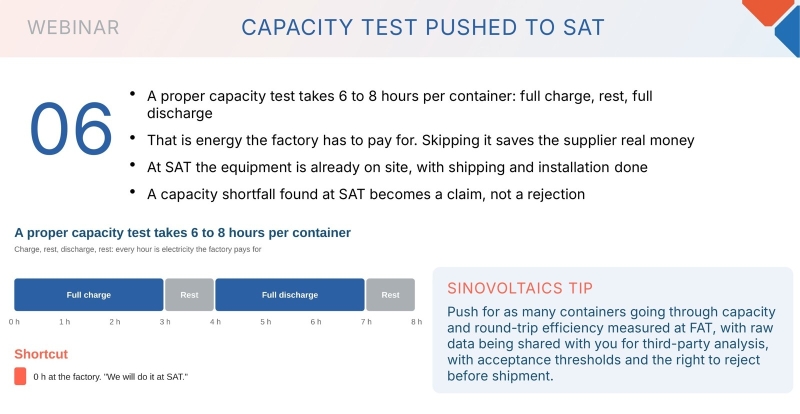
6. Capacity test pushed to SAT. A proper capacity test takes 6 to 8 hours per container, and skipping it at the factory saves the supplier real money. But a shortfall found on site becomes a claim, not a rejection.
o Tip: Test as many containers as possible for capacity and round-trip efficiency at FAT, with raw data shared for third-party analysis and the right to reject before shipment.
7. No real support team. Cheap offers often come without a local service team, or with support subcontracted to a third party. Every day of downtime is lost revenue.
o Tip: Set response times in the contract (remote in hours, on-site in days), require a spare parts stock with penalties if commitments are missed, and clarify who provides support.
 BESS Capacity Test: Why It Belongs at FAT, Not SAT
Frequently asked questions
How much does a BESS cost per kWh in 2026?
According to Benchmark, a 4-hour LFP AC block (100 MW reference) costs around $85/kWh in China, $215/kWh for US-made systems and $243/kWh for Europe-made systems.
Will rising lithium prices make BESS more expensive?
Only slightly. Lithium makes up about 10% of the cost of a Chinese AC block and about 5% of a US-integrated system, so even a sharp lithium rally adds only a few dollars per kWh.
Will sodium-ion replace LFP?
Not before 2030. LFP holds around 95% of grid BESS installations, and sodium-ion still needs to improve on energy density, cycle life, scale and cost before it can compete widely.
What is the biggest risk of a very low BESS bid?
Hidden cost-cutting, such as B-grade cells, subcontracted manufacturing, shortened factory acceptance testing or weak after-sales support. These usually show up later as faster degradation, warranty claims or downtime.
What this means for your next BESS tender
The message from the webinar was clear: BESS prices are low and likely to stay that way, demand is broadening fast, and data centers are adding a new layer of growth. But a low price is only a good deal if quality, warranties and support hold up over the project's life. Buyers who compare offers on total cost of ownership and write strong protections into their contracts will be best placed to capture the savings.
Thank you to Pete Tillotson and Rasa Jakaitis for their insights, and to everyone who joined us live.
Missed the live session? Watch the full webinar recording here.
Planning a BESS procurement?
Whether you are comparing supplier offers, drafting procurement contracts or preparing for factory acceptance testing, Sinovoltaics can help. Our team supports developers, independent power producers (IPPs) and EPC contractors with supplier audits, manufacturing traceability, FAT witnessing and inspections, so the savings you see on paper hold up in the field.
Talk to our BESS quality team to discuss how we can protect your next storage project.