
About This Webinar
As solar PV and battery energy storage (BESS) projects across Europe approach the end of their operational lifetimes, a critical question looms: who pays for decommissioning, and has it been planned for?
According to a recent SolarPower Europe study, PV capacity in Europe is projected to reach 671 GW by 2028 — representing more than one billion solar panels that will eventually need to be decommissioned and recycled. Despite this scale, end-of-life planning is consistently missing from financial models, leaving asset owners, investors, and lenders exposed to significant unplanned liabilities.
In Webinar 34, Sinovoltaics brings together two industry experts to address this growing blind spot. The session covers the full PV and BESS project lifecycle — from planning and procurement through to operation and end-of-life — with a deep focus on decommissioning costs, EU regulatory requirements, recycling economics, and design decisions that can reduce future liabilities.
Whether you are an asset owner, developer, investor, or lender, this session provides the practical knowledge needed to treat decommissioning not as a distant afterthought, but as an essential line in your financial model.
Speakers:
- Andreas Bach, Renewable Energy Expert
- Rasa Jakaitis, Media Manager at Sinovoltaics
Webinar Transcript
Welcome and Introduction
[00:00:00] Rasa Jakaitis (Moderator): Hello everyone, and welcome to the Sinovoltaics webinar. My name is Rasa Jakaitis, Media Manager at Sinovoltaics, and I will be moderating today’s session.
[00:00:53] Today we will be talking about PV and BESS project decommissioning — a topic that for too long was ignored and treated as something to deal with later. According to a recent SolarPower Europe study, PV capacity in Europe is expected to reach around 671 GW by 2028. That represents more than one billion solar panels to be decommissioned and recycled in the future.
[00:01:33] Who will take care of decommissioning? Who bears responsibility in 30 years’ time? How much will it cost? These are the questions we will try to answer today
[00:02:08] A few housekeeping notes: this webinar will last approximately one hour. Two expert presentations will be followed by a Q&A session. Please post your questions in the chat box at any time. This webinar is being recorded and will be uploaded to the Sinovoltaics YouTube channel.
Presentation 1: PV & BESS Project Lifecycle Risks and Mitigation Strategies
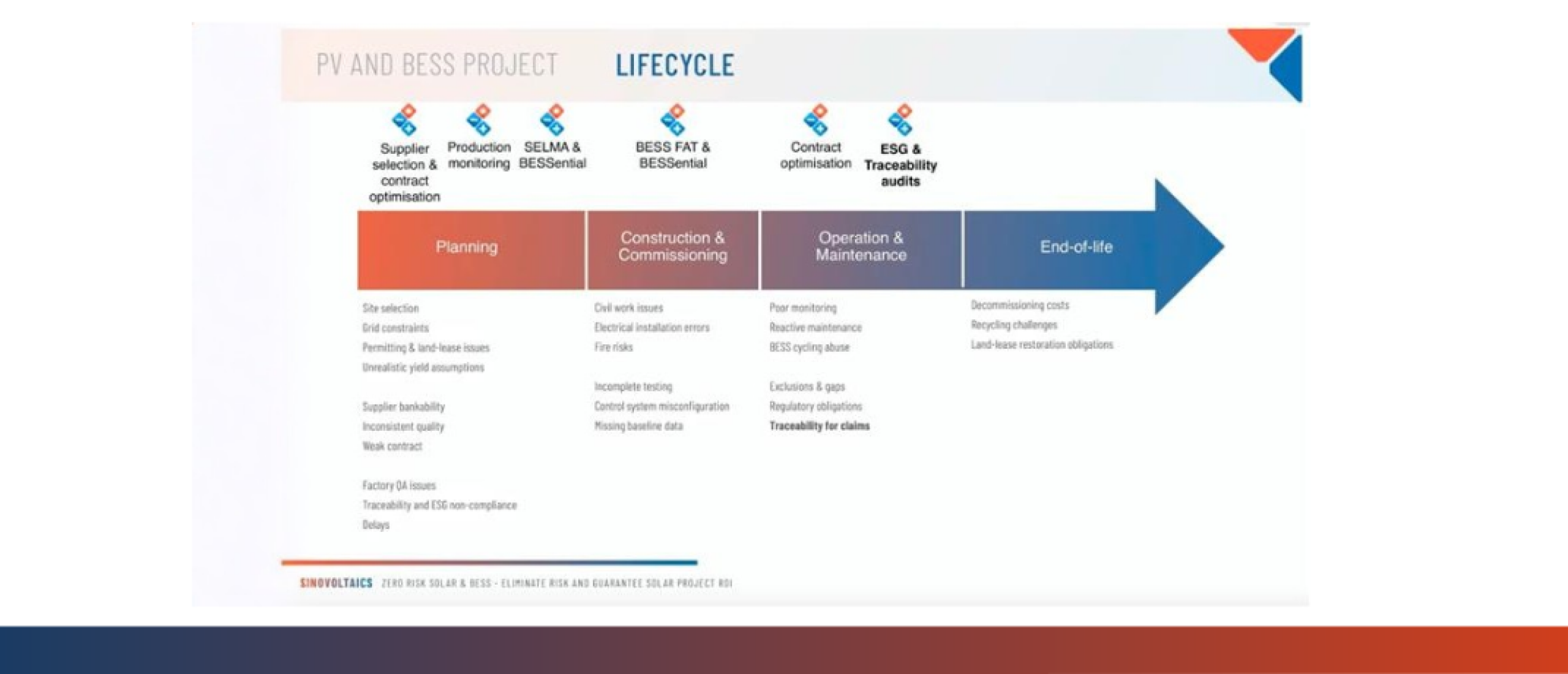
[00:04:39] Rasa Jakaitis: Understanding risks early and managing them proactively is essential if you want to deliver bankable, high-performing assets that operate safely and reliably over decades.
I will focus on three main phases of the PV and BESS project lifecycle: the project phase, the operational phase, and the end-of-life phase. The risks referenced were identified by analysing studies from DNV, PWC, and DNV GL.
Planning Phase
[00:05:58] In the planning and development phase, key risks include site selection challenges such as extreme weather conditions and environmental constraints; grid constraints from weak grid capacity or long interconnection queues; permitting and land lease risk; and overly optimistic yield assumptions. Underestimating losses or degradation can inflate energy projections and create problems with lenders and investors further down the line.
Procurement Phase
[00:07:13] A key concern in procurement is supplier bankability. You are selecting a partner for 20 to 30 years, so financial stability matters. Additional risks include inconsistent quality — where components used in manufacturing do not match what was specified — and poor contracts with weak scopes, misaligned incentives, and unclear responsibilities. Poor contracts are the most common procurement pitfall.
Manufacturing Phase
[00:08:33] Factory quality assurance issues, inadequate testing, and poor work organisation can lead to problems once assets are installed in the field. Traceability and ESG compliance has become increasingly important — institutional investors now require transparent supply chains. Manufacturing delays can result in financial losses if project obligations cannot be met on time.
Construction Phase
[00:10:01] Poor worker safety, substandard earthworks, drainage, and foundation issues can compromise structural stability and cause long-term erosion problems. Installation errors may lead to outages, thermal events, or underperformance. Fire risk is particularly prominent for BESS installations.
Commissioning Phase
[00:11:21] Commissioning is the bridge between construction and operation. Different components in BESS systems may not communicate properly with one another, and this can go undetected until the system is on site — making incomplete factory testing a significant risk.
Incorrect inverter settings or poorly integrated BESS controls can reduce system efficiency or cause grid code violations. Missing baseline data — such as IV curves or initial performance benchmarks — makes it difficult to validate warranties or diagnose performance issues later in the asset’s life.
Operational Phase
[00:12:39] Inadequate monitoring leads to slow detection of performance drifts and safety issues. Reactive maintenance — addressing problems only after significant losses have accumulated — is a common failure. For BESS systems specifically, cycling abuse (operating batteries outside their intended depth of discharge or temperature limits) can rapidly degrade capacity and void warranties. Warranty exclusions and gaps, regulatory compliance obligations, and weak traceability for claims are further risks in this phase.
End-of-Life Phase
[00:14:03] Decommissioning is the risk that receives the least attention. Dismantling PV and BESS assets, handling hazardous materials, and restoring land can be costly if not budgeted early. Recycling infrastructure for modules and lithium-ion batteries remains limited. Land lease restoration obligations may require sites to be returned to their original condition, and failure to plan for this creates significant liabilities.
Mitigation Strategies
[00:15:17] Sinovoltaics offers a range of services to address these risks across the project lifecycle:
Supplier Selection: Independent background checks, factory visits, and evaluation of manufacturing and quality assurance procedures.
Contract Optimisation: Clear wording, defined responsibilities, strict deadlines, penalties, warranty terms, and adequate testing requirements.
Production Monitoring: On-site oversight from raw material delivery to shipment to prevent quality issues.
Traceability and ESG Audits: Ensuring responsible and transparent sourcing throughout the supply chain.
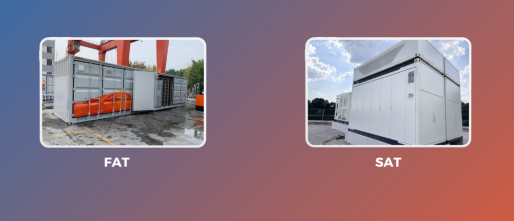
SELMA (AI-Driven EL Testing): 100% electroluminescence testing of PV modules before they leave the factory, including cell-level analysis.
BESSential (BESS Factory Acceptance Testing): Visual, electrical, mechanical, performance, and safety testing of BESS assets prior to shipment.
[00:21:07] Across a multi-million euro project, these risk mitigation services cost a fraction of the potential losses they prevent. Think of them as insurance: a small upfront premium compared to the financial exposure if problems arise.
Presentation 2: The Hidden Cost of Decommissioning — Why It Must Be in Your Financial Model
[00:21:52] Andreas Bach: A few weeks ago, I was in a board meeting reviewing a PV plant project. The CAPEX, OPEX, and design were all fully developed. At the end of the discussion, I asked: “What about decommissioning? Have we modelled it?” There was complete silence. Nobody had considered it, because it was 25 to 30 years away
[00:23:14] In all the years and in all the companies I have worked across multiple countries, decommissioning has never been a default part of project planning. Every project has a start and an end — but the end is never considered. It is always about minimising CAPEX and LCOE. Decommissioning is treated as something abstract in the far future.
The Scale of the Challenge
[00:23:51] Today, the European Union has approximately 90,000 tonnes of PV modules awaiting recycling, with a current recycling capacity of 70,000 to 90,000 tonnes. By 2030, that volume will hit 300,000 tonnes. By 2050, it will reach 2,300 kilotonnes — equivalent to stacking panels in a tower 3,500 kilometres high, or circling the Earth four times laid end to end.
[00:25:37] Several factors are driving this growth. Panel degradation is happening faster than originally projected, making repowering economically attractive — especially since modern panels of the same size produce 30 to 40% more energy than those installed 10 to 20 years ago. Feed-in tariffs in several countries are ending, and existing grid connections make repowering highly feasible. Hail damage and other unplanned events are also accelerating panel replacement.
[00:26:23] The EU has strict regulations in place. Under Extended Producer Responsibility (EPR) laws, recycling must happen within the EU — PV panels cannot be exported for recycling or dumped in landfill. The only exception is export for second life, provided each panel is certified as operational.
The Financial Reality
[00:28:15] Most financial models treat decommissioning superficially, assuming that the salvage value of recovered materials will cover costs. It does not.
€50,000 per MW peak — median dismantling cost, including full site restoration
€8,000–€12,000 per MW peak — material recovery income from recycled components
€100–€200 per tonne — recycling cost (median €150)
€110 per tonne — recovered material value (median)
[00:29:11] There is a gap of approximately €40 per tonne — a “gate fee” the asset owner must pay to the recycling facility. The largest cost driver is dismantling, followed by logistics. Transporting panels more than 300 to 500 kilometres to a recycling facility is often not economically viable, which is why mobile recycling plants are being explored as a solution.
Design Decisions That Reduce Decommissioning Cost
[00:31:48] Design choices made during construction have a significant impact on end-of-life costs. On a recent project, the initial ram and pull-out test for ground mounting was unsuccessful, and the instinct was to fill the posts with concrete. However, on a 100 MW project with 500 to 600 posts per megawatt, that amounts to thousands of cubic metres of concrete that would need to be excavated in 25 years.
[00:33:20] By commissioning additional tests and working with the substructure supplier to explore alternatives, we found a screw pile solution that eliminated the need for concrete entirely. The additional testing cost was modest compared to the future decommissioning savings.
[00:34:41] Other practical design considerations include using containerised electrical stations (which are more cost-effective to remove than concrete), maintaining accurate as-built drawings with GIS data, and using QR codes on components to capture material passports for future dismantling teams.
Mitigating the Risk
[00:35:22] Key recommendations for asset owners and developers:
Include decommissioning in your financial model: Lenders are already beginning to ask for this in due diligence. Missing it increases risk exposure and may result in higher interest rates.
Establish a decommissioning bond: Similar to warranty bonds, a decommissioning reserve protects against scenarios where the original manufacturer no longer exists in 25 to 30 years.
Plan recycling in EPC or O&M contracts: Build end-of-life responsibilities into long-term contracts from the start.
Use certified recycling partners: Audit your recycling chain and maintain documentation, as you may be required to prove compliance with EU law.
BESS Decommissioning: A Different Timeline
[00:40:30] BESS operates on a very different lifecycle than PV. Battery systems typically reach their end of life in 8 to 12 years — meaning a hybrid PV-BESS plant will likely replace its batteries two or three times over the plant’s full lifetime. This creates a much earlier recycling wave and a higher volume per project.
[00:41:30] BESS recycling shares infrastructure with the electric vehicle industry, which adds scale. The EU Battery Regulation is pushing hard to close the loop on new BESS and recycling. Currently, a 90% material recovery rate is achievable through shredding to “black mass” — a secondary raw material containing lithium, nickel, cobalt, and copper — that is rising in value.
[00:42:21] Circularity is not just a sustainability checkbox. It is capital protection. Having a decommissioning plan in place reduces risk exposure, makes it easier to sell or refinance an asset, and demonstrates to lenders and buyers that liabilities have been properly modelled.
Q&A Session
[00:44:04] Q: How important is Site Acceptance Testing (SAT)? Can post-shipment and post-installation testing mitigate further risk?
Rasa: SAT is a critical quality assurance stage. Many things can happen during transit that factory audits and pre-shipment checks cannot anticipate. SAT validates equipment performance on site and confirms that nothing was damaged in delivery. It complements, rather than replaces, pre-shipment testing.
[00:45:28] Q: If manufacturers are pursuing recyclable materials, why are some products still difficult to recycle?
Andreas: There is a fundamental trade-off between longevity and recyclability. The more durable you make a product, the harder it is to recycle — and vice versa. With PV panels targeting a 25 to 30-year lifespan, we have found a reasonable middle ground: up to 98% of materials can now be recovered through chemical-free processes. If we designed panels to last 50 years, recycling would become significantly more difficult.
[00:46:48] Q: What is the capacity of a mobile recycling plant?
Andreas: We are not yet at the stage where mobile recycling plant capacity can be reliably quoted. Some container-based concepts exist, but the leading facilities today are large fixed installations with advanced robotics. The mobile model will need to prove itself as the market scales.
[00:47:26] Q: How do you predict decommissioning prices 25 to 30 years into the future
Andreas: We work from today’s market prices and the best available studies. The recovered material income and future material prices are inherently uncertain over a 25 to 30-year horizon, so conservative assumptions are essential. The cost data used draws primarily from Fraunhofer Institute research.
[00:48:53] Q: How can asset owners access circular materials markets, such as the glass market?
Andreas: For most asset owners, accessing circular materials markets directly is not practical. A mobile recycling plant operating at the project site could make this viable at scale, but the certification requirements need careful consideration. The most straightforward route is to engage directly with a certified recycling facility.
[00:50:54] Q: Why can’t PV glass be reused in manufacturing new panels?
Andreas: There is a specific chemical material used in PV glass — predominantly sourced from China — that European glass-producing machinery cannot process. As a result, recovered PV glass goes into other streams, such as glass bottles, rather than back into solar panel production. I will follow up with the exact compound name.
[00:53:35] Q: What is the recommended SAT testing scope at the installation site?
Rasa: We typically recommend a focused set of on-site tests covering EL testing, flash testing, visual inspections, insulation resistance checks, and for BESS systems, safety and BMS diagnostics. These tests confirm that nothing was damaged in transit and that installation meets the required performance and safety standards.
[00:54:44] Q: Which stakeholder can best drive design-for-recycling — EPC contractors, policymakers, or manufacturers?
Andreas: Under EU law, the manufacturer (producer) is legally responsible for the recycling of their product — similar to how TV manufacturers fund consumer electronics recycling. It is therefore in the manufacturer’s direct interest to design products that are as easy and cost-effective to recycle as possible. That said, asset owners still need to establish their own decommissioning reserves, because the manufacturer’s responsibility does not guarantee that the company will still exist in 25 to 30 years.
[00:56:19] Q: What is your advice to an asset owner who is unwilling to include decommissioning costs in their financial model?
Andreas: Expect higher financing costs. Lenders are already flagging the absence of a decommissioning plan as a risk during due diligence, and they compensate for that risk with higher interest rates. If your exit strategy is to sell the plant, a buyer will either use the missing plan as a negotiating point to reduce the purchase price or treat it as a deal hurdle entirely.
[00:57:43] Andreas (additional point): There is also a broader industry concern about stranded assets. If an asset owner outside the EU walks away from a plant after 25 years without having planned for decommissioning, and the original manufacturer no longer exists, the liability falls to the grid operator, the landowner, or ultimately the taxpayer. As an industry, we should be working to prevent that outcome.
[00:58:55] Q: Some O&M providers are promising 20-year BESS lifetimes. Is this realistic
Rasa: This could be an issue. Real-world BESS lifetimes under typical cycling and thermal conditions are often closer to 10 to 12 years, and as we discussed in a previous webinar on BESS degradation, batteries may degrade faster than manufacturers declare. Our advice is to validate lifetime claims through warranty wording, cycling limits, usable capacity figures, and independent technical assessments.
[01:00:08] Andreas: Any lifetime promise is based on best-case simulation. I would apply the same scepticism we have learned from the PV industry — what was promised 20 years ago versus where we are today. Take it with a grain of salt.
Closing Remarks
[01:00:41] Rasa: Thank you, Andreas, for joining us today. The key takeaway is this: during the design phase, you can already make choices that make the decommissioning process easier and less costly in the future. Regulation is already in place. If you do not think about decommissioning today, you are exposing yourself to a major risk.
We received several questions we were unable to address during the session. Written answers will be sent to all attendees and registrants by email.
This is the final Sinovoltaics webinar of 2025. We look forward to welcoming you again in January 2026.
[01:01:15] Andreas: It was a pleasure. Thank you.