
As global solar installations continue to surge, the industry is facing a growing challenge that can no longer be ignored: what happens to PV modules when they degrade, fail, or reach the end of their operational life? During Sinovoltaics’ recent webinar on solar module life cycle management, experts from Solar Materials explored one of the most pressing issues in the renewable energy sector today — how to manage solar panel degradation, enable second-life reuse, and scale sustainable recycling solutions.
The discussion highlighted alarming new research showing that many solar modules are degrading significantly faster than expected, with some losing performance at nearly double the anticipated rate. At the same time, global PV waste volumes are projected to rise dramatically over the coming decade, while only a small percentage of end-of-life modules are currently recycled.
Throughout the webinar, representatives from Solar Materials and Sinovoltaics explained why premature module failures occur, how hidden defects such as microcracks and encapsulation degradation impact long-term performance, and why stronger quality assurance before procurement is becoming increasingly critical. The session also examined the rapidly emerging second-life solar market, where functional decommissioned modules can be tested, refurbished, and redeployed instead of discarded.
In addition, the speakers provided an in-depth look at modern PV recycling technologies, including innovative material recovery processes capable of extracting valuable resources such as silver, silicon, aluminum, and glass from retired modules. They also addressed the technical, economic, and regulatory challenges the industry must overcome to build a truly circular solar economy.
Webinar Transcription
00:00:00
Rasa Jakaitis:
Hello everyone, and welcome to today’s webinar on solar module life cycle management, covering degradation, reuse, and recycling.
Over the last several years, hundreds of gigawatts of solar capacity have been installed worldwide. This extraordinary growth is now colliding with an uncomfortable reality.
New research from the University of New South Wales, published this year, shows that around one in five PV panels is degrading up to 1.5 times faster than average, with some modules lasting only half of their anticipated lifespan.
The waste implications are significant.
According to research published last year in PubMed, global PV panel waste is expected to reach 1.7 million tons by the early 2030s. Yet today, only around 10% of end-of-life panels are recycled, while the majority are dumped, burned, or buried.
Today’s experts from Solar Materials, together with myself, will explain why this is happening and what the industry can do about it — from smarter procurement to reuse assessment and recycling innovation.
Before introducing the speakers, let me share a few housekeeping notes:
• This webinar will last approximately one hour.
• The three presentations will be followed by a Q&A session.
• On the right-hand side of your screen, you will see the Q&A chat box. Please use it to submit your questions at any time during the presentations.
• This webinar is being recorded and will be uploaded to the Sinovoltaics YouTube channel.
If you do not want to miss future renewable energy content, please subscribe to our channel.
One final reminder: the presentations from all speakers will be shared with attendees after the webinar.
Now, without further ado, let me introduce our first speaker.
00:02:21
Rasa Jakaitis:
Our first speaker today is Franziska Ruff, Sales Manager Raw Materials at Solar Materials.
Franziska brings both a commercial and practical perspective to the second-life solar module market. She studied Business Management and is also passionate about painting.
Franziska, welcome.
00:02:59
Franziska Ruff:
Hello everyone.
00:03:03
Rasa Jakaitis:
Our next guest speaker is Dr. Janett Schmelzer.
Dr. Schmelzer leads Research and Development at Solar Materials, where she oversees the development of innovative recycling processes across multiple panel technologies as well as continuous improvements to the company’s recycling lines.
She also manages quality control for recycled materials to ensure they meet high industry standards.
A very warm welcome to you as well.
00:03:36
Rasa Jakaitis:
And finally, a few words about myself.
My name is Rasa Jakaitis, Media Manager at Sinovoltaics. I am a communications professional with international experience across renewable energy, insurance, and technology industries.
I spent four years living in Belgium before returning to my homeland Lithuania three years ago.
At Sinovoltaics, I oversee international PR activities and manage the Sinovoltaics webinar program.
Before handing over the virtual microphone to Franziska, I would also like to briefly introduce Sinovoltaics for those joining our webinar series for the first time.
Sinovoltaics is a Dutch-German company providing technical compliance and quality assurance services for both battery energy storage systems and PV projects worldwide.
We provide:
• Inspections
• Factory audits
• ESG reporting
• Traceability audits
for utility-scale developers and investors.
With more than 15 years of experience, we have audited over 350 PV and BESS factories globally, covering all major components such as:
• Modules
• Inverters
• Transformers
• Cables
• And more
With boots on the ground across Asia and around the globe, we are a trusted partner for high-quality renewable energy projects.
Franziska, the virtual microphone is now yours.
00:04:44
Franziska Ruff:
Thank you very much.
Hello everyone. I am delighted to be here today and to share some insights about second-life solar modules.
Today I am presenting on behalf of my colleague Louisa Schwitzer, who is responsible for the Better Sol brand and the second-life division at Solar Materials.
The energy transition is fully underway, and the expansion of solar energy continues to grow exponentially. We all need this trend to create a future-proof world.
But what happens to solar panels at the end of their lifespan or once subsidies expire?
Solar Materials offers a solution that closes the loop.
Decommissioned modules are sent to our facility in Magdeburg, where we inspect solar modules removed from commercial installations. This allows us to separate functional modules from defective ones.
Defective modules are sent for recycling, while functional modules are resold as second-life modules through our own online shop.
You may be surprised to learn that, according to studies by ARENA and Circusol, one in two disposed solar panels is still operational and can be reused after inspection or minor repair.
To better understand the scale of this issue:
By 2025, the electricity needs of all households in Brandenburg could theoretically have been covered by solar panels that were disposed of too early the previous year.
Premature disposal results in the loss of critical and finite raw materials. It also wastes valuable renewable energy generation potential.
By 2030 alone, this lost energy output could equal the production of five gas-fired power plants.
At Better Sol, our goal is to save still-functional solar modules from premature disposal while preserving the renewable electricity they can continue generating.
This combines two essential future drivers:
• Circular economy principles
• Renewable energy expansion
00:07:52
Franziska Ruff:
On this slide, you can see our business model.
We source used modules from commercial suppliers, store them at our Magdeburg facility, and test them using our in-house testing systems.
Modules that pass testing are listed in our online shop and sold, for example, as balcony solar systems.
In principle, all modules are suitable for testing provided there are no major visible defects such as:
• Broken glass
• Cracked backsheet films
Modules unsuitable for reuse are recycled by Solar Materials, enabling recovery of valuable raw materials.
My colleague Janett will explain the recycling process shortly.
We collaborate with:
• Recycling companies
• Solar farm operators
• Resellers
to purchase used modules.
The key advantage for these partners is that, for the first time, they can receive reimbursement for still-functional modules while avoiding recycling costs for reusable panels.
We also collaborate with recyclers, manufacturers, EPCs, and module resellers.
For recyclers, this creates an opportunity to generate revenue from materials previously considered waste.
00:11:20
Franziska Ruff:
To determine whether modules are suitable for second-life use or recycling, we perform several tests at our Magdeburg facility.
The process begins with visual inspection to exclude modules with obvious defects such as broken glass or cracked backsheets.
We then conduct:
• Performance measurements
• Electroluminescence testing
• Electrical safety testing
Performance testing allows us to measure module output and degradation levels.
Electroluminescence imaging reveals hidden cell defects such as:
• Hotspots
• Microcracks
Electrical safety testing ensures no dangerous electrical faults are present.
Modules that pass inspection are sold through our online shop to both B2B and B2C customers.
These modules are approximately 30% cheaper than new modules while delivering comparable performance.
They are sold under the Better Sol brand, which focuses on high-quality inspected second-life modules.
By combining reuse and recycling, we provide comprehensive end-of-life management for solar modules.
Reuse allows us to preserve critical resources such as:
• Silicon
• Silver
while also reducing carbon emissions.
Each reused module can save more than 160 kilograms of CO₂ equivalent emissions.
Thank you very much.
I will now hand over to my colleague Dr. Janett Schmelzer, who will explain the recycling process in greater detail.
00:14:20
Dr. Janett Schmelzer:
Thank you very much.
And thank you Franziska for introducing the second-life side of solar modules.
When second-life applications are no longer possible, recycling becomes extremely important.
Let me begin with a brief introduction to Solar Materials.
We transform solar waste into strategic raw materials by recovering materials such as:
• Silver
• Silicon
• Glass
• Aluminum
Solar Materials was founded in 2021 as a spin-off from a university research project.
The company has grown very quickly over the past years. We now employ more than 60 people.
Last year, we recycled approximately 7,000 tons of PV modules, and we continue expanding rapidly.
This is really just the beginning of the Solar Materials recycling story.
00:16:24
Dr. Janett Schmelzer:
Currently, around 95% of installed PV modules are crystalline silicon modules.
Historically, most PV recycling has relied on shredding and sorting processes.
This approach is considered acceptable because recovering:
• Glass
• Aluminum
already satisfies approximately 80% recycling requirements mandated by law.
However, we believe the industry can do much better.
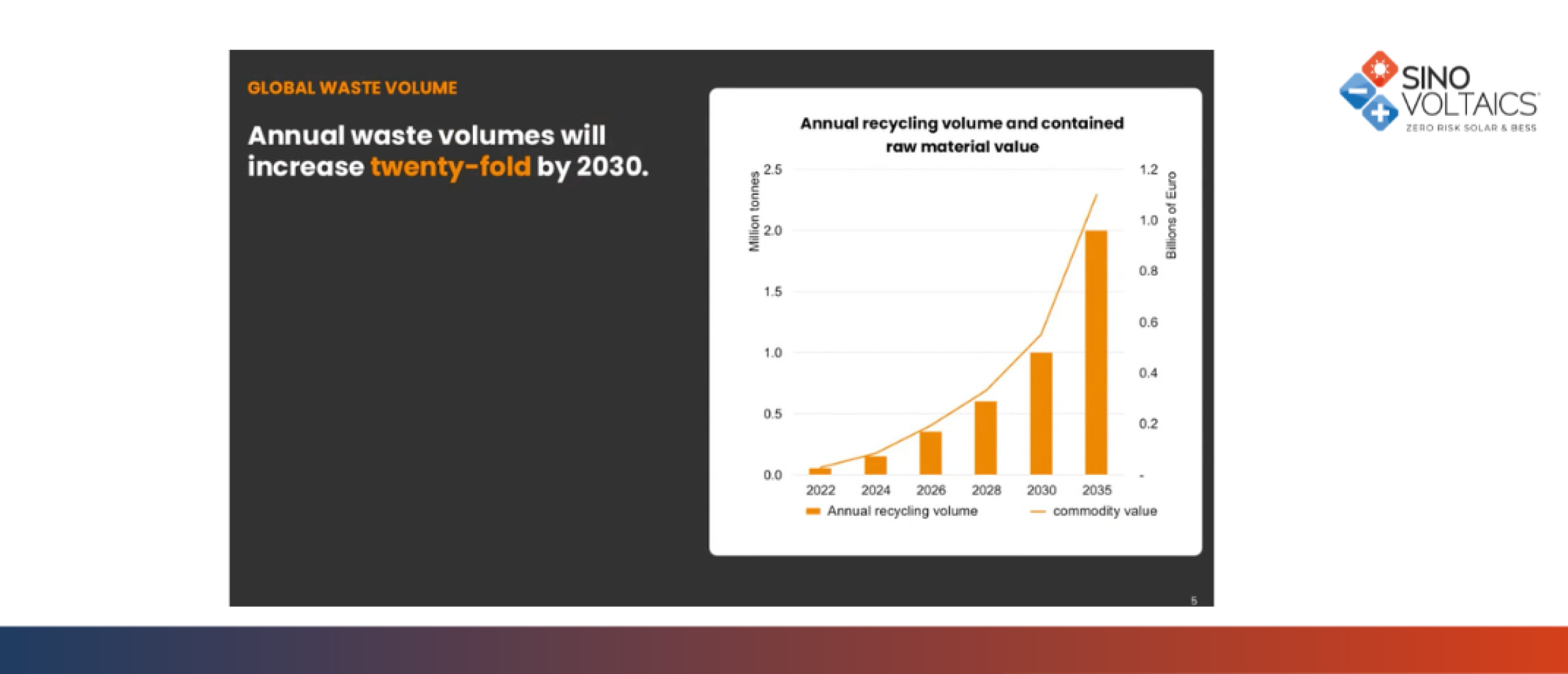
Within the coming years, PV waste volumes will increase dramatically.
Millions of tons of modules contain billions of euros worth of recoverable raw materials.
As recyclers, we essentially “live in the past” because the modules we receive today were manufactured 10–15 years ago.
Right now, we are receiving modules originally installed around 2006–2008.
The waste volumes will rise sharply over the coming decade.
This means we urgently need sufficient recycling capacity to recover critical materials from these modules.
00:19:26
Dr. Janett Schmelzer:
One major issue with conventional recycling is that while aluminum and glass are recovered relatively easily, silicon and silver are mostly lost.
The recovery rate for silver and silicon is currently close to zero in many conventional recycling processes.
This is a serious problem because approximately 10% of annual global silver production is used by the solar industry.
That represents a huge amount of valuable material disappearing from the supply chain.
This led us to ask several questions:
• How can silver be recovered efficiently?
• How can silicon purity be improved?
• What can be done with recovered plastics?
• How can recycling processes become safer?
• How should we prepare for future module technologies?
The key challenge with silver recovery is that silver represents less than 1% of module weight.
If modules are shredded together, recovering that tiny fraction becomes nearly impossible.
That is why Solar Materials developed a “reverse production” approach.
Instead of shredding modules immediately, we separate every individual layer to recover clean material streams.
00:21:22
Dr. Janett Schmelzer:
Our recycling process begins by:
1. Removing the frame
2. Separating the glass
3. Delaminating the encapsulated wafer
The critical challenge is accessing the wafer surface where the silver fingers and busbars are located.
To do this, we must remove the encapsulant layers.
There are several approaches:
• Thermal
• Chemical
• Mechanical
Each has advantages and disadvantages.
At Solar Materials, we developed a thermomechanical process that avoids chemical usage entirely.
This provides several benefits:
• Lower investment costs
• High scalability
• Higher throughput
• Recovery of all valuable materials
• Recovery of plastics
• Improved profitability
Silver is especially important economically.
Although silver represents only around 0.1% of module mass, it accounts for approximately 50% of material value.
Today, we recover roughly 8–9 grams of silver from modules that originally contain around 10 grams.
00:25:47
Dr. Janett Schmelzer:
Silicon recovery remains a much bigger challenge.
Currently, we achieve silicon purity levels around 95–96%.
However, impurities remain, including:
• Silver
• Aluminum
• Tin
• Lead
At the moment, this recovered silicon cannot yet be reused as solar-grade silicon.
It is primarily used in non-ferrous alloys.
One major issue is that there is currently very little demand for recycled silicon in Germany.
Purifying silicon to solar-grade levels would require additional wet chemical processes.
This remains a major challenge for both recyclers and the chemical industry.
00:29:28
Dr. Janett Schmelzer:
Another major issue is recovered plastics.
We can recover plastics in relatively high quality because we separate all module layers.
However, there is currently no strong market for these plastic fractions.
Most recovered plastics are still sent for incineration to generate energy, which is not profitable.
One reason is that old modules contain highly variable material compositions.
Twenty years ago, nobody designed modules with recycling in mind.
Different additives, stabilizers, and environmental aging conditions all affect plastic quality.
Backsheet fluorine content also creates challenges.
If anyone in the audience has ideas for high-value applications for recovered plastics, please feel free to reach out.
00:32:20
Dr. Janett Schmelzer:
Safety is another critical issue.
We have learned a great deal over the past years about handling hazardous materials safely.
Important areas include:
• Compliance with standards
• Automated dismantling
• Robotics
• Dust and fume extraction
• Worker safety monitoring
Hazardous materials include:
• Lead
• Tin
• Fine silicon dust particles
When recycling thousands of tons of modules annually, these issues become extremely important.
00:34:33
Dr. Janett Schmelzer:
Future module technologies will create additional recycling challenges.
New technologies such as:
• Perovskites
• Thin-film modules
contain materials including:
• Cadmium
• Tellurium
• Indium
• Gallium
These require entirely different recycling approaches and create additional environmental and safety concerns.
We also need stronger producer responsibility regulations and better material transparency from manufacturers.
For example, recyclers should ideally receive full bills of materials for incoming modules.
00:38:00
Dr. Janett Schmelzer:
Here you can see one of our fully automated recycling lines.
By the end of this year, we will expand capacity to 21,000 tons annually through three fully automated production lines.
Recovered materials include:
• Aluminum frames
• Copper cables
• High-quality flat glass
• Plastics
• Silicon
• Silver
The silver is ultimately refined into elemental silver.
Thank you very much for listening.
00:39:24
Rasa Jakaitis:
Thank you Janett.
We have received more than 40 questions already, which shows how important this topic is.
Before moving into the Q&A session, I would like to briefly explain what causes PV module degradation and how these failures can be prevented before commissioning.
00:40:04
Rasa Jakaitis:
As mentioned earlier, the recent University of New South Wales study analyzed nearly 11,000 PV modules globally and found that:
• One in five modules degrades at least 1.5 times faster than expected
• Roughly one in twelve degrades twice as fast
For some systems, useful lifetime shrinks to only 11 years, with 45% performance loss by year 25.
The researchers identified three major causes:
1. Cascading compound failures
2. Infant mortality caused by manufacturing defects
3. Minor flaws that worsen over time
Importantly, climate itself is not the main driver.
These failures occur globally.
00:41:17
Rasa Jakaitis:
One of the most widespread hidden defects is microcracking.
According to research from the US National Renewable Energy Laboratory, approximately 84% of PV modules contain at least one cell crack.
Most are invisible to the naked eye.
These cracks often originate during manufacturing and continue propagating during transportation, installation, and field operation.
They eventually create:
• Hotspots
• Blocked cell areas
• Moisture ingress pathways
Another major issue is junction box failure.
Poor soldering connections combined with moisture and heat can disconnect bypass diodes and create dangerous hotspots.
We observed one case in Taiwan where:
• 700 out of 3,500 rooftop modules
developed junction box hotspots due to a single soldering defect.
The manufacturer replaced the modules but did not cover labor costs for diagnosis and replacement.
00:43:11
Rasa Jakaitis:
Encapsulation quality is also critical.
Poor encapsulation allows EVA degradation, producing acetic acid that corrodes:
• Cell grid lines
• Busbars
and accelerates delamination.
The International Energy Agency PVPS Task 13 report published last year clearly stated that existing IEC 61215 certification tests are not designed to evaluate long-term polymer stability.
This is a known weakness within current certification systems.
00:43:52
Rasa Jakaitis:
To reduce long-term degradation risk, quality assurance must begin before modules leave the factory.
A robust QA process requires four layers:
1. Factory audits
2. During-production monitoring
3. Pre-shipment inspection
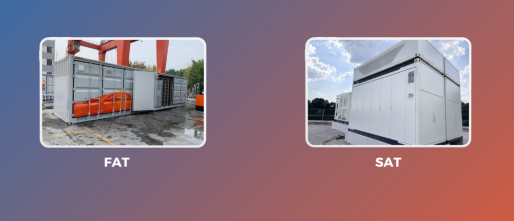
4. Factory Acceptance Testing (FAT)
Electroluminescence imaging is particularly important because it is the only reliable method for detecting hidden microcracks.
At Sinovoltaics, we use our proprietary AI-based analysis tool Selma to inspect 100% of modules within customer orders.
The final protection layer is Site Acceptance Testing after delivery to verify that modules were not damaged during transportation.
The modules you purchase today will determine whether they can later be:
• Repaired
• Reused
• Recycled
Quality assurance must therefore move upstream — not downstream.
00:45:42 — Q&A Session
Rasa Jakaitis:
We now move to the Q&A session.
Thank you again to both guest speakers from Solar Materials.
We received more than 40 questions, so unfortunately we will not be able to answer all of them live.
Any unanswered questions will be addressed afterward via email.
00:46:26
Question:
You mentioned that every second disposed module still works. Is this statistic based on Germany only?
Franziska Ruff:
Yes, the statistic is based on Germany.
00:47:04
Question:
What is your operational experience regarding module reuse viability?
Franziska Ruff:
Solar modules generally degrade very slowly — roughly 0.5% per year.
After 10 years, many modules have lost only around 5% of their output.
Our testing often shows degradation rates lower than manufacturers’ warranty assumptions.
We believe that between 80% and 99% of tested modules can still be reused after inspection.
Most of these modules are around 10 years old.
00:49:32
Question:
Why is silicon considered a critical raw material when it is abundant and relatively cheap
Dr. Janett Schmelzer:
This is a very good question.
Currently, recycled silicon has relatively low market demand in Germany.
The main challenge is that refining silicon to very high purity levels is extremely energy-intensive and costly.
One possible future solution could involve direct remanufacturing of wafers from recovered modules instead of fully reprocessing the silicon.
However, this remains technically very difficult today.
00:52:03
Question:
How do you determine whether a module should be reused or recycled?
Dr. Janett Schmelzer:
The first step is visual inspection.
Modules with broken glass, damaged frames, or severe defects are excluded immediately.
Modules then undergo electrical and performance testing.
If they meet defined performance thresholds, they qualify for second-life applications.
00:53:53
Question:
What warranties are offered for second-life modules?
Franziska Ruff:
Currently, the standard warranty is two years.
At the same time, we are working on developing a dedicated certification framework for second-life modules together with several research institutes.
This project is still in its early stages and may take approximately two years to complete.
00:55:10
Question:
Do you receive modules mainly from utility-scale projects or also from residential systems?
Dr. Janett Schmelzer:
We receive both.
Utility-scale projects are easier because they contain large quantities of identical modules.
Residential collection points are more challenging because modules often arrive in poor condition and with high variability.
00:56:23
Question:
Are recovery rates maintained for other materials besides silver and silicon?
Dr. Janett Schmelzer:
Yes.
Aluminum frames are recovered very effectively.
We also recover essentially all glass from the modules.
The most valuable recovered materials remain:
• Glass
• Aluminum
• Silver
00:58:30
Question:
How will frameless modules affect recycling economics?
Dr. Janett Schmelzer:
Currently, aluminum frames represent an important revenue source.
Future frameless designs will reduce that revenue stream.
However, recycling technologies will also continue improving.
00:59:12
Audience Comment:
Recovered plastics may potentially be reused in lead-acid battery containers, which already contain recycled plastics.
Rasa Jakaitis:
Thank you very much for the suggestion.
00:59:48 — Closing Remarks
Rasa Jakaitis:
Thank you again to Dr. Janett Schmelzer and Franziska Ruff from Solar Materials for today’s highly practical and evidence-based insights.
What we learned today is that:
• PV degradation is often occurring faster than expected
• Root causes vary widely
• Module reuse is possible in many cases
• Recycling technologies are rapidly evolving
Most importantly, strong quality assurance before procurement can significantly extend module lifetime.
The webinar recording will be shared with all attendees.
Thank you everyone for joining us today, and we look forward to welcoming you again to future Sinovoltaics webinars.
Follow us to receive the latest news!
Follow us to receive the latest news!
<:optin-form-placeholder>

From Cracks to Circularity: PV Module Degradation, Reuse, and Recycling
Place comment