
After battery energy storage systems (BESS) moved from pilot projects to critical grid infrastructure, the industry's focus has shifted. Building and commissioning projects is no longer enough. The real challenge lies in ensuring that assets continue to perform safely, reliably, and profitably over the next 10, 15, or even 20 years.
In this Sinovoltaics webinar featuring experts from NR Flex, the discussion explored how asset management has become a critical factor in maximizing the long-term value of battery storage projects. As BESS assets face increasing exposure to volatile energy markets, complex warranty structures, evolving technologies, and stringent performance requirements, owners and operators must adopt a more proactive approach to managing operational risk.
The webinar covered the full lifecycle of battery storage asset management, from data acquisition and operational monitoring to predictive maintenance, contract management, warranty enforcement, and performance optimization. The speakers also highlighted the importance of building a strong foundation through quality assurance during manufacturing, factory acceptance testing (FAT), and site acceptance testing (SAT), emphasizing that long-term performance begins long before a system enters commercial operation.
As battery storage deployments continue to accelerate worldwide, developers, investors, EPCs, asset owners, and operators face growing pressure to safeguard performance and protect revenues throughout the asset lifecycle. Understanding the processes, tools, and quality measures that support long-term operational success has never been more important.
Webinar Transcription
Rasa Jakaitis: [00:00:00] Hello, everyone, and thank you for joining us today. Welcome to this Sinovoltaics's webinar, hosted in collaboration with NR Flex on best asset management and optimization for long-term operational performance. My name is Rasa Jakaitis, and I'll be moderating today's session.
Battery storage is moving fast from a niche technology to a core part of the energy mix. But the conversation is shifting. It's no longer just about getting projects built, it's about what happens after commercial operation date. Have assets performed over ten, 15 or 20 years, how they're managed, how warranties hold up, and how owners protect the returns.
That's what we'll be digging [00:01:00] into today. Before I introduce our guest speakers, a few quick notes. This session will run for about an hour. Our speakers will share their perspectives, and we'll have, time for Q&A at the end of the, webinar. Please drop your questions in the chat box, at, on the right-hand side of your screen, and we'll get to as many questions as we can, at the end of this webinar.
Please know that this webinar is being recorded and will be uploaded on Sinovoltaics's YouTube channel. If you don't want to miss the newest content updates on YouTube, don't forget to subscribe to our channel. So now let me introduce the stars of today's webinar. I'm really glad to have Maxime Robin.
Maxime, I invite you to join me on the stage. from NR Flex team, a co-founder and associate director. Good to see you.
Maxime Robin: Hello, everybody.
Rasa Jakaitis: Maxime leads engineering [00:02:00] studies for large infrastructure projects across all technical disciplines, working closely with owners, contractors, and operators. At NR Flex, he has delivered several large-scale BESS projects in France, ranging from ninety to two hundred megawatts, covering development, procurement and execution.
He brings end-to-end BESS expertise across procurement, integration, contractual management, and feasibility and strategic studies. next guest speaker from NR Flex company is Edouard Vuylsteke. good to have you, Eduard. And good to see you.
Edouard Vuylsteke: Yes. Hi, everyone. Thanks for
Rasa Jakaitis: having me. Eduard has seven years of experience as technical asset manager, specialized in battery energy storage systems.
He has overseen- ... operational BESS assets from one megawatt to 100 megawatts across Europe, the US, and Chile, working with NW Group and Grenergy. His exper- his expertise spans performance spec- [00:03:00] specifications, testing and commissioning, O&M, and technical asset management. And finally, a third speaker in today's webinar is my dear colleague, Ville Julin.
Ville, good to see you.
Ville Julin: Hi, everybody.
Rasa Jakaitis: Ville is an energy storage expert with a master's degree in electrical engineering. At Sinovoltaics, he advises clients on PV and BESS quality control and supply and supplier contract negotiations. Ville also brings hands-on experience across the Nordics and Latin America in BESS early stage development, hybrid projects, and revenue analysis, with a technical foundation in virtual power plant systems and power electronics R&D.
So we have a really strong, list of speakers today, and before I hand over the virtual microphone to NR Flex team, let me quickly introduce Sinovoltaics to those who, don't know us. So Sinovoltaics is quality assurance and [00:04:00] engineering services firm working with developers, IPPs and investors across the solar and storage industry.
For over 17 years, we've helped clients de-risk their projects through factory audits, supply due diligence, production monitoring, and technical advisory with teams based in Asia, Europe, and Americas. and the last point I want to mention is, Sinovoltaics new platform launch. So, last week we launched PV Lab Test Advisor, a free web-based tool that helps developers, IPPs, and DPCs build project-specific reliability testing scopes for their solar projects.
The thinking behind it, it is simple. The industry has gotten used to copy-pasting the same testing scope from one project to the next, but that doesn't really reflect how different the actual risks are between, say, a project in Atacama Desert and one, in northern Germany. So climate technology choice and site conditions all change what you should be testing [00:05:00] for.
The tool takes a few project-specific inputs and generates a tailored testing scope that you can download as a PDF report. It sits within our zero-risk solar framework and is free to use. I'll, I'll pop a, a link, to this platform in the chat box so you can test it out. and right now, I want to hand over the virtual microphone to NR Flex team.
Maxim, over to you.
Maxime Robin: Thank you, Rosa. just a few words, about NR Flex before we get into the core of the presentation. So, we are a consulting and engineering company dedicated to energy storage projects. we work for developers, project owners, investors throughout all the life cycle of the project, from early stage development down to, commissioning and operation phases, including, permitting, [00:06:00] support, due diligences, procurement, and owner engineering.
we've been operating, since 2024. and, we have been involved so far in, about five gigawatt hour of BSS projects in eight different countries. and, so far we, we, we totalize one point seven gigawatt hour of project that are, right now, in operation. in the last two years, we have witnessed the fact that, doing asset management for BSS is not an easy task.
we are facing challenges that are quite new in the industry, compared to classical renewables. first of all, from technical point of view, we are dealing with very new products that are constantly evolving, the densities, C-rates, sodium ion, [00:07:00] cooling, inverter technologies, fire safety, regulation, et cetera.
Everything is changing very fast in this industry, as you all know. And obviously, the data available to track, understand, and predict the behavior of the system is, quite limited at the moment. and this is something, this is a fact that we have to deal with as asset manager. it's also to be noted that, BSS is not a single product, but it's a combination and integration of many subsystems that have to work together to, interface together and that have to deliver a global and, and single performance as a whole.
it's also important to note that compared to, to traditional renewables, BSS is particularly sensitive [00:08:00] to control and data monitoring, and we'll see it a bit later in the presentation. Second point, second particularity, I would say, of the BSS is its contractual complexity. we have witnessed also how difficult is it to track and measure the gaps, between what happens in the real life- And the contract KPIs, which is essential to enforce contract obligation, right?
So having good contracts and warranties will not secure 100% the potential loss of revenues. On top of that, asset management scope is not standard. It's usually ranging between pure financial monitoring, to O&M direct management, sometimes a bit of both, part of both. and this configuration phase change during project lifetime.
for example, some asset manager [00:09:00] wants to take over, some activity, maintenance, for example, after a few years of operation. and even though when the scope is clear between all the, the parties, it requires to have very smooth workflow and interface, definition between all the parties involved, including al- al- also the aggregator or the, I would say, the market, representative.
the third aspect, that makes BSS very specific is the revenues. as most of you know, I guess, majority of the revenues today are based on freq- frequency regulation, markets, at least in France and most of European countries. but with the saturation of those markets in the next years, the revenue generation will shift to be mostly based on spot market, day-ahead, intra-days.
a- and we know that those markets are very [00:10:00] volatile. So to capture the value of those markets, batteries will have to exchange large volume of energy at several time slots during the day, and thus require the battery to be fully operational with maximum capacity during those time slots. This means that downtime, degradation generates direct and increasing risk of losses and potential penalties, for, for the project.
So this being said, how to address those challenges and ensure, even optimize, long-term operational performance? we believe that, asset managers have to put in place strong process from the lower project level, means at the site raw data, up to, KPIs visualization and high-level decision. [00:11:00] And that this process, we believe that this process should be, could be formalized into five modules that we are going to develop for you today.
I let Edouard, take over from here.
Edouard Vuylsteke: Yes. Thank you, Maxim. so yes, in order to, to better address, these challenges explained by, just explained by, by Maxim, and to optimize, long-term operational performance, a balanced mix of human expertise and appropriate tools, tailored tools, is essential.
So the first layer of this asset management, environment, I would say, represented by the first module of the, the asset management rack in the picture on the left, is the onsite data setup and, and acquisition. So what are the main, messages here? define [00:12:00] early, align clearly. So the objective is to define at an early as possible, ideally even before the contract signature, define with the client and other third parties, all the data requirements.
secondly, more data, more control. So, data is available for every project, but, its accessibility varies a lot depending on the provider. some provider are accustomed to, to give full access to all raw operational data, from the battery system to the point of interconnection. while others, follow more, let's say a, a black box approach, allowing only limited and tightly controlled access, to the data.
third point, capture, data at, the right source. so data must be collected at the [00:13:00] appropriate level. For example, the energy measured at the point of interconnection will, defer from that at the rack level, obviously. and then enable compliance and, performance tracking. So, all these setup are mainly driven by the contractual specifications, the client's specific requirements, and the operational activities.
this basically define the precision asset manager will, will be able to have in their, operational tools. and the ability, as well as the ability to make, detailed and, and, and, and in-depth, technical analysis.
so the, the, the second module of our rack, is the data transfer and organization. It is when the data, is received by [00:14:00] the data infrastructure. and then here the, the main messages, are so secure data, connectivity so all data infrastructure, including the on-site part, must be set up in a, a really secured environment.
firstly, at a cybersecurity level, implementing, passwords, firewalls, avoiding remote access, with application as, AnyDesk or TeamViewer, for example. and prioritizing secure channel, even when possible with IP traceability. and secondly, at the communication level, basically to ensure the continuity of communication between the site and the data infrastructure.
Secondly, right data, right resolution. Here, the point is to define, [00:15:00] the precision needed for the different users. for example, for troubleshooting, and alerting, higher precision, normally at one second or, or even below, is needed compared to-- in, in comparison with, the supervision and the reporting activities, where more aggregated data, are commonly, used.
w- we used to, to see, one minute or five minutes, granularity, e- e- even, even, even more. thirdly, structure data for performance and compliance. So ensure to, to align with OEM warranties, for example, in the battery data storage strategy, long-term storage in opposition with, monthly raw data storage.
And finally, long-term robustness and flexibility. [00:16:00] so all these developments must be, carried out with the understanding that these tools need to remain adaptable while ensuring long-term reliability. now just, as an example, to give you an example of what fun- what can... looks like, data infrastructure for BEST, asset management, here is more or less our infrastructure, NR Flex infrastructure.
it's probably neither the best or the worst option, but, it is a type of infrastructure that is simple to implement, allows us to meet the da- the data requirements for a BEST project, which are quite specific, and, is highly adaptable. so it's a combination of tools with several function.
Basically, you can see, the data reception, the long-term storage, the data configuration, the data visualization parts, the, the code [00:17:00] storage, and, and finally, the, the all, general orchestration.
So the third module of our ac-- so the, the two first modules are, really key in order to, to preparing and optimizing, the activities of the remaining three. So the third module, the day-to-day, operation management. so here the main objectives in this part are, firstly to, to minimize the number of on-site intervention in order to decrease the O&M, extra costs by filtering and assessing whether an urgent on-site intervention is required or not.
secondly, to reduce response time to maximize the site availability. And thirdly, efficiently guide the, the field, intervention technician to maximize also the performance of the project. So minimize the number of on-site intervention, reduce response [00:18:00] time, and guide the... efficiently guide the, the field intervention technician to, decrease the O&M extra cost, maximize the site availability, and maximize the performance of the project.
So to meet these objectives, these challenges, the asset manager expertise is supported by, have to be supported by, data-driven insight, precise analytic tools, and automatic alerting system. Ideally, supported by AI to facilitate, for example, common diagnosis.
The fourth module of, of our rack, of our asset management rack is, the default anticipation. So indeed, anticipate failures, is the best way to prevent long-term unavailabilities, allowing preventive material replacement and spare part supply anticipation mainly. So [00:19:00] how can it be done? mainly by deploying trained algorithm based on, multi-sources data, diverse projects, technologies, products, markets, and so on, to identify, patterns and abnormal trends.
So as per example, two of the most, let's say, easily predictable faults because the most common we are seeing in our, day-to-day asset management currently, are, firstly the, the battery internal temperature deviation or battery room temperature deviation. basically the detection of sudden or gradual and, and isolated or recurring deviation by comparing, expected behavior under defined condition with, the abnormal behavior.
second example is, the cells voltage deviation. So basically, voltage is relatively easy to monitor, provided that the data [00:20:00] is, is accessible, obviously depending on the, on the provider. so voltage deviation compared to, other cells- Or even between, can be, can be done between racks. so it can generally be detected quite easily, both for cells and racks.
so this is particularly critical given that battery module are usually not included in the, in the spare part inventory due to, the really specific storage conditions. so making it possible to anticipate replacement within a planned and, and controlled timeframe. I told you about these two particular, failures, defaults, but I can add also, to prevent, cell imbalance, internal module resistivity imbalance, specific inverters temperature deviation and, and, and other critical defects that may have a significant impact, on [00:21:00] the overall project, on the overall project performance.
Maxime Robin: Okay. thank you, Edouard. to continue with the last, module, of this approach. the high-level operation management, it's basically, the visible part of the asset management. It is what most of the people think that it's the scope of the asset management. and this is the, the, the, the, the part that is the most, yeah, that is the most, exposed.
what is important to understand here is that all tools, process, and expertise described in the modules, previously only aim at enabling the asset manager to perform those function. So the high-level operation [00:22:00] management is basically the four, functions that are, described on the, on the right side.
the, the, the first one is the contracts management, so all the data infrastructure and the organization that we saw, should support the good and accurate contract management, should help to activate the LDs, to manage the claims when necessaries, to en- en- ensure contractual obligation are met. the second aspect is the warranties.
The data is, is helping to monitor and enforce warranty conditions in order to protect the asset value and minimize the risk. Third point is, of course, a very important part of the, of the, of the asset manager is to, to be able to, to report on the assets, to stakeholders and decision-makers. So again here, the, the [00:23:00] data infrastructure and organization that, that we have set up previously will help to provide A transparent data-driven reporting.
S- s- fourth, aspect is the, the financial awareness. it is basically, it consists here of understanding the financial impacts of all preventive and corrective actions on the battery, and control them better. for example, plan, to plan unavailabilities as much as possible to limit the impacts on the revenues, avoiding to have the battery off grid during peak, during market peak hours or specific period in the year.
It is the, the, the purpose here is to make connection between technical parameters and financial KPIs. now speaking of KPIs, here just a, a quick example of how we, how we, [00:24:00] how we visualize, those data. so Edouard developed, I would say the left part of the diagram above here, which is the data, infrastructure and data flow.
here we are talking rather about the right side of the diagram, which is visualization and reporting. So there are plenty of tools that can be developed and used by asset managers. here two example. On the, on the, on the left side is a dashboard for, O&M support and precise fault diagnosis that we've been using.
And, on the right side is a, a dashboard rather for high-level supervision, decision-making, et cetera. So, those dashboard are, are, are powered, with, algorithms, developed by, by NR Flex. it's, to, to ... It, it allows to, do some automatization of alerting, anticipate [00:25:00] failures, optimize maintenance planning, et cetera.
Of course, there are many, tools and dashboards that can be developed, depending on the use, depending on how the asset managers want, to work, and, and how, how necessary they need to complement their skills by, the tools. As Edouard has said in introduction, asset management is always a combination of human expertise and, customized tools.
last slide, las- last slide, sorry, of our presentation, it's about the future. we, we, we explained the challenges that today, BSS asset manager fa- are facing, but it's also very important to understand and anticipate the challenges of tomorrow. the first one is, the market. we, we, we know that BSS are facing higher and higher [00:26:00] exposure to spot market volatility, so it's important for the asset manager to understand- to understand that and adjust valuation strategy accordingly and be able all the time to challenge aggregators, about the, the, the, how, how, how, the, the way, the asset is being, valued on the market.
The second point is the contract. we saw how important it is to have secured long-term commitment with the EPC, with the suppliers, with the O&M, with the aggregator. but it's also very important to have, to keep flexibility, for configuration change. BSS project are here for, 15 years, 20 years, sometimes more.
we know that the, the, the, there will be some changes, whether technically, whether organizationally. we, for example, a asset manager want sometimes take, to take over or, or actually [00:27:00] to, to let some part of the scope to, to a third party. so, so contracts have to be set up for that. The third point is the technology.
we, we, we acknowledge the fact that there are continuous technological advancements improving battery performance, safety and lifespan. we, we talk a lot about innovation in battery chemistry, energy density, et cetera. But for asset management, we believe that digitalization is key, will be key, to improve monitoring, control, and, optimization capabilities.
So asset managers will have to integrate that for sure. and, the last point is, the asset lifetime extension. it's essential to maintain and enhance system performance over the time. Can be done with different strategies, repowering, augmentation, but, [00:28:00] also optimizations of the control command.
this is for the purpose of extending, of course, the, the, the lifetime, but also sometimes it's a matter of adapting to evolving requirements, and to optimize, during the course of the project, the overall return on investment. So, that's it for us. thank you very much. I will, I will let, Razah and, Ville take over from here.
Rasa Jakaitis: Thank you, Maxime, and thank you Eduard, for, for an interesting one. while you kept present... while you were presenting, we, we kept receiving, questions. I think it, it also si- signalizes the, the importance of the topic. Ville, I would like to invite you on the stage, to, to continue the presentation on, on today's topic, and we'll be handling the Q&A session after Ville's presentation.
Over to you, Ville.[00:29:00]
Ville Julin: Yeah. Thank you, Rosa. And thank you, Maxim and Edouard, for the very good presentation. So I'll be also covering long-term BESS performance, but from a slightly different perspective on how focusing on quality from the very beginning will play a big role on, on the future performance of the, of the battery asset.
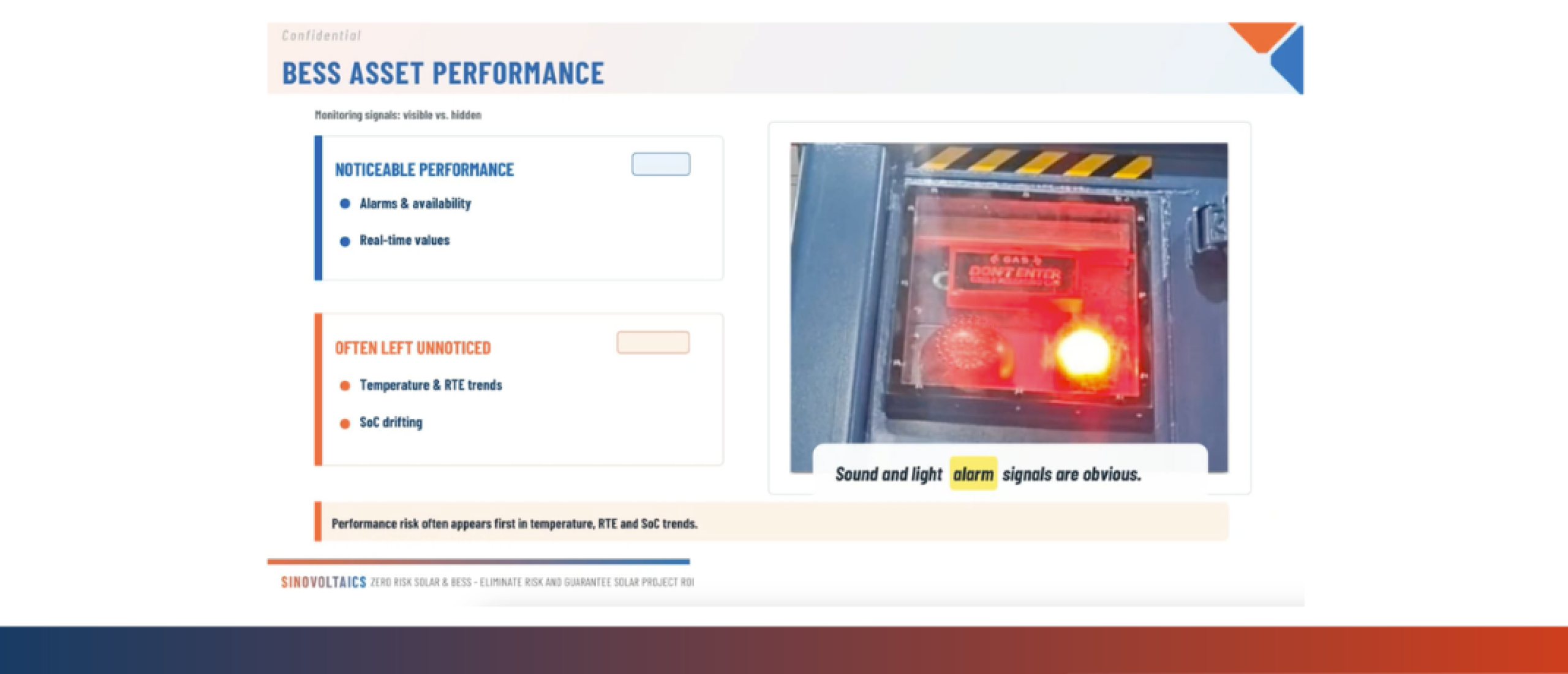
So when I think of, battery or BESS performance, I try to divide it into two groups. So you can think of, noticeable performance of the, of the system, like getting alarms, knowing the availability of the system or getting real-time, values of the system like, energy, [00:30:00] temperatures, voltages, currents, and so on.
But then there's also a lot of things that often go unknown to- unnoticed, as, NR Flex was also explaining, that are difficult to, to read or interpret. So these are often like temperature trends or long-term trends, round trip efficiency, how the voltages are behaving, state of charge of the system, drifting, meaning that the real state of charge is something else than the BMS is saying.
And these kind of, small unnoticed things, they gradually become, issues, and later on they b- can become these kind of noticeable performance topics like, the system is no longer available, or you cannot get the right amount of energy out, or you just have [00:31:00] a short circuit and get an alarm. So these kind of things, both of these performance topics, start from the same place, from the design of the system and also from the factory floor.
So in my opinion, you should optimize the system only after you have, functioning system after a strong, strong basis. So how to achieve that kind of, strong basis is, threefold. So of course, you start with the contracts, and when you actually start with the manufacturing of the, of the battery inverter, transformer, so on, that's where the- And these kind of, faults or underperformance issues can, can start with.
[00:32:00] So what we do, for example, with batteries, is that we, we are starting to do production supervision monitoring, meaning that when the manufacturer is, well, manufacturing the batteries, installing the modules into racks, containers, we are there to see every step of that manufacturing process to see that, no shortcuts are taken, everything is smoothly installed, and thus preventing any mistakes before the product reaches the end of line.
And there's often a lot of very sim- like, small things that can seem trivial and not relevant at the, at the factory stage, like some tolerances, being slightly off [00:33:00] or, some machines are not being calibrated that use, are used to manufacture the equipment. And that's most likely true that in the very beginning it doesn't really matter, but then when the asset is operating five, ten, fifteen years, then those small tolerances start, stacking up and then creating, bigger differences between the components and, and assets.
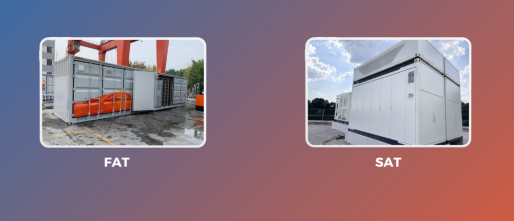
So that's the first step, that we do. Secondly, the normal way is also to do a factory acceptance testing. So for example, batteries, you do visual inspections, safety, electrical, mechanical testing, and also a performance test, meaning a full charge-discharge cycle to see if the, if the battery container is, [00:34:00] fulfilling its, contractual performance, like, energy capacity, round-trip efficiency, power, and, and so on.
Since that test is often only for the-- it's only on the container level, but you still have subcomponents like modules and racks inside of the container, we u- we use this, essential software to analyze also each and every one of those subcomponents during the FAT. And the idea there is that with FAT and this analysis in general, is that when we find these issues during the, at, at the factory floor, it's going to be much quicker to replace and cheaper and easier to replace and fix these issues than At the site when you need to do troubleshooting and use spare parts or send an en-engineer from China to the [00:35:00] site.
so that's the second step. Even though we would do a perfect, FAT for all the components at the factories, you still need to do site acceptance testing. So to verify that also the components, subsystems, and the whole system is operating at the, at the site conditions, not just at the perfect factory conditions.
So focusing on that, of course, is, is vital as well to prove that the system is working as it should. And, one option there is also to do this potential for the batteries during site acceptance testing. Since in many cases we try to push that we can do one like, FAT and this analysis for all of the containers at the factory, which would be ideal.[00:36:00]
But if you cannot do all of them at the factory, then we can do like a hybrid analysis for the rest of the containers at the, at the site. And using these three pillars of, quality checks and inspections, you will get your, system faster in operation since you eliminate most of the issues, be it like a small, small baby issue or like, real performance issue that was found during the inspections and also especially with this, essential when you can, you can verify that also not just the container level will be working, but also the racks and the modules are working as it should be, [00:37:00] then you can really say that you have the contracted performance of the, of the system.
And lastly, a couple examples what we find on the field, on the factories. So one very common thing we find is the fire safety system not working properly. It can be, it can be sensors that are not working or they are not, installed properly, or then they can work on, on a software level, but then using real signals like heat, smoke, they, they are not working.
Secondly, high temperature differences. NR Flex was also highlighting this. so this is something which is, sometimes difficult to implement in your contract, having, [00:38:00] a certain threshold for how big the temperature differences can be, what are the absolute temperature thresholds when performing these kind of tests.
And sometimes, of course, we see that the temperatures are, are above those thresholds, then it means, of course, a failed, failed test. But sometimes they- the temperatures are close to that threshold. It's still going to be a pass, but it's important to keep an eye on those, units or containers, modules that are closer to this limit.
So then, then you can transform-- transfer that to your O&M team to know to focus on, on those especially. And yeah, cell voltage dif- imbalances we also see quite often with our software, meaning [00:39:00] that, when you charge or discharge the, the batteries, the-- some of the cells will reach their threshold voltage faster than the others.
and that will result in, like, aging differences between the cells and, and the modules. And, and also you will get less available energy out of the system since some of them will start or stop, earlier. yeah, that's my part. And let's go to the Q&A session.
Rasa Jakaitis: Thank you, Ville. yeah, truly enlightening presentation.
And, you know, the number that you shared, like the twenty-five percent of fire safety system not working, that also reminds me of the case, I saw, in the news last week from this, UK-based, one of the oldest battery systems that caught fire because of [00:40:00] short circuit. And imagine your, fire suppression and alarm systems not working in such case.
So that's, that's a disturbing number, I think. yeah. Thank you, Ville. I would like to invite Maxime and Eduard back on the stage for the Q&A session. And thank you all the delegates for a really good number of questions. let's, let's try to answer at least some of them, but I think we should be able to answer most of them as we have a nice, 20 minutes, for the Q&A.
so Ville just to, to pick up on, on your presentation, you showed that the fire sa- safety system was not working in 25% of cases checked. That's a striking number. I agree with that. What's behind it? And are these issues being caught by the O&M's, own internal QC or only by independent inspections like Sinovoltaics?
Ville Julin: Yeah. It's, it's a good question. So I think [00:41:00] the... Let's say the reasons behind it are mo- most of the, these kind of issues are, like, human related that just some, component has been wrongly installed, cables have been turned around, so to say, or there's some, just some bad components over there. and some of this, of course, will be found by the company or the O&M itself, but it's a very, let's say, different...
It, it's a range of, how would I say? companies or, or manufacturers, factories, they have all a very different set of testing that they do for the, for the containers. So some of them will have plenty of tests and ways of, seeing this, and [00:42:00] some of the companies will also only do, like, very limited testing.
So then, for example, using just a signal on a laptop to simulate, a problem instead of a real, like, smoke. So that's why these kind of things often slip through their hands, and then we spot them during our inspections.
Rasa Jakaitis: Yeah. And, and also, if I may add, if it's not included, you know, some tests or the scope of the tests are not included in your contract, well, the manufacturer says, is not obliged to do these tests.
So it's also a contract optimization, a very important process. Thank you, Ville. now let's, let's turn to Arnflex team. a general question about the software itself. Is your software, locally hosted or cloud-based? Will it require local hardware integration?
Whoever wants to pick up this one
Edouard Vuylsteke: Yes. I will take this one. [00:43:00] the software, is generally, part of it, cloud-based. I mean, the, the long-term storage part, we'll say. and then we have also, yes, a part of, the software, locally hosted. but this is the, the minor part. And, local hardwa- hardware integration.
So in order to, to, collect the data, we are, are, currently using several, systems, both with implementing on-site hardware system, really simple and, and really easy to implement, and, by connecting directly, with the on-site data logger in order to collect in our infrastructure directly from, [00:44:00] the on-site equipment.
Rasa Jakaitis: All right. Thank you. Thank you. a question from Irwin, also to NR FLEX team. Can the tool calculate equipment availability?
Edouard Vuylsteke: I will say yes. So, we, we are able to, to calculate, obviously the equipment availability, and it will depend on, what avail- availability, will be need. basically, normally, we are calculating several, availabilities. It could be, the, the grid availability, the, the overall project availability, even, the rack level availability could be, could be useful in order to calculate a really precise availability.
So, so yes, we are, used to, set up our equipment in order to calculate all the relevant [00:45:00] availability of the project.
Maxime Robin: Yeah. I, I will just add that, if the question is about the contractual availability, as we have explained during the presentation, we, we are, we will set up all the data, process and organization also in order to have the good KPIs for the contract, management.
So, definitely one of the purpose of, our asset management service is to be able to properly manage the contract, and we know how, important is the availability, parameter in the contract management. So, so, so definitely... And, and, and the possibility to have an independent measurement or calculation of this availability is actually key, in the BSS asset management, because otherwise- We are, we are depending on, on, I would say third-party, parameters, sometimes with, interpretation, a- and way [00:46:00] to, to, to measure and calculate, which is exactly what we want to, to avoid by, by deploying, a, a, a, an independent asset management, system.
Rasa Jakaitis: Thank you, Maxime. another question to your team again. so Julian is, is saying that he assumes that knowledge is limited so far, but do you also observe failures due to external factors at the location of the BSS system?
Edouard Vuylsteke: So yes, obviously the, the main, external factor that impact the, the BESS system is the, the temperature. And this is, the, this component have to be, taken consideration, really early in the, in the development phase. And generally, it is the case. So in main of the project, we are seeing [00:47:00] if the battery are developing in, north of Europe, you will have different, temperature regulation system than, batteries developed in, Texas, for example.
so this is the, the, the main external factor. And, I will say another external factor to the, to the BESS system will be the, the grid himself. so some grid compartment can affect the BESS system and, and, and, and declare some, some failures of the, of the equipment. Yes.
Rasa Jakaitis: Mm-hmm. Okay. Thank you, Eduard.
another, another one for you from Laura Sofie. how should we as an EPC handle long-term service agreements? We don't want to be tied to the manufacturer for 15 years. What would be your advice? [00:48:00]
Maxime Robin: That, ... Okay, first of all, it's a very wide question that, I will be, will be pleased to, to discuss, if we, if we had more time.
But if I, trying to be short on that, how to, how to do it, first it depends what type of company you want to be, because we, we don't improvise in this, activity. So, basically if, if you want to take over from the manufacturer, and, and to actually do, O&M by yourself, it requires, expertise, in-house, but also that you can find, through partners.
it requires a clear organization in your company and even a, a company strategy around that So for me, the first question is, do you want to do that? Do you want to be, like that? it's als- so basically, yeah, the expertise and the, the, the, the, the organization you will put around that is key, and [00:49:00] necessary.
Second aspect, important as well, is the, the financial robustness because, you will need to, to hold, the, the guarantees of the product, facing the clients, so you need to have the capacity financially to do that. and there, there are probably other, other aspect that, ... The question is, is quite large, but I would say, at, at first glance, this is, this would be, this would be my, my, my answer is organization, expertise, and, and financial, robustness.
Rasa Jakaitis: Thank you, Maxime. another one for you from Bjorn. does NR Flex offer a service to assist companies with permitting processes such as those under the Federal Emission Control Act in Germany?
Maxime Robin: at the moment we are, we are developing asset management, [00:50:00] in Germany. however, we are, we are not yet active into development support in Germany.
but we have partners, who can help doing that, and even ourself we are considering doing it, but at the moment, we don't. so depending on the context, we can discuss and see, maybe if, how we can support.
Rasa Jakaitis: Okay. Thank you. another one for you from Beryl. it's actually two questions. So you mentioned that data acquisition strategy should be defined from the-
earliest project stages. In practice, how often do you see owners get this right at contract stage, and what's the most common mistake you see in the contract specifications? And we can take the second question after you- Yeah ... address the first part.
Maxime Robin: Right. Yeah. The, the, the, the first question is, is very relevant.
it's actually the question we are, we, we, we, we've been asking also ourself since day one. [00:51:00] so to answer, no, we don't see very often owners to get this right at the contract stage. usually it has to be specified very early in the, in the RFP, when you, when you select a supplier, when you select an architect, an architecture as well, because it depends also on the way you want to procure the project.
so from the procurement strategy, it has to, to be, to be sought. it has to be properly written in the specification. It has to be- Discussed and I would say challenged during the contract, negotiation because sometimes this part is considered as a bit as secondary. We think first, okay, I want to negotiate the price of my batteries and, data accessibility and control commands and so on.
This is, I would say, not critical. So, we, we strongly recommend to have it done, and, I would say square before contract signature. [00:52:00] and, and for that, yeah, it requires to have the expertise also at this moment, of the process to do it, right from, from RFP specifications. and the second question, about the remuneration.
what, how does that change what an asset manager should be monitoring day-to-day? the, the, the, the first point is, the, the, the, I mean, what is, what is critical when we will be on the, on the spot market is the usable energy, and it's the, the capability to monitor it. because when we are on the frequency regulation, we, not having the full energy available is not, doesn't have, doesn't have too much consequences.
But when, when we are on spot market, any, percentage, or any, megawatt hour of, loss of [00:53:00] usable energy is, is revenue that, that cannot be, obtained. So capability to monitor usable energy in operation is, is, is, I would say the, the, the most important. And the second aspect also is, the battery is going to operate in a different way, with, full power, cycles, and, which are going to trigger, more, thermal, effects.
So, so the, so more constraint on the battery, that needs to be as well anticipated and monitored, particularly on the, on, on, on when the battery is going to be under charge compared to, frequency regulation. Again, the, the, those are the two things that comes to my mind. There, there are probably other, other points, that can be developed.
Rasa Jakaitis: Thank you, Maxime. a-another one for you, and then I have a question to Ville. [00:54:00] So how does your asset management approach differ from the battery data analytics companies like Accur and TWICE?
Edouard Vuylsteke: So this is a good question. Yes, it's a good question. in fact, this is, this is, these are company to, that are provided, some really good software to integrate In the, all asset management services. And, to be able to anticipate, failures, to be able to monitor KPIs, but this is a part of asset management.
the approach, our approach is, using these type of tools. in our case, we are, developing our own tools in order to support, the clients. And, and then offer the, the asset management expertise services, to, to, in [00:55:00] order to, to use these, tools and to do the basically the day-to-day asset management services.
so the, the, the difference, the main difference is, that these company are, providing softwares when we are, providing this type of software, also customized and tailored, and we are using it and, using our expertise in order to, yes, to, to, to, to use these tools, the, the best way we, we can.
Yeah.
Maxime Robin: j- just to summarize and, and complement is, we are, to make it clear here, we, we are not selling a tool. and this is a different business model here, compared to, to the company you des- you described. we believe the role of the, the, the asset management starts from the specification of the contract, and goes, until and through commissioning and, and all, all the way [00:56:00] down to, to the operation.
So this requires at any, at every stage of the process, expertise, setting up, things for the, for the, for the project. You, you may have the best tool in the world. If you don't have, the, your data accessible, and if your supplier says, "My contract allows me to do it," you're stuck and, and, and you may have a very nice tool.
if you have a very nice tool, but you don't have, I would say the expertise to understand and set up, the, the, the, the, the, the data that the tool or the, the, the information that the tool is going to render, you will not be able to, to detect, sometimes and understand the actions to be done, also to, to correct, and to anticipate the potential problems.
So it's, it's, it's a, it's really a holistic, w- approach, which is really based on tool but, [00:57:00] with a lot of expertise throughout all the process. And I would say this is the, the main difference
Rasa Jakaitis: Thank you. Thank you, Maxim. Ville, a rhetorical, question rather, but maybe, maybe you'll have a comment on this one.
How can you... A comment from Chris. how can you talk about zero risk working with lithium batteries that carry a risk of fire when some of the safety systems fail or performs incorrectly? We need batteries that are in- intrinsically safe, for example, that do not need all these external safety systems.
Is it possible even?
Ville Julin: Yeah, I don't think it's possible. You have, chemistries. You have, you know, you have power, energy flowing through, and equipment. It can be a, it can be a battery. It can be an inverter. Anything can catch fire and have their own safety concerns. But i- if you think about, LFP [00:58:00] battery, it's already, an improvement from, from NMC, meaning that, if it catches fire, it should be limited to, like, one rack, one container.
And inside, like, fire safety of, of a BESS consists of many, let's say, different levels. You start from the, from the BMS that, it will allow or disable the batteries if the, like, the voltage thresholds are, are reached, or it will detect, high temperatures. It will try to cut them off. Then you have, like you have controls on the cell levels, module rack levels, container levels.
Then you have fire safety systems there. You have, EMS for the whole, whole system. Then you have, of course, an external systems as well, like the fire [00:59:00] safety system, or then you can connect your, your SCADA to, local fire municipality, for example. So there's a lot of steps, and if, if the battery catches fire, it has, it means that a lot of things have failed.
And we try to, like, prove by testing that, that these, all of these levels are, are working. But it's only we cannot do a test every day. So then, then it's up to the operators to see how these, temperatures, for example, are, are behaving or doing yearly regular testing and checks that everything is in place.
So yeah, in a short, short answer, it's, I don't think anything is, like fail- fail-safe when you talk about, like, active components like [01:00:00] batteries or, for example, inverters.
Rasa Jakaitis: Yeah. Thank you, Ville. and, we come to, to a close of this webinar. I encourage you to reach out to our, speakers and experts of today's webinar.
You can see their contact details, on the screen. A webinar recording will be sent to the, delegates of this webinar. and, yeah, I will see you hopefully in the, in the future Sinovoltaics webinars, and thank you all for, such a nice, set of questions. We were not able to answer all of these questions unfortunately, but the experts will be able to follow up on these questions after the webinar.
So thank you and see you in the next future Sinovoltaics webinars. And thank you guest speakers.
Maxime Robin: Thank you, Reza.
Ville Julin: Thank you all.
Maxime Robin: See you all. Bye-bye.