
Sustainability in European Solar: Insights From the Solar Stewardship Initiative Fully Polished Webinar Transcript
As Europe races toward an accelerated clean energy transition, the solar industry is facing a new reality: sustainability and supply chain transparency are no longer optional, they are rapidly becoming essential requirements for market access, financing, and long-term competitiveness. From evolving EU due diligence regulations to growing investor scrutiny around forced labor and carbon emissions, solar companies are under increasing pressure to prove that their supply chains are both responsible and transparent.
In a Sinovoltaics webinar #32, sustainability leaders from the Solar Stewardship Initiative (SSI) and Sinovoltaics explored how the solar sector can respond to these challenges through robust ESG standards, traceability systems, and independent assurance frameworks. The discussion highlighted not only the regulatory shifts reshaping the global PV market, but also practical strategies companies can implement today to strengthen trust, improve compliance, and future-proof their operations.
Featuring insights from Clara Segon, Assurance and Assessment Lead at SSI, the webinar provided a deep dive into the future of responsible solar manufacturing from ESG certification and supply chain traceability to real-world project case studies and carbon footprint analysis.
Webinar Transcription
00:00:00
Rasa Jakaitis:
Hello everyone, and welcome to today’s Sinovoltaics webinar.
My name is Rasa Jakaitis, Media Manager at Sinovoltaics, and I will be moderating today’s webinar on sustainability and transparency in the solar industry.
As Europe accelerates toward renewable energy targets, solar supply chains remain heavily reliant on imports from Asia. At the same time, new EU regulations on due diligence and carbon footprint disclosure are creating increasing pressure for companies to demonstrate responsible sourcing.
Today, we will hear from leaders at the Solar Stewardship Initiative and Sinovoltaics about how assurance frameworks can help the PV industry build trust, secure market access, and align with evolving EU requirements.
Before I introduce our esteemed speakers, a few quick housekeeping notes:
• This webinar will last approximately one hour.
• The two expert presentations will take around 45 minutes and will be followed by a Q&A session.
• On the right-hand side of your screen, you will see a chat box. Please use it to submit any questions during the presentations.
• You will also see a poll section. During the webinar, we will run two live polls and encourage everyone to participate.
• This webinar is being recorded and will be uploaded to the Sinovoltaics YouTube channel.
If you do not want to miss future content updates, please subscribe to our channel.
Now let me introduce the two speakers joining us today.
00:02:27
Rasa Jakaitis:
Today we are joined by Clara Segon, Assurance and Assessment Lead at the Solar Stewardship Initiative, where she drives the design and implementation of SSI’s assurance system.
Clara has more than 16 years of experience in sustainability standards and responsible sourcing across global supply chains.
At SSI, she supports the mission to promote credible, transparent, and responsible solar value chains through robust standards, certification, and stakeholder engagement.
Today, Clara will present:
• The story behind the Solar Stewardship Initiative
• SSI standards and certification processes
• Why sustainability assurance matters for the solar sector
For those less familiar with SSI, the Solar Stewardship Initiative is the first sustainability assurance program designed specifically for the solar PV sector. It establishes clear standards built on international best practices and industry expertise to make sustainability practical and scalable for solar businesses.
Our second speaker today is my colleague Pierre-Yves Bridel.
Pierre-Yves is ESG and Traceability Director at Sinovoltaics.
He is a supply chain management and sustainability expert with more than 20 years of experience across:
• Healthcare
• Consumer goods
• Renewable energy
He previously served as Global Supply Chain Manager at Nestlé, where he led large-scale transformation programs and sustainability initiatives.
At Sinovoltaics, Pierre-Yves focuses on ESG due diligence and supply chain traceability.
Today, he will share practical case studies demonstrating where ESG should play a role across the PV project lifecycle and how these initiatives benefit businesses.
Before handing over the virtual microphone to Clara, let me briefly introduce Sinovoltaics for those joining our webinar series for the first time.
Sinovoltaics is a Dutch-German company providing technical compliance and quality assurance services for battery energy storage systems and PV projects worldwide.
We provide:
• Inspections
• Factory audits
• ESG reporting
• Traceability audits
for utility-scale developers and investors.
With more than 15 years of experience, we have audited over 350 PV and BESS factories globally, covering major components such as:
• Modules
• Inverters
• Transformers
• Cables
• And more
With boots on the ground across Asia and globally, we are a trusted partner for high-quality renewable energy projects.
Before we begin, I would also like to briefly mention our newly announced initiative.
We are currently building a virtual factory tour platform that will host fully immersive, VR-ready 360-degree factory tours of major PV and BESS manufacturing facilities worldwide.
This initiative aims to democratize access to factories and increase manufacturing transparency for the industry.
We will share the registration link for the waiting list in the chat, allowing you to become among the first visitors to virtually step inside facilities such as Tongwei and JA Solar directly from your desk.
Finally, before Clara begins, we would like to launch our first audience poll.
We would like to better understand how mature your company’s ESG and supply chain traceability activities are today.
Please submit your responses through the poll section on the right-hand side of your screen.
I can already see responses coming in, and it is encouraging to see that many participants already have strong ESG strategies integrated into their business operations.
While you continue submitting your responses, I would now like to hand over the presentation to Clara Segon.
00:06:52
Clara Segon:
Thank you so much, Rasa and Pierre-Yves, for having me today.
Good morning or good afternoon to everyone joining us today.
As Rasa mentioned, I am Clara Segon, and I lead Assurance and Assessment at the Solar Stewardship Initiative.
It is a pleasure to open today’s webinar.
I prepared several slides to explain how SSI is helping Europe’s solar sector improve transparency, traceability, and regulatory alignment.
Before diving into our assurance framework, I would first like to briefly introduce SSI for attendees who may not yet be familiar with the initiative.
The Solar Stewardship Initiative is a solar-specific value chain assurance program.
It was co-founded by a broad coalition of stakeholders across the solar sector, and our objective is ambitious but straightforward:
We want to help build a more sustainable and responsible solar future.
Why does SSI exist?
Because as solar becomes a cornerstone of the global energy transition, our industry faces increasing scrutiny from:
• Governments
• Financial institutions
• Investors
• Civil society
particularly regarding:
• Labor and human rights
• Responsible sourcing
• Traceability
• Environmental impacts of manufacturing and raw material extraction
This is where SSI creates value.
SSI supports companies on three key fronts:
1. Compliance — helping companies meet evolving regulatory expectations and due diligence requirements.
2. Reputation — providing credible proof of sustainability that supports trust, innovation, and market access.
3. Collaboration — creating a platform where stakeholders can jointly shape standards and address challenges throughout the solar value chain.
In short, SSI is not simply about certification.
It is about equipping the solar sector to operate responsibly in a rapidly changing regulatory and market environment.
00:09:53
Clara Segon:
One of the defining characteristics of SSI is that it is a multi-stakeholder initiative.
This means the standards are not created solely by industry participants.
Instead, SSI brings together:
• Manufacturers
• Developers
• Purchasers
• Installers
• Civil society organizations
• Human rights experts
• Financial institutions
This diversity of perspectives gives SSI its credibility and balance.
It ensures that our standards and assurance framework are not only technically robust, but also aligned with broader societal and market expectations.
Another major strength of SSI is the strong support we have received from international financial institutions.
For example:
• The European Investment Bank
• The Asian Development Bank
are both active members of our Stakeholder Advisory Group.
In addition, the International Finance Corporation sits directly on the SSI Board.
This support from major financial institutions is extremely important because it demonstrates that sustainability and transparency in solar are not simply technical topics — they are becoming prerequisites for:
• Access to financing
• Long-term investment confidence
SSI is also supported by major investors and developers across the solar industry.
As shown in the slide, this broad support demonstrates that SSI is increasingly recognized as a key platform for driving collective sustainability action within the solar sector.
00:12:41
Clara Segon:
At the core of SSI are two standards designed to bring transparency and credibility to solar supply chains.
These standards are mandatory for all SSI manufacturing members.
The first is the ESG Standard, which was published in October 2023.
It contains 96 requirements evaluating manufacturing site performance across three key areas:
• Governance and business ethics
• Environmental performance
• Human and labor rights
This standard certifies the manufacturing site itself.
Already, more than 10 certified sites represent over 85 GW of annual module production capacity.
The certification levels are straightforward:
• Gold: No nonconformities
• Silver: No major nonconformities and only a limited number of minor findings with improvement plans
• Bronze: No major nonconformities and up to 10 minor findings with corrective action plans
The second standard is the Supply Chain Traceability Standard, published in late 2024.
This standard represents the first step toward full visibility into how materials flow through the solar supply chain — beginning from quartzite mining all the way to final module production.
The standard contains 25 requirements.
Its rating system reflects increasing levels of traceability:
• Gold: Full traceability back to quartzite
• Silver: Traceability to metallurgical-grade silicon
• Bronze: Traceability to polysilicon
We are currently preparing for the first certifications under this traceability standard later this year.
Together, these two standards establish the foundation for responsible solar supply chains.
00:16:08
Clara Segon:
SSI certification is designed to cover the full solar value chain.
Certification is available not only for module manufacturers, but also for upstream suppliers including:
• Metallurgical-grade silicon producers
• Ingot manufacturers
• Wafer manufacturers
• Cell manufacturers
• Quartz mining operations
By covering every stage from raw material extraction through final module assembly, SSI provides end-to-end assurance regarding sustainability, traceability, and responsible business practices.
This comprehensive scope is what makes SSI unique and provides confidence to stakeholders regarding the integrity of certified solar supply chains.
00:16:51
Clara Segon:
Certification under SSI follows a structured assessment process designed around continuous improvement.
The process begins with the manufacturing site completing a self-assessment questionnaire.
An independent assessment body is then selected through a tender process to ensure competence and independence.
The site and the assessment body jointly prepare the assessment plan.
During the on-site assessment, the assessors review evidence using a triangulation approach that combines:
• Documentation review
• Site inspections
• Unsupervised stakeholder interviews
After the assessment, the assessment body submits a report to the SSI Secretariat, which then supports the certification decision.
Once certification is granted, a public summary report is published on the SSI website.
If issues are identified, corrective action plans are required.
Surveillance assessments are also conducted throughout the certification cycle to ensure standards continue to be maintained over time.
This process is what gives SSI certification its consistency and credibility.
00:18:53
Clara Segon:
The SSI assessment cycle operates over a three-year period.
A site enters the program with an initial assessment in year zero.
If the site achieves Gold certification, no further assessments are required until recertification in year three.
If the site receives Silver or Bronze certification, annual surveillance assessments are conducted during years one and two.
These checkpoints are important because certification grades can improve as corrective actions are implemented.
Finally, all sites undergo recertification in year three.
This structure creates the right balance between rewarding excellence and encouraging continuous improvement.
00:20:12
Clara Segon:
Another core principle of SSI is independent third-party verification.
All official assessments are conducted exclusively by accredited assessment bodies.
These organizations are carefully selected, trained, and overseen by the SSI Secretariat to ensure consistency and rigor.
Although companies may choose to work with consultants to help prepare for assessments, these consultants do not conduct the official assessments themselves.
This separation between consulting and certification is critical for preserving the integrity and credibility of the system.
00:21:35
Clara Segon:
To conclude my presentation, I would like to step back and discuss the broader regulatory environment shaping the solar industry today.
Globally, we are seeing a major shift from voluntary sustainability guidance toward binding legislation.
What was previously considered best practice is increasingly becoming a license to operate.
Noncompliance can now lead to:
• Blocked shipments
• Market exclusion
• Reputational damage
Human rights due diligence has become a central issue.
For example:
• In the United States, the Uyghur Forced Labor Prevention Act has already resulted in detained solar shipments.
• In the United Kingdom, the Modern Slavery Act is being strengthened.
The common message is clear:
If companies cannot demonstrate that their supply chains are free from forced labor, they risk losing access to markets.
At the same time, Europe is advancing regulations such as:
• The Corporate Sustainability Due Diligence Directive (CSDDD)
• The Forced Labor Regulation
These rules increasingly require companies to demonstrate both social and environmental compliance.
Importantly, this trend extends beyond Europe and North America.
Countries such as:
• Indonesia
• India
• China
are also strengthening ESG and traceability requirements.
As a result, supply chain transparency is no longer optional.
It is becoming a prerequisite for:
• Market access
• Financing
• Long-term competitiveness
This is precisely why SSI matters today.
Thank you very much for your attention.
I would also like to thank Sinovoltaics, which has been an important partner of SSI since its inception.
I hope this session provided a clearer understanding of how SSI is helping the solar industry improve transparency, traceability, and responsible practices.
Thank you once again, and I will now hand back to our moderator.
00:25:31
Rasa Jakaitis:
Thank you, Clara.
Thank you very much for these valuable insights into what SSI is, why it matters, and how companies can leverage the initiative.
I would now like to invite my colleague Pierre-Yves Bridel to continue the webinar by presenting real case studies demonstrating how ESG and traceability initiatives are applied in practice.
Pierre-Yves, the floor is yours.
00:26:33
Pierre-Yves Bridel:
Thank you very much, Rasa.
Before I begin, let us quickly look at the poll results.
More than 50% of participants indicated that their organizations already have advanced or structured ESG and traceability activities.
This reflects what we have observed across the solar industry during recent years.
The industry has invested significant time and effort into ESG and traceability improvements.
The PV industry is becoming increasingly mature in this area.
However, battery energy storage systems still have some way to go compared with PV.
Today I will present a real end-to-end sustainability case study involving one of our clients — a European sustainable finance company financing utility-scale PV projects across nearly 20 sites.
This company is highly advanced regarding ESG and traceability because sustainable finance increasingly requires extensive ESG reporting and due diligence.
As sustainability requirements become more important within financial markets, they create new expectations for all actors throughout the value chain.
00:30:27
Pierre-Yves Bridel:
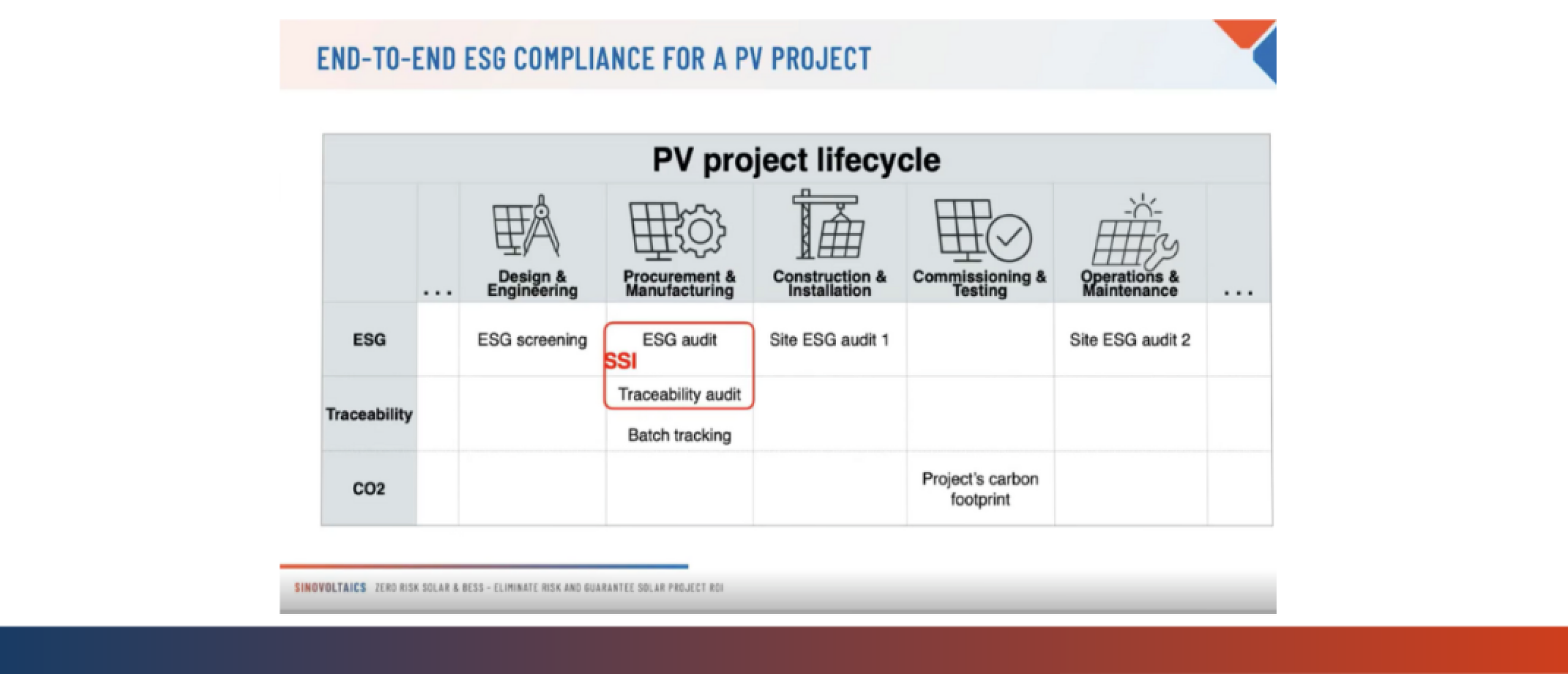
For this client, we focused on several stages of the PV project lifecycle:
1. Design and engineering
2. Procurement and manufacturing
3. Construction and installation
4. Commissioning and operation
5. Carbon footprint analysis
During the design phase, we began with ESG screening.
This involved lightweight ESG assessments across a shortlist of suppliers to identify:
• Potential red flags
• Best practices
• General ESG maturity
The client initially screened 13 manufacturers covering components such as:
• Modules
• Inverters
• Transformers
• Mounting structures
Following this screening process, the shortlist was narrowed to five manufacturers for full ESG and traceability audits.
00:35:28
Pierre-Yves Bridel:
The next phase involved full ESG audits and traceability audits conducted on-site at manufacturing facilities.
In addition to these audits, we also performed batch tracking.
Whereas traceability audits evaluate the management system itself, batch tracking verifies the actual materials used for a specific customer order.
This includes collecting documentary proof such as:
• Purchase orders
• Delivery notes
• Bills of lading
• Material receipts
The objective is to ensure that:
• Only approved suppliers were used
• Materials align with the bill of materials
• No blacklisted suppliers entered the supply chain
This provides lenders and developers with a very high level of visibility and confidence.
00:37:52
Pierre-Yves Bridel:
Once manufacturing and shipment were completed, we conducted ESG audits during the construction phase of the PV projects.
These on-site assessments evaluated areas such as:
• Labor conditions
• Health and safety
• Environmental compliance
• Documentation procedures
These audits provided reassurance to the client that EPC contractors complied with all required standards and regulations.
Importantly, no systemic ESG issues were identified across the sites.
This type of documentation also increases the long-term value of the project because future investors and buyers can verify that ESG risks were properly managed from the beginning.
00:40:06
Pierre-Yves Bridel:
Finally, we conducted cradle-to-grave carbon footprint analyses for each project.
This included:
• Raw material extraction
• Manufacturing
• Transportation
• Construction
• Operations
• End-of-life dismantling and recycling
One key finding was that PV module manufacturing represented approximately 35% of total project carbon emissions.
However, electrical infrastructure and cabling also represented a significant share — roughly 20%.
This analysis helped the client identify opportunities to reduce carbon intensity further.
For sustainability-focused lenders and developers, this type of analysis provides the data required for ESG reporting and demonstrates that environmental considerations are integrated into project development.
00:42:18
Pierre-Yves Bridel:
To conclude:
ESG and traceability are becoming increasingly important due to both:
• Financial market expectations
• Regulatory requirements
The solar industry has already reached a relatively mature level regarding ESG.
However, traceability still requires substantial improvement, particularly within battery supply chains.
What SSI has accomplished is extremely important because it creates:
• Shared definitions
• Public standards
• Transparent audit methodologies
• Public certification results
Ultimately, ESG is about conducting ethical business and building trust across the entire solar value chain.
At Sinovoltaics, we aim to provide tools that strengthen this trust between every actor within the renewable energy ecosystem.
Thank you very much.
I will now hand back to Rasa for the Q&A session.
00:45:34 — Q&A Session
Rasa Jakaitis:
Thank you, Pierre-Yves.
Before moving into the Q&A session, we launched our second poll asking participants what type of support would be most useful in advancing ESG and supply chain traceability within their organizations.
The most popular response was:
“Access to suppliers with verified ESG and traceability data.”
This clearly shows that supply chain transparency is becoming increasingly important.
Now let us move into the audience questions.
00:48:41
Question:
How many factories have been audited under SSI standards so far?
Clara Segon:
Approximately 16 manufacturing sites have already undergone assessments.
Public certification results are available on our website for completed certifications.
00:49:24
Question:
Do you have a roadmap of which factories will be audited during the next three years?
Clara Segon:
Currently, that information is not publicly available.
However, we are building a digital platform for SSI members that will provide greater visibility into certification progress.
A useful indicator is that each manufacturing member must assess at least two sites within 12 months of joining SSI and continue adding sites over time.
00:50:56
Question:
What components were included in the project carbon footprint analysis?
Pierre-Yves Bridel:
The analysis covered the entire project lifecycle from manufacturing to end-of-life.
This included:
• PV modules
• Transformers
• Mounting structures
• Inverters
• Cabling
• Fencing
• Roads
• Construction activities
• Recycling and dismantling
00:51:34
Question:
Since most PV supply chains are located in China, how can inspections remain credible regarding forced labor risks?
Clara Segon:
SSI does not conduct assessments in regions where unsupervised stakeholder interviews cannot be performed.
In addition, our ESG standard includes a very detailed chapter on responsible sourcing and due diligence aligned with OECD guidance.
This includes supplier risk assessments, supplier due diligence, and procedures for identifying and addressing high-risk suppliers.
00:53:37
Question:
How does SSI ensure its standards remain credible and aligned with international best practices?
Clara Segon:
SSI already follows many best practices recommended by organizations such as ISEAL.
This includes:
• Multi-stakeholder working groups
• Public consultations
• Pilot testing
• Transparent standard development processes
We are also preparing for future ISEAL membership.
00:55:03
Question:
Is 85 GW of certified manufacturing capacity considered significant?
Clara Segon:
Yes.
To provide context, 85 GW roughly corresponds to the combined annual PV demand of Europe and the UK during 2024.
00:55:43
Question:
What are the biggest challenges companies face regarding upcoming EU carbon footprint and due diligence regulations?
Clara Segon:
The most important recommendation is simple:
Do not wait.
Companies should begin preparing now because these regulations will have major operational impacts.
Pierre-Yves Bridel:
I fully agree.
Companies should already start requesting:
• Environmental Product Declarations (EPDs)
• Carbon footprint data
• Supply chain transparency information
The earlier companies begin collecting this information, the easier future compliance will become.
00:57:43 — Closing Remarks
Rasa Jakaitis:
We unfortunately ran out of time and still have several unanswered questions.
We will respond to those questions afterward in writing and share them with webinar attendees.
To summarize today’s key message:
Supply chain transparency is rapidly becoming a major market differentiator.
Companies able to demonstrate verifiable responsible sourcing will not only comply with regulations, but also gain stronger customer trust and investor confidence.
As Clara emphasized, SSI exists to help companies demonstrate compliance and build trust across the solar value chain.
If you would like more information about SSI, please feel free to contact Clara.
And if you need support regarding ESG and traceability for your projects, please reach out to Pierre-Yves and the Sinovoltaics team.
Thank you again to all attendees and to our speakers for joining us today.
We look forward to seeing you again at future Sinovoltaics webinars.
Visit sinovoltaics.com to learn more.