
As TOPCon technology rapidly becomes the dominant architecture in the global solar market, the industry is entering a new phase of performance and reliability challenges. While higher efficiencies and lower levelized cost of electricity (LCOE) continue to drive adoption, researchers and quality assurance specialists are increasingly focused on one critical question: how will these next-generation modules perform over decades in real-world conditions?
One issue attracting growing attention is ultraviolet-induced degradation (UVID) — a degradation mechanism that recent research suggests may significantly impact long-term TOPCon module reliability. New findings from the University of New South Wales (UNSW) reveal how UVB radiation can break silicon-hydrogen bonds within TOPCon cells, leading to passivation losses, interface defects, and measurable power degradation over time. At the same time, field observations and large-scale inspection data from Sinovoltaics indicate that current industry testing standards may not yet fully capture the realities of long-term outdoor exposure.
In this Sinovoltaics webinar 39, Professor Bram Hoex of UNSW and Pedro Quintana Ceres, PV Specialist at Sinovoltaics, shared the latest developments in UV-induced degradation research, corrosion mechanisms, advanced reliability modeling, and AI-driven quality assurance for modern PV technologies. The discussion explored not only the science behind UVID, but also the broader reliability risks emerging as the industry transitions from PERC to increasingly complex TOPCon, bifacial, and future tandem architectures.
Webinar Transcription:
00:00:33
Rasa Jakaitis:
Hello everyone, and welcome to today’s Sinovoltaics webinar.
My name is Rasa Jakaitis, Media Manager at Sinovoltaics, and I will be moderating today’s timely webinar on the latest developments in UV-induced degradation in TOPCon technology.
This webinar comes at a critical moment for the solar industry.
As TOPCon technology rapidly scales across commercial and utility-scale projects worldwide, new reliability challenges are emerging — and ultraviolet-induced degradation, or UVID, is proving to be one of the most important among them.
Recent research from the University of New South Wales has shed new light on how invisible UVB radiation breaks silicon-hydrogen bonds in TOPCon cells, leading to measurable wattage losses over time.
At the same time, field data from Sinovoltaics confirms what many asset owners and operators are already beginning to observe in real-world performance figures.
Today, we are bringing together two experts to discuss this topic.
Before introducing our speakers, let me briefly share a few housekeeping notes.
• This webinar will last approximately one hour.
• Expert presentations will be followed by a Q&A session.
• On the right-hand side of your screen, you will see a chat box. Please feel free to submit your questions during the presentations.
• This webinar is being recorded and will be uploaded to the Sinovoltaics YouTube channel.
If you do not want to miss future renewable energy updates, please subscribe to our channel.
Now let me introduce the two stars of today’s webinar.
00:02:21
Rasa Jakaitis:
I am very pleased to welcome back Professor Bram Hoex.
Professor Hoex is well known throughout the renewable energy industry.
He is Professor and Deputy Head of Research at the UNSW School of Photovoltaic and Renewable Energy Engineering.
He is also the author of more than 300 scientific publications and is best known for pioneering the use of aluminum oxide for crystalline silicon surface passivation.
Most recently, Professor Hoex and his team have been providing international leadership on UV-induced degradation in TOPCon solar cells.
He also co-founded PV2+ Technologies, an Australian clean-tech company developing AI software and robotics for autonomous solar farm operations.
Professor, it is a pleasure to have you back again.
00:02:56
Prof. Bram Hoex:
Thank you.
00:03:03
Rasa Jakaitis:
We are also joined today by my colleague Pedro Quintana Ceres.
Pedro studied engineering at EPFL, a leading Swiss research university, before completing his Master’s degree at ETH Zurich, specializing in materials science.
His research spans a wide range of photovoltaic technologies, including:
• Crystalline silicon
• TOPCon
• Thin-film technologies
• Perovskite solar devices
all developed through hands-on laboratory work.
Before handing over the virtual microphone to Professor Hoex, let me briefly introduce Sinovoltaics for those joining our webinar series for the first time.
Sinovoltaics is a global technical advisory firm specializing in solar and energy storage.
We help developers, investors, and manufacturers reduce technical risks through:
• Due diligence
• Quality assurance
• Safety assessments
Our mission is to make renewable energy projects safer, more reliable, and more bankable.
Now, without further ado, Professor Hoex, the floor is yours.
Please continue submitting your questions in the chat throughout the session.
00:05:06
Prof. Bram Hoex:
Thank you.
Today, in addition to UV-induced degradation, I will also provide updates on our latest insights into corrosion mechanisms.
At UNSW and many other research institutions, we care strongly about improving solar cell efficiency.
However, there is now increasing focus on degradation rates as well, because both efficiency and reliability are essential for reducing LCOE.
If degradation rates become sufficiently low, even modules with slightly lower initial efficiency may ultimately provide the same return on investment.
When we examine major reliability concerns for TOPCon and heterojunction technologies, damp heat degradation remains a key issue.
Although most modules perform very well, we definitely observe outliers that perform extremely poorly.
For example, 2,000 hours of damp heat exposure would roughly correspond to approximately 15 years of outdoor exposure in northern Australia if this were the only degradation mechanism involved.
In reality, however, degradation modes often interact with one another.
This means these modules could perform significantly worse under real-world conditions.
00:06:29
Prof. Bram Hoex:
The data shown here comes from PVEL’s Module Reliability Scorecard.
The results align very closely with our own findings.
For glass-glass modules, degradation often begins at the edges, which is visible in electroluminescence images.
In these EL images:
• Bright areas indicate good performance
• Dark areas indicate degraded performance
The degradation progresses inward from the module edges because this is where moisture ingress occurs.
Of course, the current hot topic is UV-induced degradation.
We observe that:
• PERC
• TOPCon
• Heterojunction
all exhibit some level of UV sensitivity.
For TOPCon specifically, we have observed outliers showing up to 10% power reduction after UV120 testing.
This corresponds to 120 kWh/m² of UV exposure.
Although that may sound large, it represents only slightly more than two years of outdoor exposure in Sydney.
Clearly, this is far from the expected 25-year module lifetime.
00:07:46
Prof. Bram Hoex:
We also observe that modules are not spatially uniform.
In some cases, we see checkerboard degradation patterns, especially when modules are stored in the dark after UV exposure.
This degradation can become quite severe.
The presentation today will cover:
1. Corrosion-related degradation
2. UV-induced degradation
3. Translation of laboratory findings into yield prediction modeling
We are also making substantial progress in modeling the main degradation stressors, including:
• UV exposure
• Thermal effects
00:08:28
Prof. Bram Hoex:
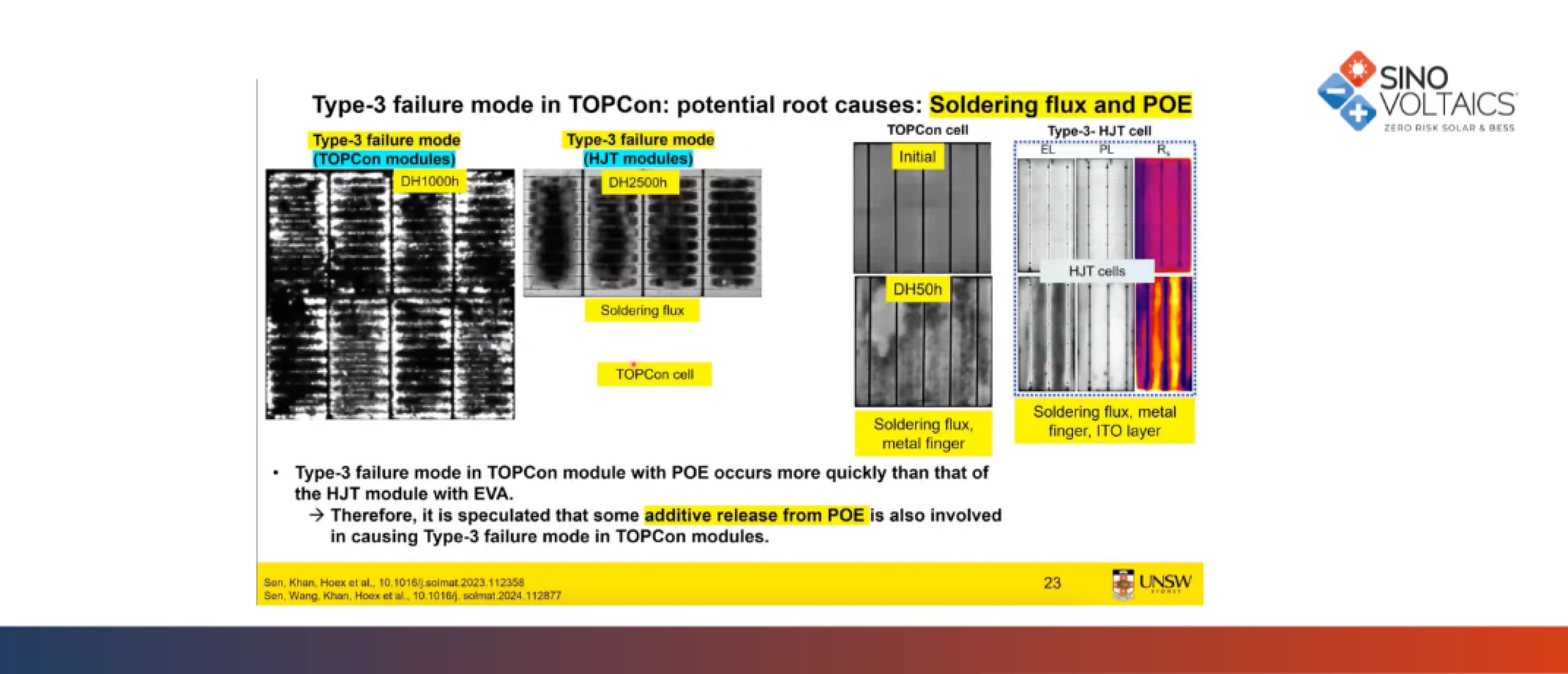
Several years ago, we identified new failure modes in heterojunction and TOPCon technologies.
For heterojunction modules, we observed multiple corrosion-related defects capable of causing up to 50% performance loss.
This level of degradation is extremely severe.
These EL images show the so-called “Type 3” failure mode after 1,000 hours of damp heat exposure.
At this point, module performance becomes too low to be commercially meaningful.
For TOPCon, we identified two major corrosion-related degradation modes.
Again, the most severe was the Type 3 failure affecting the entire sample area.
The positive aspect of this research is that we were able to reproduce all these degradation modes at the cell level.
This is important because cell-level testing is much faster — typically only one day — and allows us to control stress conditions precisely while conducting advanced analysis.
00:09:44
Prof. Bram Hoex:
We identified several root causes:
• Contamination
• Soldering flux interactions
• Encapsulant-related corrosion
For heterojunction cells, soldering flux reacted strongly with both:
• The metallization paste
• The transparent conductive oxide (ITO)
Additionally, acetic acid combined with soldering flux caused busbar darkening in EVA-based modules.
At the cell level, testing can be performed rapidly, which allows us to make fast progress in understanding these mechanisms.
00:11:00
Prof. Bram Hoex:
We also investigated soldering flux effects in TOPCon cells.
This work was published earlier this year.
We tested TOPCon cells from three manufacturing generations:
• 2019
• 2022
• 2023
using two widely used industry soldering fluxes.
The cells were exposed to damp heat after soldering flux application on both front and rear sides.
The results were striking.
The 2019 cells showed very little sensitivity.
The 2022 cells were substantially more sensitive.
The 2023 cells — especially before widespread adoption of laser-assisted firing — were dramatically more sensitive.
In fact, degradation occurred so rapidly that we had to reduce testing duration by a factor of twelve and lower the testing temperature by 15°C.
This represented at least a fourfold acceleration in degradation rate.
00:13:27
Prof. Bram Hoex:
Cross-sectional SEM analysis revealed several important changes.
Compared with earlier TOPCon generations:
• Silver usage had decreased
• Metallization lines became narrower
• Surface-to-volume ratios increased
All of this increased corrosion sensitivity.
At the same time, aluminum content in the metallization increased.
After stress testing, this aluminum reacted strongly and caused severe interface etching.
This became one of the main root causes of the observed degradation.
Laser-assisted firing has significantly improved corrosion resistance, although the issue is not yet fully resolved.
00:14:37
Prof. Bram Hoex:
The second major topic is encapsulant-induced degradation.
We tested multiple EVA and POE encapsulants in glass-backsheet TOPCon modules.
One bill of materials resulted in a 65% performance loss after only 1,000 hours of damp heat exposure.
This publication created substantial concern throughout the industry.
Vertically integrated manufacturers already knew that certain TOPCon cells were highly sensitive to encapsulation chemistry.
However, module manufacturers sourcing cells externally were often unaware of this risk.
If the wrong POE formulation was selected, modules could degrade extremely rapidly.
The degradation was primarily caused by increased series resistance due to metallization degradation.
00:16:35
Prof. Bram Hoex:
We eventually identified one specific UV absorber additive inside the POE as the root cause.
This additive reacted strongly with:
• Lead oxide
• Zinc oxide
• Aluminum within the metallization paste
The resulting corrosion compromised the contact interfaces.
One critical point is that corrosion can initially progress invisibly inside contacts for years before measurable degradation appears.
This means certain degradation modes may only become visible after 5–10 years of field operation.
00:18:36
Prof. Bram Hoex:
We also studied magnesium oxide, commonly used as an acid scavenger in EVA.
Under damp heat conditions, magnesium oxide significantly reduced acetic acid formation.
However, we discovered another unexpected degradation mechanism.
Using detailed characterization techniques, we found that magnesium reacted strongly with the silicon nitride layer on the TOPCon rear side.
This corrosion triggered degradation of the TOPCon contact itself.
The exact mechanism is still being studied, but hydrogen release likely plays a key role.
This finding demonstrates that no part of the TOPCon surface stack is fully immune to corrosion.
00:28:35
Prof. Bram Hoex:
Now let us move to UV-induced degradation.
We developed rapid UVB testing methods that accelerate the same degradation mechanism observed under natural UV exposure.
The key findings are:
• UV breaks silicon-hydrogen bonds
• Hydrogen accumulates at interfaces
• Interface defects form
• Fixed charge density changes
This worsens passivation performance.
At the same time, dark storage after UV exposure creates reversible degradation.
The good news is that much of the dark-storage degradation recovers relatively quickly once modules are re-exposed to light.
This means dark-storage degradation itself is not highly relevant for field operation.
However, permanent UV-induced degradation still remains a concern.
00:33:13
Prof. Bram Hoex:
We also identified interactions between UV-induced degradation and LeTID.
Unfortunately, LeTID has not disappeared.
It still exists in TOPCon, although it is no longer the dominant degradation mechanism.
We also see large variations between cells manufactured on the same production lines.
Some cells degrade much faster than others despite nominally identical production.
This variability remains an open research question.
00:39:21
Prof. Bram Hoex:
The final part of our work focuses on translating laboratory findings into real-world field modeling.
Modules in the field experience multiple stressors simultaneously, including:
• UV
• Temperature
• Humidity
• Electrical operating conditions
These stressors interact in complex ways.
To model this accurately, we developed advanced global UV and thermal stress models based on:
• Satellite data
• Wavelength-dependent UV exposure
• Tracker angle dependence
• Advanced thermal modeling
We found that module operating temperature can vary by 5–10°C depending on tracking strategy and electrical operation.
Because many degradation reactions approximately double for every 10°C increase, this has enormous implications for reliability forecasting.
00:44:12
Prof. Bram Hoex:
To summarize:
• Corrosion remains a major reliability concern
• UV-induced degradation is still highly important
• Significant progress has been made in understanding mitigation pathways
• Better global stress modeling is helping improve degradation prediction
All publications from our research group are available free of charge through the provided link.
Thank you very much for your attention.
00:45:25
Rasa Jakaitis:
Thank you very much, Professor.
That was extremely insightful, and we already have many questions coming in through the chat.
I now invite Pedro Quintana Ceres to continue the discussion from the Sinovoltaics quality assurance perspective.
00:46:27
Pedro Quintana Ceres:
Thank you very much, Rasa.
And thank you, Professor Hoex, for the very interesting presentation.
I will discuss reliability issues and the emerging risks that require testing methodologies beyond standard certification procedures.
As we know, the market is now dominated by TOPCon technology.
This means we are transitioning away from the previously PERC-dominated market and therefore encountering entirely new reliability challenges.
For example:
• LeTID dominated PERC concerns
• UVID is now emerging as a major TOPCon concern
At the same time, modules are becoming:
• Thinner
• Larger
• More bifacial
which introduces additional mechanical reliability challenges.
00:47:47
Pedro Quintana Ceres:
Current IEC UV testing standards expose modules to 60 kWh/m² UV dosage.
However, our field observations indicate that these testing conditions are still far from representative of real-world 25–30 year exposure.
Research remains essential to develop more realistic UV reliability standards.
00:48:26
Pedro Quintana Ceres:
At Sinovoltaics, we also see growing risks associated with mechanical defects in modern thin bifacial modules.
This requires reliability testing that goes beyond existing standards.
To address this, we developed our proprietary AI-based EL inspection algorithm called Selma.
SELMA allows 100% electroluminescence inspection of all modules within a purchase order instead of only random sampling.
To date:
• More than 40 million modules
• Across over 40 manufacturers
have been inspected using SELMA.
With an average rejection rate of 0.56%, approximately 78,000 defective modules were identified before installation.
00:50:58
Pedro Quintana Ceres:
The most common defects detected include:
• Soldering faults
• Finger interruptions
• Microcracks
Soldering faults are especially important because they can evolve into:
• Resistive losses
• Hotspots
• Fire hazards
Finger interruptions directly reduce power output.
Microcracks may propagate further during transport and installation.
The AI system continuously evolves and is retrained using new field data and new module technologies.
00:52:57
Pedro Quintana Ceres:
To conclude:
• More advanced architectures provide higher efficiency but introduce new degradation risks
• Independent audits and qualification testing are becoming increasingly important
• AI-based inspection tools can significantly improve early defect detection
• Continued research investment is essential for developing future reliability standards
As the industry moves toward tandem and perovskite technologies, entirely new reliability challenges will emerge.
Thank you very much for your attention.
00:54:13 — Q&A Session
Rasa Jakaitis:
Thank you, Pedro.
Professor Hoex, welcome back for the Q&A session.
We have received many questions, so let us begin immediately.
00:54:53
Question:
How does SELMA adapt to new cell technologies that produce different EL signatures?
Pedro Quintana Ceres:
Selma is continuously retrained using new inspection data and new module technologies.
As the industry moves toward technologies such as perovskites and tandem cells, the algorithm evolves accordingly.
00:55:41
Question:
How much recovery can occur after UV degradation through light soaking?
Prof. Bram Hoex:
The answer depends heavily on temperature.
At elevated temperatures, degradation recovery can become almost complete if sufficient annealing time is provided.
Dark-storage degradation itself is fully reversible.
However, permanent UV-induced degradation still remains.
00:56:15
Question:
How does recovery differ between heterojunction and TOPCon?
Prof. Bram Hoex:
Heterojunction behaves quite differently.
TOPCon recovery is strongly linked to charge dynamics inside aluminum oxide layers.
Heterojunction recovery depends much more on hydrogen mobility and therefore occurs more slowly.
00:57:29
Question:
Do glass-glass modules significantly reduce degradation risks?
Prof. Bram Hoex:
For corrosion-related degradation, yes.
Glass-glass structures significantly reduce moisture ingress because water can only enter through the module edges.
However, glass-glass modules introduce other challenges such as increased vulnerability to severe hail events.
00:59:33
Question:
Do you observe rejection rates increasing because Selma detects more defects?
Pedro Quintana Ceres:
Yes.
Because traditional inspections rely only on sampling, full-scale AI inspection naturally identifies substantially more defects.
01:00:16
Question:
How much does climate contribute to module degradation?
Prof. Bram Hoex:
Almost all degradation modes accelerate with environmental stress.
Examples include:
• Higher UV exposure
• Higher temperatures
• Humidity
• Extreme weather
Many degradation reactions approximately double for every 10°C increase in temperature.
Severe hailstorms can also create catastrophic module failures, especially as glass thickness continues decreasing.
01:02:09
Question:
If dark-storage degradation fully recovers after sunrise, is it truly relevant in the field?
Prof. Bram Hoex:
Dark-storage degradation itself is not highly relevant because modules recover quickly after light exposure.
However, permanent UV-induced degradation remains.
That is why modern IEC test development now requires measurements shortly after UV exposure to better represent real field conditions.
01:03:20 — Closing Remarks
Rasa Jakaitis:
Thank you very much, Professor Hoex and Pedro Quintana Ceres, for these highly insightful and technically rich presentations.
The audience will receive both presentation decks and the research links referenced during the session.
We also appreciate all the excellent questions submitted today.
For any unanswered questions, we will follow up afterward via email.
Thank you everyone for joining us today, and we look forward to welcoming you again to future Sinovoltaics webinars.
Prof. Bram Hoex:
Thank you, Rasa.
Pedro Quintana Ceres:
Thank you everyone.
Rasa Jakaitis:
Goodbye, and visit sinovoltaics.com to learn more.